
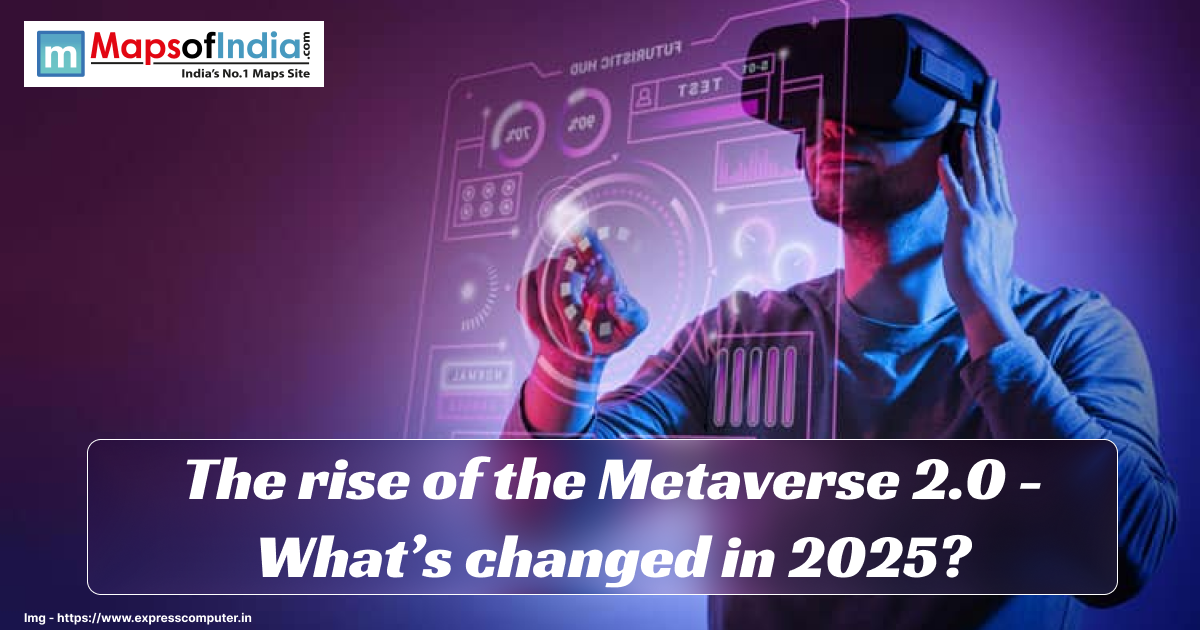
The Metaverse isn’t just hype anymore. Come 2025, it’s turning into something folks are naming Metaverse 2.0. It is a sharper, easier-to-reach setup woven deep into daily routines, way past old sci-fi dreams. Instead of sticking to games or online trinkets, it’s stepping into jobs, shopping trips, classrooms, and chats. Because of this shift, the fake world starts mirroring reality so closely you can’t always tell where one ends and the other begins.
A New Era of Digital Reality
Metaverse 2.0 is not just a practice zone anymore. It’s now a working environment. Earlier, people thought of the Metaverse mostly through VR goggles and digital characters you could control. These days, it’s an interconnected space where tools such as AR, smart algorithms, and decentralized ledgers come together smoothly. Experiences inside feel deeper, tailored closer to who you are. You don’t need a bulky VR headset anymore just to get into virtual spaces. Pretty much any gadget, maybe even smart glasses, hooks you up right away.
Integration with Everyday Life
The Metaverse has removed the barrier between itself and the non-technological world. Hence, it has become an inseparable part of our everyday lives. In the 3D office, virtual meetings are now possible. Digital malls have come into existence, where one can purchase clothing and also be sure of the fit by using an avatar. Educational institutions have utilized virtual campuses to facilitate global classrooms. Even concerts and festivals have turned into hybrid events where audiences have the option to partake either physically or virtually simultaneously.
Reinventing Work and Collaboration
Remote work has reached a whole new level in the year 2025. By means of virtual offices, the team members spread across different continents could work jointly as though being in the same room. The use of Digital whiteboards, 3D presentations, and real-time translators has shortened the time for collaboration and has made it a more natural process. A number of companies have converted their “metaverse Central” into their main offices, thus enabling the employees’ commitment to be raised, together with office expenses being cut down.
Virtual Commerce and Digital Economies
The digital economy inside Metaverse 2.0 is booming. Virtual real estate, fashion, and collectables are thriving industries. But unlike the early NFT (Non-Fungible Token) craze, the market has matured. Digital assets now have clear utility. By way of example, a virtual store layout may be rented or sold; a digital commodity may grant the holder real-world advantages. Currently, cryptocurrencies are gradually giving way to more stable and government-regulated digital currencies.
AI as the New Architect
Artificial Intelligence is the brain behind the modern Metaverse. It builds dynamic worlds that change based on user activity. Apart from that, AI is also in charge of the environment design process, interaction supervision, and user experience personalisation. In fact, it is capable of generating on-demand virtual spaces, thus making each visitor’s experience unique. Consequently, the Metaverse has become more efficient, engaging, and lifelike.
Augmented Reality Takes the Lead
Augmented Reality (AR) is the biggest factor responsible for the success of the metaverse 2.0. Unlike other technologies that disconnect users from reality, AR enhances the real world with digital information. For example, one can be a part of a virtual fashion show, which is being displayed in their living room, or go through a museum exhibition, which is partly online. With AR stepping out of the labs and onto the streets, the future of the Metaverse is becoming a reality for everyone. The inclusion factor is significant; wearing AR glasses or using contact lenses would be a simple and comfortable method of connection.
Education in the Metaverse
Schools and universities are ready to take advantage of the triple revolution of radical change in the educational scene, which is the Metaverse. Previously, students had to settle for dull video calls. Today, they find themselves sitting together in virtual classrooms where lessons are fun and interactive. The past is made vibrant through compelling narratives, and scientific experiments occur in secure online laboratories. Moreover, with the help of the Metaverse, education has no boundaries, connecting students and teachers from around the globe in real-time.
Healthcare and Virtual Wellness
The healthcare sector has an innovative space in the Metaverse 2.0. Virtual clinics enable patients to see doctors in realistic settings. Therapists take advantage of immersive experiences for mental health sessions. Fitness trainers lead users through exercises with the help of motion tracking. These breakthroughs are turning healthcare into a service that is reachable to anyone, particularly those who live in distant locations.
Entertainment Like Never Before
The entertainment sector is the most enthusiastic adopter of the Metaverse 2.0. Consequently, the possibilities for interaction with virtual concerts, premieres of films, and live sports are boundless. Attending a digital arena becomes an option for the fans. Also, they can virtually chat with performers or even be present as a part of the audience. The Metaverse is utilised by the big studios as well as the artists to connect with audiences all over the world, by providing experiences that traditional media cannot compete with.
Security and Privacy Challenges
Concerns related to privacy and security are emerging. There are many incidents that have shown difficulties related to the security of the data and user privacy. In today’s world, where people are spending more time on digital platforms, the safeguarding of their personal data is really important. Hence, developers are working on decentralized systems and security measures that are user-friendly. Furthermore, biometric authentication and encrypted identities are being introduced as normal operations also.
The Road Ahead for Metaverse 2.0
The Metaverse is gradually taking shape. Rules for digital space are being set up by governments and international organizations. Moreover, Interoperability- the linkage of separate virtual worlds- is getting better. In the near future, users will be able to switch from one platform to another without losing their data or identity. The main issues being dealt with are those of inclusion and the ethical use of the virtual world, so it remains beneficial to everyone.
What Makes Metaverse 2.0 Different
Metaverse 2.0, as opposed to its early version, is more realistic. It is not merely a community for gamers or tech enthusiasts. It has come into fields like education, healthcare, art, and commerce. The journey has become smoother, gadgets are less expensive, and there are no limits to the applications. The present objective is not to run away from reality but rather to upgrade it.