


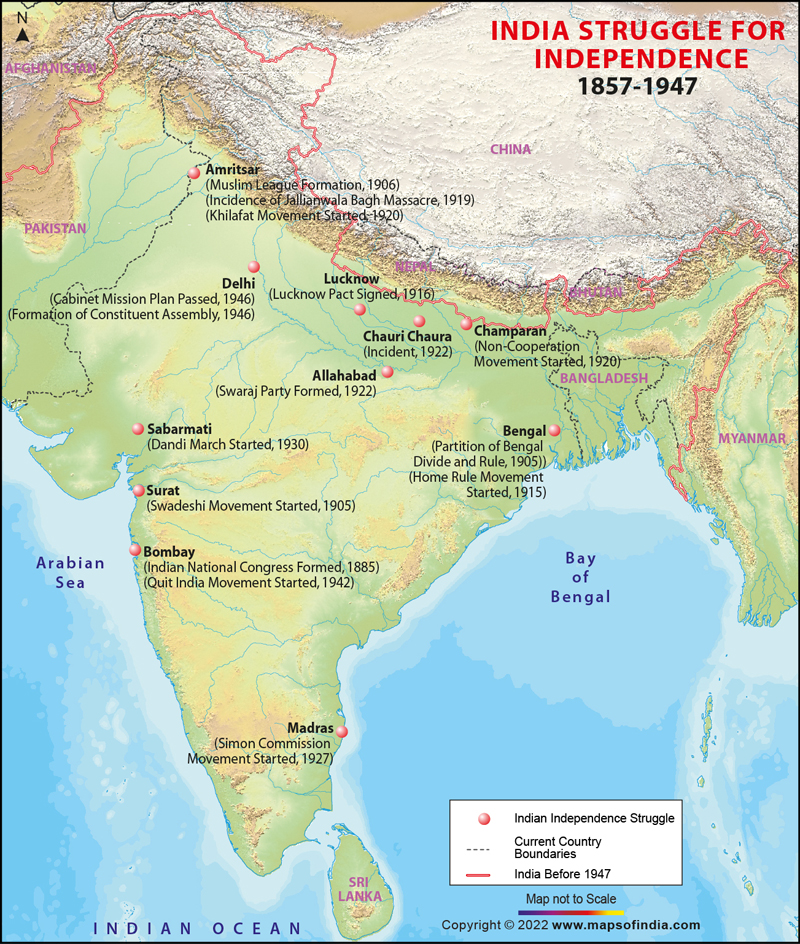



After the Battle of Plassey 1757, the British won political power over India and this is when they came and ruled the country for almost 200 years. In 1848, during the tenure of Lord Dalhousie, their rule began to establish. North-west India was one of the initial targets of the British and by 1856 they had developed a firm authority. It was in the nineteenth century when the British rules gained its major heights.
Due to the discontent and dissatisfied local rulers, peasants and the soldiers who were unemployed by then broke out into a revolt, commonly known as the "revolt of 1857" or the "mutiny of 1857".
The Revolt of 1857
This mutiny began with a revolt by the soldiers at Meerut who were unemployed. The cause of their unemployment was the new cartridge introduced in the new Enfield Rifles which contained grease made of cow and pig fat which had to be removed by their mouths in order to use the weapon. This was not religiously agreeable and accepted to both the Hindu and the Muslim soldiers, hence, they refused to use the weapon and in return they were left unemployed.
Soon this revolt became widespread, mainly in Delhi and the nearby states. But this revolt proved to be a failure and the British army shot back by plundering, loots, murders etc. and left the people helpless. This revolt affected Delhi, Awadh, Rohilkhand, Bundelkhand, Allahabad, Agra, Meerut and western Bihar the most where some of the most ferocious battles were fought. But still the revolt of 1857 did not prove to be a success and failed within a year.
Post Revolt of 1857
While the British rule controlled the revolt of 1857 within a year, the East India Company came to an end and many new policies starting forming in the British government. Queen Victoria was proclaimed as the Empress of India.
Reformists like Raja Rammohan Roy, Bankim Chandra and Ishwar Chandra Vidyasagar were seen emerging and fighting for the rights of the Indians. Their main aim was to unite and fight against the foreign rule.
Indian National Congress (INC) came into being
The foundation of the INC was laid in 1885. Its main aim was to put forward the view of the middle class educated citizens. In 1906, the Congress session at Calcutta gave a call to the attainment of 'Swaraj' and hence the 'Swadeshi Movement' started.
In 1905, the partition of West Bengal took place and the capital of the country was shifted from Calcutta to Delhi.
Simultaneously, the British government too was preparing against the Indian efforts and as a result they passed several reforms in 1909 known as the Morley-Minto reforms which instead of the development aimed at creating differences between the Hindus and the Muslims.
On one hand, the reformists and the revolutionaries were working and planning whereas on the other hand, the Jallianwala massacre took place in Punjab in 1919 where people had gathered to celebrate Baisakhi.
It was after the First World War (1914-1918) that Mahatma Gandhi came back to India and observed the condition of the country and started the non-violent agitation, "Satyagrah".
Non-Cooperation Movement
In 1920, Mahatma Gandhi started the Non-Cooperation Movement after realising that it was baseless to expect a fair treatment from the British government. This movement continued till 1922 and proved to be a great success.
Simon Commission
Immediately after the non-cooperation movement was called off, in 1927, another commission was introduced in the Indian government which had no Indian member included in the reforms and showed no intention of accepting the demand for 'Swaraj'. Under the leadership of Lala Lajpat Rai, great protests were held.
Civil Disobedience Movement
The Civil Disobedience Movement started in December 1929 and it aimed at complete ignorance and disobedience of the British government. It was during this movement that the revolutionaries: Bhagat Singh, Sukhdev and Rajguru were arrested and hanged to death.
Quit India Movement
It was in August 1942 that Gandhiji started this movement which aimed at complete freedom from the British rule and posed as a 'do or die' situation. There were widespread actions of sabotage, violent protests etc. Finally Netaji Subhash Chandra Bose fled from the British detention and formed the Indian National Army. India got its freedom in August 1947 from the ruthless British rule after all the hard work, sacrifice and selflessness of the rulers, revolutionaries and citizens of the then country.
Indian Freedom Struggle Timeline
| Year | Location | Event | Protagonist |
|---|---|---|---|
| 1857 | Berhampore | Sepoys of the 19th Infantry refused rifle practice | |
| 1857 | Meerut | Sepoy Mutiny | |
| 1857 | Ambala | Unrest at Ambala | |
| 1857 | Barrackpore | Mangal Pandey attacked British officers and was later hanged | Mangal Pandey |
| 1857 | Lucknow | 48th Mutiny at Lucknow | |
| 1857 | Peshawar | Native garrison were disarmed | |
| 1857 | Kanpur | 2nd Cavalry mutinies, Satichaura Ghat Massacre, Massacre of women and children in the Bibighar | |
| 1857 | Delhi | Battle of Badli-ki-Serai | |
| 1857 | Jhansi | Rani Lakshmi Bai protested against the denial of rights of her adopted son and led successful defense of Jhansi against invading armies | Rani Lakshmi Bai |
| 1857 | Meerut | 50 Europeans killed by sepoy and crowd | |
| 1857 | Kanpur | Second battle of Cawnpore (Kanpur): Tatya Tope defeated by company forces | Tatya Tope |
| 1857 | Jhelum | Mutiny of native troops against British | |
| 1857 | Gurdaspur | Battle of Trimmu Ghat | |
| 1858 | Calcutta | East India Company abolished | |
| 1858 | Gwalior | Battle of Gwalior when Rani Lakshmi Bai with Maratha rebels captured Gwalior from Scindia rulers | Rani Lakshmi Bai |
| 1858 | Jhansi | Rani Laxmi Bai died | Rani Lakshmi Bai |
| 1859 | Shivpuri | Tatya Tope captured and executed | Tatya Tope |
| 1876 | Queen Victoria declared as the "Empress of India" | ||
| 1885 | Bombay | Indian National Congress (INC) formed by AO Hume | AO Hume |
| 1898 | Lord Curzon became Viceroy | ||
| 1905 | Surat | Swadeshi Movement started | |
| 1905 | Bengal | Partition of Bengal | |
| 1906 | Dhaka | All India Muslim League founded | Aga Khan III |
| 1908 | 30th April: Khudiram Bose was executed | ||
| 1908 | Mandalay | Tilak was sentenced to six years on charges of sedition | Bal Gangadhar Tilak |
| 1909 | Minto-Morley Reforms or Indian Councils Act | ||
| 1911 | Delhi | Delhi durbar held. Partition of Bengal was cancelled | |
| 1912 | Delhi | Delhi established as the new capital of India | |
| 1912 | Delhi | Delhi Conspiracy Case to assassinate Lord Hardinge (Viceroy of India) | |
| 1914 | The Ghadar Party was formed at San Francisco | ||
| 1914 | Kolkata | Komargata Maru incident | |
| 1915 | Mumbai | Gopal Krishna Gokhale died | |
| 1916 | Lucknow | Lucknow Pact Signed | Muhammad Ali Jinnah |
| 1916 | Pune | Tilak founded Indian Home Rule League first in Poona (Pune) | Bal Gangadhar Tilak |
| 1916 | Madras | Annie Besant led Home Rule League | Annie Besant |
| 1917 | Champaran | Mahatma Gandhi launched the Champaran campaign in Bihar | Mahatma Gandhi |
| 1917 | Montagu Declaration made by Secretary of State, Edwin Samuel Montagu | ||
| 1918 | Champaran | Champaran Agraria Law passed | |
| 1918 | Kheda | Kheda Satyagraha | |
| 1918 | Beginning of trade union movement in India | ||
| 1919 | Amritsar | Jallianwala Bagh Massacre | |
| 1919 | Rowlatt Act passed by Imperial Legislative Council in London | ||
| 1919 | Khilafat Movement started | ||
| 1920 | Tilak founded the Congress Democratic Party | ||
| 1920 | Non-Cooperation Movement started | Mahatma Gandhi | |
| 1920 | All India Trade Union Congress started | Narayan Malhar Joshi | |
| 1920 | Calcutta | Gandhiji proposed a resolution that called for British to grant dominion status to India | Mahatma Gandhi |
| 1921 | Malabar | Moplah rebellion | |
| 1922 | Chauri Chaura | Chauri Chaura incident | |
| 1922 | Allahabad | Swaraj Party formed | Sardar Vallabhbhai Patel |
| 1925 | Communist Party of India was formed | ||
| 1925 | Kakori | Kakori Conspiracy | Ram Prasad Bismil, Ashfaqulla Khan, Chandrasekhar Azad |
| 1925 | Bardoli | Bardoli Satyagraha | Vallabhbhai Patel |
| 1928 | Bombay | Simon Commission arrives in Bombay and an all-India hartal was observed | |
| 1928 | Lahore | Lala Lajpat Rai assaulted by police at Lahore and later died due to injuries | Lala Lajpat Rai |
| 1928 | Nehru Report proposed new Dominion Constitution of India. | Motilal Nehru | |
| 1929 | Lahore | Lahore Session of the Indian National Congress held | Pt Jawaharlal Nehru |
| 1929 | Lahore | Freedom fighter Jatindra Nath Das fasted till death demanding for better facilities for prisoners | Jatindra Nath Das |
| 1929 | All Parties Muslim Conference formulates the 'Fourteen Points' | Muhammad Ali Jinnah | |
| 1929 | Delhi | Central Legislative Assembly bomb throwing incident | Bhagat Singh, Batukeshwar Dutt |
| 1929 | Lord Irwin announced that the Government would meet for a Round Table Conference with Indian representatives | ||
| 1929 | Lahore | Jawaharlal Nehru hoisted the flag of India | |
| 1930 | Purna Swaraj declaration was publicised by the Indian National Congress | ||
| 1930 | Sabarmati Ashram | Beginning of Civil Disobedience Movement with Dandi March or the Salt March | Mahatma Gandhi |
| 1930 | Chittagong | Chittagong Armoury Raid | Surya Sen |
| 1930 | London | First Round Table Conference begins in London to consider the report of the Simon Commission | |
| 1931 | Lahore | Bhagat Singh, Sukhdev and Rajguru hanged till death | Bhagat Singh, Sukhdev and Rajguru |
| 1931 | Gandhi Irwin Pack signed by Mahatma Gandhi and Lord Irwin | ||
| 1931 | Second Round Table Conference | Mahatma Gandhi, Sarojini Naidu, Madan Mohan Malaviya, Ghanshyam Das Birla, Muhammad Iqbal, Sir Mirza Ismail, S.K. Dutta, Sir Syed Ali Imam | |
| 1932 | The Indian National Congress and its associate organisations declared illegal | ||
| 1932 | Gandhiji was arrested for sedition without trial | Mahatma Gandhi | |
| 1932 | British Prime Minister, Ramsay Macdonald announced the "Communal Award" to grant separate electorates to Indian minority communities | ||
| 1932 | Gandhiji began his "fast unto death" to improve status of untouchable castes that lasted for six days | Mahatma Gandhi | |
| 1932 | London | The Third Round Table Conference | |
| 1933 | Gandhiji fasts to focus attention on the welfare of untouchables. | Mahatma Gandhi | |
| 1934 | Gandhiji withdraws himself from active politics and dedicates himself towards constructive programmes | Mahatma Gandhi | |
| 1935 | The Government of India Act 1935 passed | ||
| 1937 | Indian Provincial Elections held under the Government of India Act 1935 | ||
| 1938 | Haripura | Haripura session of the Indian National Congress held | |
| 1938 | Subhash Chandra Bose was elected as the President of the Indian National Congress | Subhash Chandra Bose | |
| 1939 | Jabalpur | Tripuri Session conducted | |
| 1939 | Congress ministries in the provinces resigned to protest against the war policy of the British government. Subhash Chandra Bose resigned from the post of the Indian National Congress' President | Subhash Chandra Bose | |
| 1939 | The Muslim League observes 'Deliverance Day' to celebrate the resignation of the Congress ministries | Muhammad Ali Jinnah | |
| 1940 | Lahore Session held by the Muslim League for the creation of 'Independent States' for Muslims | ||
| 1940 | 'August Offer 1940' made by Lord Linlithgow that offered Indians' the right to create their own Constitution | ||
| 1940 | Wardha | Congress Working Committee rejects the 'August Offer' and launched 'Individual Satyagraha' | |
| 1941 | Subhash Chandra Bose escapes from India | Subhash Chandra Bose | |
| 1942 | Quit India Movement or August Movement started | ||
| 1942 | Churchill announces the Cripps Mission | ||
| 1942 | Bombay | Indian National Congress adopted 'Quit India' Resolution | |
| 1942 | Gandhiji and other top Congress leaders were arrested | Mahatma Gandhi | |
| 1942 | 'Azad Hind Fauj' established | Subhash Chandra Bose | |
| 1943 | Port Blair | Cellular Jail declared as the headquarter of the Provisional Government of India | |
| 1943 | Subhash Chandra Bose proclaims the formation of the Provisional Government of free India | Subhash Chandra Bose | |
| 1943 | Karachi | Karachi session of the Muslim League adopted the slogan 'Divide and Rule' | |
| 1944 | Moirang | Colonel Shaukat Malik of the Azad Hind Fauj defeated British in the region with Japanese support | Colonel Shaukat Ali |
| 1944 | Simla | Simla Conference held between Viceroy Archibald Wavellin and Indian political leaders | |
| 1946 | Delhi | Cabinet Mission Plan passed | |
| 1946 | Delhi | Constituent Assembly formed | |
| 1946 | Royal Indian Navy Mutiny | ||
| 1946 | Delhi | Cabinet Mission arrives in New Delhi | |
| 1946 | Lahore | Jawaharlal Nehru takes over as Congress President | Jawahar Lal Nehru |
| 1946 | Interim Government of India formed | ||
| 1946 | Delhi | First session of the Constituent Assembly of India held | |
| 1947 | British Prime Minister, Clement Attlee declared that the British government would grant full self government to British India | ||
| 1947 | Lord Mountbatten appointed as the Viceroy of India and then became the first Governor General of Independent India | ||
| 1947 | Mountbatten Plan was made for the partition of India into fully sovereign dominions - India and Pakistan with effect from 15th August 1947 under the Indian Independence Act 1947 |
Last Updated on : April 02, 2026
