

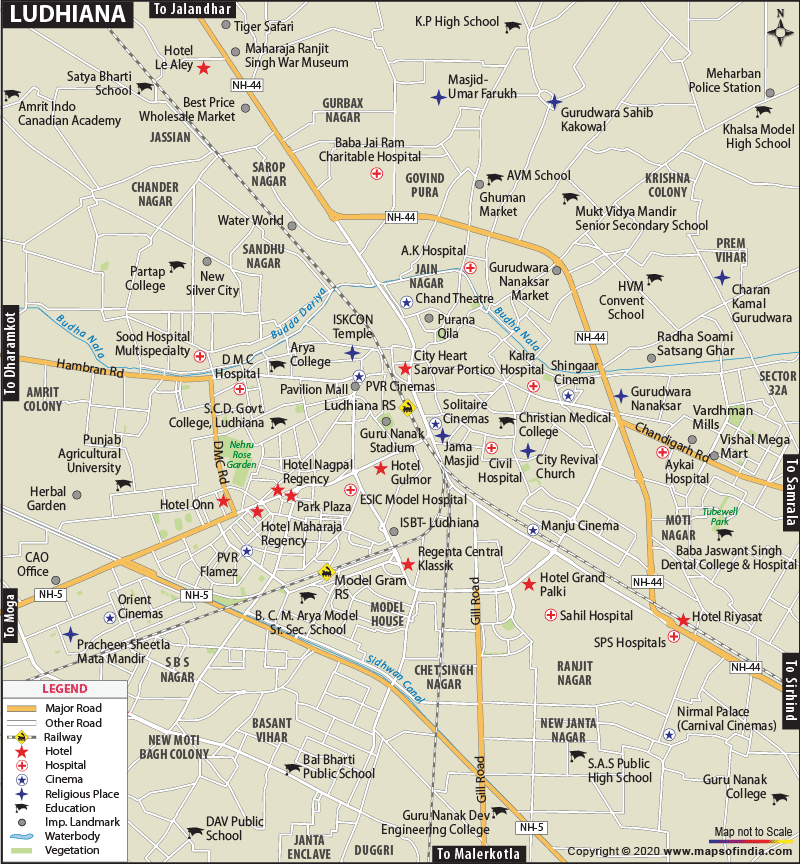



Introduction
Ludhiana sits in central Punjab, alongside the Sutlej River, just 13 kilometers south of where the water flows now. Back in 1480, under the rule of the Lodhi Dynasty, it began as a settlement - named after those rulers who started it. Travelers moving between Delhi and Amritsar often pass through here, thanks to the old Grand Trunk Road cutting right across the town. Making hosiery drives much of the local economy; woven cotton goods come next, followed by steel items, machines, then crops turned into food and raw materials.
History
Ludhiana is one of the most important cities in Punjab and traces its origin to the Lodi dynasty. The Lodhi dynasty ruled Delhi from 1451 to 1526 and it was during this time that Ludhiana rose. The reign of Sikander Lodi saw many raids by plunders from Baloch which caused great trouble to the local population around Ludhiana. To deal with this problem, Sikandar Lodhi sent two of his chiefs Yusuf Khan and Nihang Khan to maintain order in the region. They both established their base at Mir Hota which was a small village at that time.
Yusuf Khan was determined to fight the Khokhars in the Jalandhar Doab Whereas Nihang Khan decided that he would stay back and it was during this time that he laid the foundation for Ludhiana. The earlier name of the city was Lodhi-ana which translated to the “city of the Lodhis”. It later evolved into the present name Ludhiana.
The descendants of Nihang Khan were crucial in shaping the city and bringing in several developmental measures. Jalal Khan built the fort of Ludhiana And divided the surrounding land among the natives. The Lodhis could not rule the region for long because, after the fall of the Lodhi dynasty in 1525 and the rise of the Mughal Empire, they lost their power and submerged into Mughal society.
The Mughals brought Ludhiana into the Sirhind Sarkar which would fall under Delhi's administration. The western part of the city was given as a lease to the Rais of Raikot. He became semi-independent from the muggles during the 18th century. The death of Akbar in 1605 brought turbulence in the region and several local rulers were now in the race to gain independence. Raja Ala Singh of Patiala and Rai Kalha II were two of the most influential rulers in the region.
In 1739 Nadir Shah invaded the region crossing the Sutlej River at Ludhiana and marching along the Trunk Road. Many historical records argue that he ordered a massacre but it remains uncertain to say anything with claims. After this invasion by Nadir Shah, in 1747, we see that Ahmed Shah Durrani invaded Ludhiana and fought the Imperial Army near Khanna. The Mughals did their best to stop him but he was determined in his efforts and made successive invasions to Ludhiana. By 1760, we see that the Rais of Raikot took control of Ludhiana town from the Mughals.
In 1763 the Sikh forces were successful in defeating Zain Khan who was appointed governor of Sirhind by Durrani. They were able to destroy the city and this was the final blow to the Mughal rule in the Ludhiana region. What happened in 1785 was very unfortunate; the Sutlej river changed its course and Ludhiana was no longer situated on the banks. In 1798, the Sikhs under Bedi Sahib Singh of Una decided to attack Ludhiana.
Rai Alias the young ruler of Ludhiana sought the help of his agents Roshan and Gujar to defend the city but Roshan got injured in the battle and died. After this, the Phulkian chiefs came to ally with the Rais and were successful in preventing the Bedi from consolidating power. The Rais then with the help of British mercenary George Thomas was able to send back the Sikhs across Sutlej.
In 1806 Maharaja Ranjit Singh came into the picture and he led his first expedition across Sulej. He was able to throw away the Rais of the territories including Ludhiana. He didn't move the city to his Lahore state immediately.
Colonel David Ochterlony established a cantonment in Ludhiana which marked the beginning of direct British control rule in the region. In the same year, the Treaty of Lahore was signed which restricted Ranjit Singh's access to the north and west of Sutlej. Since the Zindag family did not have any heir, the British invoked the doctrine of labs in the region in 1835 and took control of it.
Deputy Commissioner Ricketts was able to suppress the local resistance during the revolt of 1857 with the help of his agents Nabha and Malerkotla Chiefs. India's independence movement was led by many political leaders who came from Ludhiana including Maulana Habibur Rehman. Ever since then, Ludhiana has grown to become Punjab's most populous metropolitan city.
Culture
If one wants to know about the traditional culture of Ludhiana one has to dive deep into the roots of Punjab Heritage. Festivals like Baisakhi Lohri and Guru Purab are the major festivals that are celebrated in Ludhiana with immense zeal. These festivals are the epitome of the custom and the rituals celebrated in the region. On such occasions, men and women are expected to dress in the traditional Punjabi attire which is Salvar Kameez for women and Kurta pajama for men. Bhangra and Giddha are the folk dances practiced in the city and it symbolizes the spirit of the people in Ludhiana. Makki Di roti, Sarso da saag, and Amritsar kulcha are some of the local cuisines of the city which are famous worldwide.
With time the city has evolved into a metropolitan urban centre that has grown with the changes in time. There are many industrial powers in Ludhiana particularly in the textile and Hosiery sectors. Because of these developments, the city is now known as Manchester of India. Today one can see a modern infrastructure including shopping malls, high-rise buildings, and multiplexes in Ludhiana.
Language
Punjabi holds status as Ludhiana's official tongue, widely used across the city. This Indo-Aryan speech grows naturally among Punjabi communities. Still, local voices shape it differently - Malwai, Doabi, Majhi, and Powadhi color daily talk here. Writers like Shiv Kumar Batalvi shaped its soul; Waris Shah carved epics into its fabric; Amrita Pritam wove emotion deep within its lines.
In addition to Punjabi, many folks in Ludhiana speak Hindi - brought along by those arriving from different corners of India chasing jobs or running enterprises. As the city shifts toward more modern setups and construction reshapes neighborhoods, English quietly steps into daily routines. Education runs on it, offices rely on it, even official matters tie back to it - it’s woven into how things get done across the country.
Geography
The latitudinal and the longitudinal extent of Ludhiana is 30°54′N 75°51′E. The average elevation of the region is 244 metres which is 801 feet approx. One can divide the city into two major domains: the old city and the new city. The new city comprises the civil lines area which was the official quarters of the colonial British encampment.
The climate in Ludhiana is a dry monsoon-influenced humid subtropical climate. To classify it in more broader terms it would be a hot semi-arid climate with three distinct seasons; summer, monsoon and winter. The area receives around 809.3 millimetres of precipitation annually and the official weather station is located at the civil surgeon's office which is to the west of Ludhiana. The weather station here dates back to 1868.
| Ludhiana City Information | |
|---|---|
| Country | India |
| State | Punjab |
| District | Ludhiana |
| Established Year | 1888-89 |
| Area | 3,767 km2 (1,454 sq mi) |
| Population | 1613879 as Census January 2011 |
| Population Density | 975/km2 (2,530/sq mi) as Census January 2011 |
| Language | Punjabi, Hindi, English |
| Official Languages | Punjabi |
| Literacy Rate | 82.5% as Census January 2011 |
| Sex Ratio | 869/1000 |
| Time zone | IST (UTC+5:30) |
| Pin code | 141001 |
| Area code | 161 |
| Lat Long | 30.9100° N, 75.8500° E |
| Religion | Sikh, Hinduism |
| Festivals | Lohri, Basant Panchmi, Baisakhi,Holi, Diwali, Teej ,Tika, Dussehra, Sikh Gurupurabs |
| University | Punjab Agricultural University, Guru Angad Dev Veterinary and Animal Science University (GADVASU). |
| Sports | Guru Nanak Stadium for Football (JCTFC), Astroturf Hockey Ground - PAU |
| Airport | Sahnewal Airport |
| Railway Station | Ludhiana Jn (LDH), Ludhiana Railway Station |
| Tourist Attractions | Rakh Bagh Park, Gurudwara Shrimanji Sahib Alamgir, Gurudwara Charan Kamal, Pir-I-Dastgir Shrine, Phillaur Fort, Bilwanwali Masjid |
| Nearby Tourist Attractions | Chandigarh, Kasauli, Mcleodganj, Dharamsala, Shimla |
| Popular Things | woolen garments, machine tools, dyes, cycle parts, mopeds, sewing machines and motor parts |
| Notable People | Sukhdev Thapar, Kartar Singh Sarabha, Dharmendra, Sunil Mittal, Juhi Chawla, Gulzar Singh Sandhu, Pankaj Kapoor |
| National Highway | National Highway No. 95 (Chandigarh - Ludhiana - Ferozepur ) |
| Popular Food | Makki Di roti, Sarso da saag, and Amritsar kulcha |
| Major Towns | Ludhiana 1, Ludhiana 2, Machhiwara, and Samrala |
FAQs
Q1: Which are the top tourist spots in Ludhiana?
Famous for its history, Ludhiana draws people every year from distant places. Stopping at the Maharaja Ranjit Singh War Museum is something most travelers do without thinking twice. Near loud roads, the ancient walls of Ludhiana Fort remain, standing still. When moving across the city, few pass up the chance to see the Rural Heritage Museum. Quietly tucked between narrow paths, Gurudwara Charan Kamal sits where belief lingers low. After this stretch, the Pir-I-Dastgir Shrine appears - unseen yet pulling travelers near. A short walk away, a second Gurudwara Charan Kamal breathes under the wide sky. Further on, Rara Sahib Gurudwara holds ground like words murmured through time. Close by, Gurudwara Manji Sahib stays ready, its entrances parted just enough. Morning light spills across the Shivala Sangliwala Temple, quiet and bright. Nearby, the Bhir Mosque rests still, its shape shifting gently with the moving shade.
Q2: Which is the best time to visit Ludhiana?
Winter's edge brings milder days to Ludhiana, making October through December stand out for outdoor movement. Coolness lingers in the air, opening paths for full-day walks without strain. Temperatures stay gentle then, easing travel across neighborhoods. This stretch settles into comfort before sharper heat returns.
Q3: Does Ludhiana have any options for recreational activities?
Parking lots stretch beside playgrounds where families wander near deer enclosures under morning light. Shops line wide halls lit by glass ceilings, filled with people touching fabric and testing electronics. Rides spin at odd hours while children shout above mechanical music loops nearby. Gardens unfold in spirals of red and pink blooms watched closely by older couples on benches. Cages hold striped animals pacing behind bars thick enough to block hands. Bright signs flash promises without words across food counters deep inside concrete buildings. Each corner turns into another crowd moving slowly past mirrors and drinks stands. Moments pile up when escalators climb between floors selling toys and shoes.
Last Updated on: May 08, 2026
| Find Distance from Ludhiana to other Indian Cities | |||
