

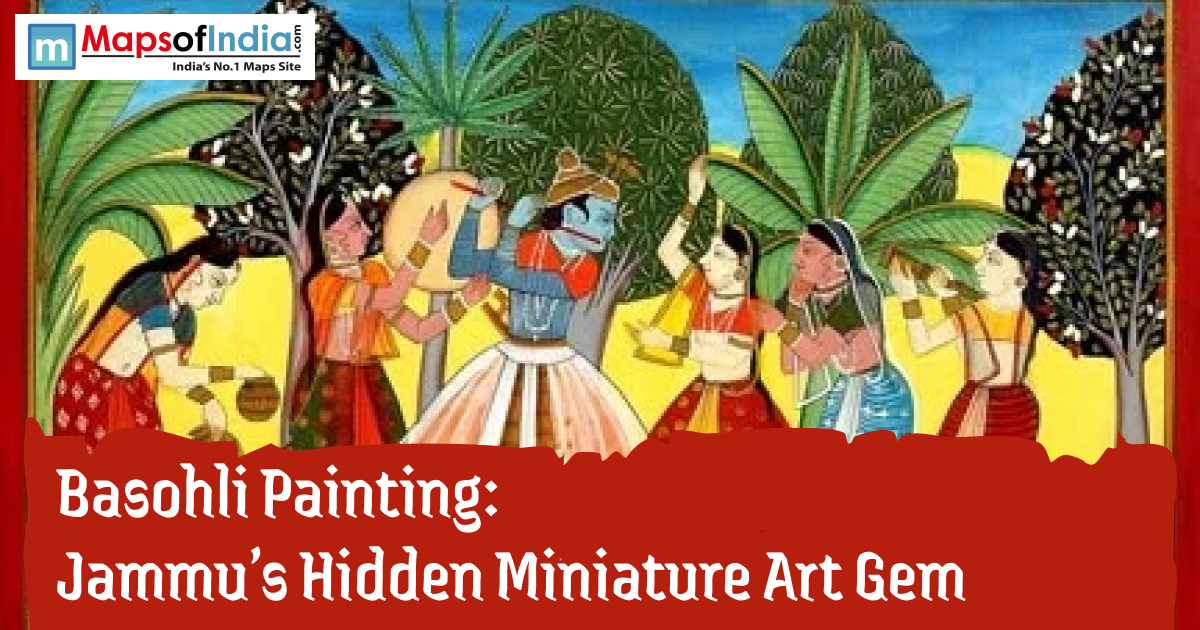
An art of the Basohli painting kind is tucked away in the hills of Jammu and is barely known to people. Basohli painting isn’t only a visual. It narrates its tale through the hues and the minutest details. This age-old miniature style is a collection of the three golden themes of love, devotion, and mythology. Basohli art is characterized by its thick contour lines, bright colours, and happy faces and is, therefore, one of the least recognized artistic treasures in the world of Indian art.
Origins of Basohli Painting
The inception of Basohli painting dates back to the town of Basohli, which is in the Kathua district of Jammu and Kashmir. Its zenith was in the 17th and 18th centuries under the Basohli kings’ governance. Those monarchs were patrons par excellence of the arts and had painters draw the unique visual manifestations of their culture. The upshot was a distinct style that not only differed structurally but also ideologically from other Indian miniatures of the Mughal or Rajasthani courts.
The Royal Influence and Artistic Growth
The Basohli monarchs were not only lovers of art but connoisseurs as well. Their courts became the hubs of creativity, as a result, attracting skilled painters from neighbouring places. These painters merged the local customs with the Mughal school influences create a new style. Art, being well funded by the kings, eventually reached its peak, and many rich works were made for temples, palaces, and manuscripts. The plots were mostly based on religious texts, epic tales, and romantic poetry.
Distinctive Features of Basohli Painting
One of the most defining characteristics of the Basohli art is its strong appeal to the eyes through the usage of colour and shape. The painters usually employ the vivid colours of red, yellow, and blue. Character faces got treated with heavy line drawing, and their eyes were given the characteristic “look alive” kind. Often, the characters are depicted as being in motion even if their poses are stationary. The backdrops are unadorned, yet stuffed with symbolic things like flowers, clouds, and buildings. The elements were very few, but they were extremely profound.
Symbolism and Style
No detail was without a reason in a Basohli painting. The reds used for the backgrounds stood for passion and energy. Cool and calm blue was a colour chosen to represent the divine. The almond-shaped eyes conveyed the feelings much stronger than any spoken word. The jewels and gowns were done at a great level of detail, thus showing the affluent times. The use of gold and the natural pigments gave the paintings depth and roughness.
The Rasamanjari Series: A Masterpiece
The Rasamanjari paintings are one of the great examples of Basohli’s creative work. Created near the close of the 1600s, they express human emotions using graceful forms along with vivid hues. Each image connects to a verse from the original poem, bringing the words alive through visual scenes. These pieces can now be found in museums, which give glimpses into India’s deep emotional past.
Techniques and Materials
Basohli painters kept to age-old methods and used all-natural materials. The colours used in this art come from minerals, vegetables, and gems. Most of the time, they used paper made by hand, which was then polished with a stone to give it a shiny look. Small detailing was done by brushes made of squirrel hair. The method was not fast, but it was accurate and required a lot of patience and great expertise. The completed work was often very bright because of the high-quality pigments and the skill of the maker.
Themes of Love and Devotion
Although mythology was the main theme, love was the core of Basohli artworks. The love between Radha and Krishna was the symbol of the spiritual bond between man and God. The artists depicted their love in such gentle yet strong manners – by the use of gestures, glances, and colours. These were not thought of as mere ornaments but as an outward expression of inward feelings and philosophical ideas.
Depiction of Nature and Environment
Nature is the main theme of Basohli art. Trees, rivers, and flowers are not the typical elements of the background but are the symbols of the newborn life and the flowing emotion. The artists presented the nature surrounding them by using very basic yet eye-catching designs. Birds that were flying through the sky and lotus flowers that were opening in the ponds were the elements that made the pattern even more harmonious. The mutual relationship between nature and people was perfectly depicted in every picture.
Decline and Transformation
After the local kingdoms fell and the new rulers came, the Basohli painting started to be in a state of decline in the 19th century, after which the patronage went dark, and the artists shifted their style to the neighbouring areas like Kangra and Chamba, where they changed into different forms of their evolved style. Though the influence of Basohli art on later Pahari paintings is still there, Basohli art itself has faded away. Some regional artworks have also adopted some features of Basohli, such as the expressive faces and bright colours.
Preservation and Recognition
At present, the Basohli painting is one of the significant components of Indian cultural heritage. This is being preserved by the efforts of art historians and government organizations. The National Museum in New Delhi and the Dogra Art Museum in Jammu are some of the places where one can see the collection of Basohli miniatures that are rare and precious. There are also workshops and exhibitions held to promote this art and to induce new artists to enrol in traditional techniques.
Challenges in Preservation
There are still problems after the acknowledgement of the Basohli painting. The difficulty for artists to preserve their traditional art comes from the lack of consciousness and the very few opportunities for training. In addition, the pricey natural materials have made the situation worse. More help is required to assure the survival of Basohli art – from art institutions, government programs, and tourism initiatives. Creating an environment where young artists will regard it as a feasible career can bring about a significant change.
A Legacy Painted in Colour
Basohli painting is beyond the concept of art—it is a connection between history and fantasy. It is an account of faith, love, and artistry that goes beyond time. Every piece of art holds the essence of Jammu’s spirit, covered with colour and feeling. The fruition of this art depends on how we value it today.