







History
Gandhinagar is Gujarat's capital city. Constructed following independence, it is one of India's few planned capitals. The city bears the name of Mahatma Gandhi, the Father of the Nation, who lived in Gujarat for a major portion of his life and had an impact on the state's social and political landscape. Gandhinagar has the heritage of Gandhian principles while also reflecting modern urban development.
Constructed after independence, it is one of India's few planned capitals. The city bears the name of Mahatma Gandhi, the Father of the Nation, who lived in Gujarat for an important portion of his life and had an impact on the state's social and political domain. Gandhinagar carries the heritage of Gandhian principles while also impacting modern urban development.
The region was mostly rural prior to the creation of Gandhinagar. Along the banks of the Sabarmati River, it was made up of open spaces, farms, and tiny settlements. The former Ahmedabad district included these settlements. Because power centers were situated in towns like Anhilwara Patan, Ahmedabad, and subsequently Baroda, the area did not have major political significance in ancient or medieval times. Nonetheless, local trade and agriculture were sustained by the land's fertility.
The creation of the state of Gujarat in 1960 gave rise to the concept of Gandhinagar. Ahmedabad was designated as Gujarat's interim capital when Bombay State was split into Maharashtra and Gujarat. The new state's authorities, however, desired a distinct, long-term capital that would represent Gujarat and prevent traffic in Ahmedabad.
The state administration made the decision to construct a new capital from the ground up after being inspired by planned cities like Chandigarh.Because power centers were situated in towns like Anhilwara Patan, Ahmedabad, and subsequently Baroda, the area did not have political significance in ancient or medieval times. Nonetheless, local trade and agriculture were sustained by the land's fertility.
Two Indian town planners, H. K. Mewada and Prakash M. Apte, were tasked with developing Gandhinagar. Le Corbusier's design principles for Chandigarh had an impact on them. Gandhinagar's construction got underway in the early 1960s. In 1970, the city took Ahmedabad's place as Gujarat's formal capital.
Gandhinagar's design paid close attention to utility, flora, and order. There were residential neighborhoods, schools, parks, and local retail establishments in each of the city's sections.
The location of the city was significantly shaped by the Sabarmati River. It is located north of Ahmedabad on the river's west bank. Gandhinagar's steady growth was aided by its close proximity to Ahmedabad, which made transit between the two cities simple. The region later joined the Ahmedabad-Gandhinagar urban region, which is one of Gujarat's most significant urban areas.With parks and tree-lined streets all across the city, it is frequently referred to as one of India's greenest capitals.
It swiftly rose to prominence as the administrative hub of Gujarat. The Gujarat Legislative Assembly, the Secretariat, and ministers' official houses are among the significant government structures constructed here. Several crucial Gujarati politicians have called the city home, and it has played host to numerous political gatherings.
The initial administrative function of Gandhinagar has been reduced. It has grown into a center for information and education; has gained more academic significance because of establishments like Pandit Deendayal Energy University, National Institute of Fashion Technology, and Indian Institute of Technology Gandhinagar. Financial and technological advancements have also been brought to the area by the neighboring building of GIFT City.
The capital city is a representation of post-independence India's planned development. Its progress from a sleepy rural location to a contemporary capital city embodies Gujarat's vision of sustainability, order, and growth. Gandhinagar's historical importance comes from its function as a meticulously planned capital that denotes governance, Gandhian values, and Gujarat's aspirations, even if it may not have an ancient past like certain Indian cities.
Culture
The Gandhinagar region's culture shows Gujarat's broader cultural traditions and the impact of a modern planned capital. Gandhinagar residents have a way of life that maintains a balance between discipline, tradition, and modern ideals. Due to the city's post-independence development, its culture developed gradually, influenced by surrounding rural villages, educational institutions, and governmental establishments.
The primary language used in the area is Gujarati. English and Hindi are also commonly used, particularly in workplaces, educational institutions, and universities. Gandhinagar is a culturally diverse city because many of its residents are from various regions of Gujarat. Despite this diversity, individuals are united by common traditions and holidays.
Cultural life heavily relies on festivals. Large garba and dandiya festivities are held all throughout the city during the most popular festival, Navratri. During these festivities, people dress traditionally in kediyu and chaniya choli. Another significant cultural event is Uttarayan, the kite festival. Families congregate on terraces, exchange candies, and fly kites. Prayers, lights, and community get-togethers are all part of the Diwali celebration.
Traditional Gujarati food has a big influence on Gandhinagar's food culture. Dal, kadhi, roti, rice, veggies, and farsan are typical meals. Popular snacks include dhokla, khandvi, fafda, and thepla. Due to cultural and religious beliefs, a large number of people favor vegetarian cuisine. Everyday living is made more interesting by local restaurants and street food.
The area is steeped in traditional principles of community life, nonviolence, and simplicity. These principles are associated with the teachings of Mahatma Gandhi, who continues to have a significant impact in Gujarat. Public areas, cultural centers, and ashrams encourage moral behavior and social peace.
In general, people respect order, hygiene, and harmonious cohabitation. The region's cultural life also includes art and crafts. During festivals and cultural events, traditional music and dances like garba are performed. Traditional jewelry, bandhani fabrics, and embroidery are examples of handicrafts that are valued and worn on important occasions.
Gandhinagar also has a modern cultural aspect. Seminars, exhibitions, and performances are held in educational institutions, libraries, and cultural venues. A peaceful and orderly way of life is promoted by the city's thoughtfully designed layout and green areas. It is a distinct and well-balanced area of Gujarat because of its culture, which combines modern metropolitan ideals with traditional Gujarati heritage.
Language
The most common language in the city is Gujarati. It is used in social interactions, everyday speech, local markets, and cultural events. The majority of locals are raised speaking Gujarati at home, which helps to the preservation of local customs and identity.
In Gandhinagar, Hindi is also widely spoken and understood. It is extensively used in public communication, government agencies, and dealings with individuals from other states. Additionally, English is crucial, particularly in professional, administrative, and educational settings. In addition to Gujarati and Hindi, English is frequently used in schools, institutions, and official documents.
Because it is the state capital, people from many parts of Gujarat and India come here to work and study. As a result, various Indian languages like Marathi, Sindhi, Punjabi, and Rajasthani can be heard in some communities. This linguistic diversity enhances the region's cultural richness. It shows a balanced multilingual environment. Gujarati remains the cultural base, with Hindi and English helping communication, administration, and education. Together, these languages help the region to stay connected to its roots while meeting modern and administrative demands.
Geography
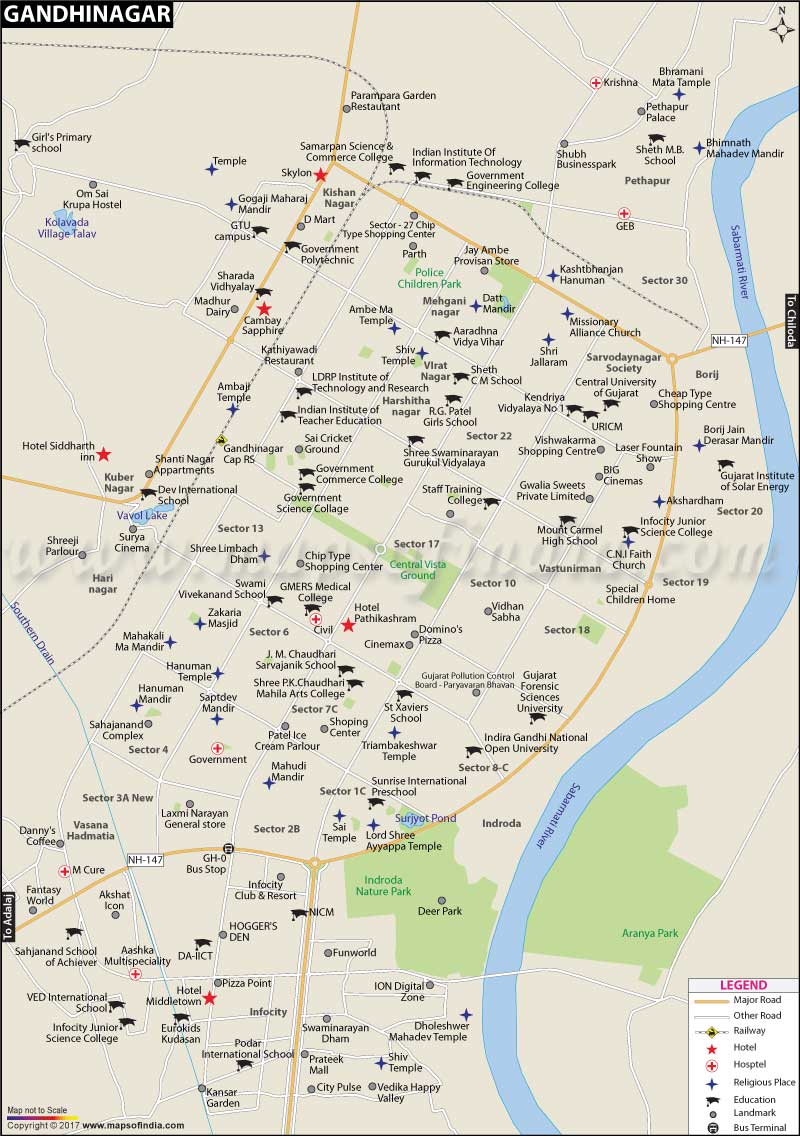
Gandhinagar is located in central Gujarat, on India's west coast. It is located on the west bank of the Sabarmati River, just north of Ahmedabad. It is part of the Ahmedabad-Gandhinagar urban area. Its location makes it easily accessible to other parts of Gujarat by roads and railroads. The surrounding topography is generally flat, which has facilitated planned urban expansion.
Geographically, it is part of Gujarat's semiarid plains. The area is primarily composed of alluvial material deposited by the Sabarmati River over time. This soil is ideal for agriculture in nearby rural areas, where crops including wheat, millet, and pulses are farmed. The river is important in delivering water for home use and irrigation, despite its seasonal character.
Gandhinagar has a hot and dry environment for the majority of the year. Summers are long and intense, typically lasting from March to June. During this time, temperatures frequently soar above 40 degrees Celsius. Heat waves are common, and midday temperatures can be extreme.
The monsoon season begins in late June and lasts into September. The region receives moderate rainfall, which replenishes groundwater and promotes agriculture. However, rainfall might be inconsistent. The winters are moderate and pleasant from November to February. Temperatures remain pleasant, making this the ideal time to visit the region.
| Particular | Details |
|---|---|
| Official Name | Gandhinagar |
| Location | North Gujarat |
| Area | 326 sq. km |
| Population | 292,167 |
| Language | Gujarati |
The Bombay state was divided into two states, Gujarat and Maharashtra, in 1960. A new capital for Gujarat was proposed to be built near the banks of Sabarmati. H. K. Mewada, a renowned architecture, along with his assistant M. Apte planned this new city, which was later named as Gandhinagar. Currently, there are 30 sectors in the city and each sector has all the basic facilities that are essential for residential areas including community centres, markets, health care centres and primary schools. There are many malls and multiplexes in the city.
Places to See
Known for its colourful culture and delicious authentic Gujarati food, Gandhinagar is a nice tourist attraction. Below mentioned are some of the many places of interest in the city:
Akshardham Temple: Also known as Swaminarayan temple, Akshardham Temple is the most popular temple and tourist attraction in the city. With a panoptic amalgamation of education, entertainment and enlightenment, the temple showcases hundreds of sculptures and dioramas and many audio-visual shows that unfold a stream of timeless experiences of Lord Swaminarayan and provides knowledge about ancient Indian cultures. A marvel of traditional stone architecture, Akshardham Temple combines thoughts with modern technology to give a panoramic view of life.
Adalaj ni Vav: Situated a few kilometres away from the main city, Adalaj ni Vav is a five-storey step-well that is quite known for intricate cravings with beautiful Islamic floral patterns, coalescing with Hindu and Jain symbolism. It was built by Queen Rudabai in 1499.
Gujarat Science Centre: Situated on the Sarkhej-Gandhinagar highway, this science centre was built by the Gujarat government for the promotion of science among students. The centre has an IMAX 3D theatre, a Planet Earth pavilion, CLP Electrodrome Museum, a hall of science, an amphitheatre, a Life Science Park, an energy park, a thrill ride and several dancing musical fountains.
GIFT City Tower: This state-of-the-art 28-storeyed structure is the tallest building in Gujarat. Gujarat International Finance Tec-City was planned as the global hub for financial services.
Sabarmati Ashram: Located in the Sabarmati suburb of Ahmedabad, Sabarmati Ashram was once a residence of Mahatma Gandhi. It has a museum - the Gandhi Smarak Sangrahalaya, which has the personal memorabilia of Mahatma Gandhi and depicts the vivid and historic events of Gandhiji's life. It houses many paintings, books, letters and manuscripts of Gandhiji and even his writing desk and spinning wheel.
Deer Park: It is a large area having many sections including Jurassic Park, Snake Park, Deer Park, Bird Park, etc.
Sarita Udhyan: Located along the banks of Sabarmati, it is a popular picnic spot that offers many recreational activities and features various flora and fauna in its botanical garden.
How to Reach?
Sardar Vallabhbhai Patel International Airport in Ahmedabad is the nearest airport to the city that has connectivity to domestic and international destinations. The Gandhinagar railway station provides connectivity to limited cities like Delhi, Haridwar and Indore, while the Ahmedabad railway station has connectivity to almost every major city and town of the country. National Highway 8C connects it to other cities like New Delhi, Jaipur, Ahmedabad, Chandigarh and Udaipur. National Highway 8 connects it to Mumbai, Navi Mumbai and Surat. The local transportation needs are met by the Gujarat State Road Transport Corporation (GSRTC).
WBST060514
WBVDA
Last Updated on : May 12, 2026
More About Gandhinagar
| Find Distance from Gandhinagar to other Indian Cities | |||
