




About
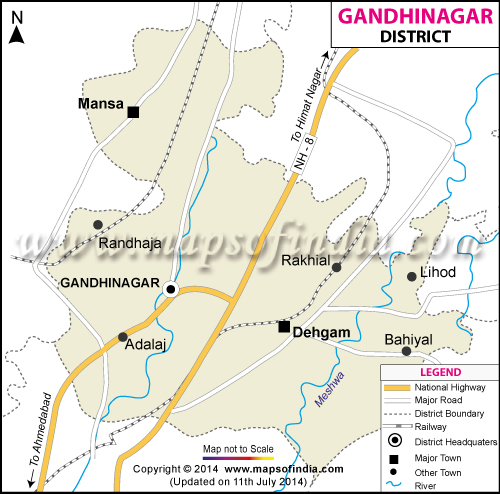
In northern Gujarat lies Gandhinagar district, functioning as both the capital and core of governance for the region. Created in 1964, it bears the name of Mahatma Gandhi, acknowledging his enduring influence on the state’s values. Order defines the urban form: wide roads, planned residential sectors, and extensive green spaces shape its structure. Spanning roughly 2,140 square kilometers, it splits into four parts - Kalol, Mansa, Dahegam, along with the central subdivision sharing the district's title.
Clearly seen as a center of authority: housing the legislature, the governor’s home, while also containing key government departments - this defines the area's function within Gujarat. Still, beyond official duties exists another layer. Places like Akshardham Temple bring quiet significance, attracting people through scale and reverence. Known among India’s most leafy state capitals, its image fits - paths shaded by trees, public lawns easing the geometry of roads, allowing nature to show itself constantly. Though designed with structure, it breathes due to vegetation; here unfolds an uncommon blend of careful layout along with natural calm.
History and Culture
Born amid Gujarat’s reshaping post-1960, the city stands as a quiet marker of regional transformation. Following the split from Bombay State, architects pursued clarity - wide avenues, structured zones, a rhythm between function and space. Drawing subtle cues from Chandigarh, its framework favors precision: grids aligned, green belts woven throughout. Though planned with contemporary ideals, it carries a name rooted in memory - Gandhi - linking forward motion with deep respect. Order shapes its streets; symbolism defines its soul.
Right now, culture thrives in Gandhinagar. Rising above the landscape, the Swaminarayan Akshardham Temple holds deep significance through detailed craftsmanship and quiet reverence. Elsewhere, near the older parts of the region, stands the Adalaj Stepwell from the fifteenth century - a place where design traditions from India and Islam meet across carved surfaces. Water preservation techniques from centuries past remain visible within its structure. Despite time passing, these elements stay connected.
Festivals breathe energy into Gandhinagar, painting it loud with hues and rhythms. As Navratri unfolds, streets shift shape - drums pulse, feet follow, bodies spin in unison beneath open skies. Music becomes a bridge: elders move beside children, memories pass without words. Then comes Uttarayan; air thickens with fluttering silks, thousands of kites stitching patterns across daylight. Rooftops fill with voices tugging at strings that lift more than paper - they carry lightness, release, shared breaths sent skyward.
Beside such customs, Gandhinagar reveals newer ambitions. Rising above the landscape, the Mahatma Mandir stands as a sign of Gujarat reaching outward - toward growth, toward connection. Events held there draw attention from across regions, signaling intent without loud claims. Yet quieter experiences exist too; take Dandi Kutir, where scale shifts, drawing visitors inward rather than aiming wide. Curving upward like a pile of sea salt, the structure guides people into spaces tracing Gandhi's journey. Inside, scenes come alive through careful detail, drawing viewers into moments that feel immediate rather than distant. One step at a time, these rooms turn past events into something felt - close, present, stirring long after departure.
Economy
A mix of state-led initiatives, community-driven efforts, and independent enterprises shapes Gandhinagar's economic landscape. While administration plays a role, local businesses contribute just as much. Oversight from institutions exists alongside self-run operations. Each part functions separately, yet outcomes often align. Structure comes not only from policy but also from everyday transactions among residents.
Administration stands central to the local economy, given that Gandhinagar hosts key institutions like the Secretariat and official residences. With many offices concentrated here, employment in public service becomes widespread across households. Livelihoods rely heavily on these roles, due to steady demand for personnel in state operations. Such positions fill daily routines for thousands who engage directly in civic management tasks. This structure shapes economic patterns throughout the region over time.
Farm output in Gujarat gains support through state-linked operations like the IFFCO Fertilizer Plant. This facility functions within a network of shared industrial efforts. Its presence influences production patterns across rural areas. Structure and scale distinguish it among similar ventures. Economic effects spread beyond immediate zones of operation.
In recent decades, growth within the service industry has accelerated notably. Located in Gandhinagar, GIFT City stands as India’s initial integrated smart urban center focused on finance, elevating the region's international profile. Institutions such as NID and PDEU, alongside modern medical centers, form key elements of economic activity here. Technology-focused zones further support this shift toward knowledge-based services across the area. In Kalol and Dahejam, ceramic production appears alongside chemical plants, while engineering workshops occupy smaller industrial zones.
Tourism
What draws people to Gandhinagar district is less its status as a capital city, more how faith, history, and green spaces come together here. Though planned with precision, it holds pockets of ancient feeling, pulling travelers who seek something beyond urban routine. Standing within this landscape is Akshardham Temple - its presence defined by vastness, materialized in rose-colored stone.
Craftsmanship covers every surface, each detail shaped without haste or compromise. Instead of mere prayer halls, what unfolds are curated experiences: storytelling through beams of colored light, voices echoing lessons from old texts.
Gandhinagar today includes structures showing what Gujarat aims to become. Housed within the Mahatma Mandir, large gatherings find space amid sweeping interiors and landscaped grounds. Although built for global meetings and commerce events, its presence draws sightseers too. Close by stands the Dandi Kutir Museum, rising like a salt-formed hill. Inside, stories of Mahatma Gandhi unfold using sound, light, motion, and touch. Rather than display artifacts behind glass, the building guides people through moments of principle. For some, stepping through means walking alongside ideas of honesty and peace instead of conflict.
Among Indian cities noted for lush landscapes, Gandhinagar stands due to thoughtful design meeting environmental care. One highlight lies west of the city center: Indroda Nature Park, sometimes compared to prehistoric exhibit zones elsewhere, though unique in its own right. Fossils rest beside living plant collections, while animal enclosures blend into broader educational goals. School groups arrive regularly; families linger near shaded paths observing both ancient replicas and present-day species.
Another space, quieter but just as cared-for, is Sarita Udyan - adjacent to a small habitat where deer move freely among visitors who keep respectful distances. Urban structure here does not push nature aside - it makes room. What results is neither accident nor trend, simply consistent choices favoring balance between built areas and open ecosystems.
Within this region, heritage meets spiritual depth alongside contemporary design. Visitors depart aware of ancient customs now paired with progressive aims. Such balance defines the area’s identity distinctly. What remains is a quiet impression of continuity shaped by change.
Demographics
What stands out in Gandhinagar district is how it balances city planning with cultural roots. Backed by data from 2011, total residents numbered 1,391,753, living within towns and villages alike. Despite growth, crowding remains less intense than in neighboring regions - this space aids orderly development without weakening village life.
What stands out in the region is a literacy level reaching 84.16%, far exceeding the country's norm. Found within are schools, universities, and centers of study shaping daily life here. Among them sit NID and PDEU - places where academic focus draws youth nationwide. Efforts by authorities, combined with local values around education, sustain this trend. Learning does not feel incidental; it forms part of how the area functions.
Within this region lives a mix of people: civil servants, skilled workers, laborers in factories, alongside those tending fields. In cities including Gandhinagar, life centers on households with steady incomes, officials managing public duties, and young individuals pursuing education. Outside these zones, villages in Mansa and Dahegam continue ways shaped by farming customs passed through generations. Such contrast brings together forward-looking goals along with deeply rooted practices - each present at once.
With regard to population makeup, Gandhinagar stands out due to its balance between males and females - a pattern aligned with wider patterns across Gujarat. Although not perfectly equal, the distribution shows signs of gradual change shaped by public policies alongside nonprofit involvement. Programs focused on learning opportunities for young females appear within community frameworks. Female advancement receives attention through locally rooted activities influenced by institutional support.
Administration
Governing Gandhinagar district unfolds through layered yet smooth operations, shaped by its status as Gujarat's seat of power. Within it lie four talukas - Gandhinagar, Kalol, Dahegam, and Mansa - each operating under distinct local frameworks. Across these divisions stretch 293 revenue villages alongside four municipal bodies, linking oversight to city centers and countryside alike. Structure here serves function, where scale does not block reach.
High above smaller administrative units sits the Collectorate, guiding actions tied to public safety, income gathering, and services. Through coordination by the Collector and supporting officers, links form between central agencies and nearby councils - movement flows without blockage. Arranged across the urban landscape are thirty divisions within Gandhinagar, laid out including homes, businesses, learning places. Beginning with structure rather than chance, this layout stands apart nationally, shaped by focus on clarity, reach.
Administration relies heavily on local self-governance. Villages find their needs met through panchayats, which focus on water, sanitation, and rural progress. Urban zones operate differently - municipal bodies take charge of roads, trash systems, and community utilities. Among them, the city’s image as orderly and eco-friendly rests partly with the Gandhinagar Municipal Corporation.
Another central element involves development administration. Via district offices, initiatives focused on rural welfare reach communities, while efforts in education proceed alongside those in healthcare. Women's empowerment programs operate within this framework, tied closely to broader implementation strategies. Attention flows not only toward the capital city but also extends deliberately into surrounding villages. Balance defines Gandhinagar’s approach - urban growth shares space with rural priorities, earning recognition over time.
| Facts of Gandhinagar District | |
|---|---|
| Official Name | Gandhinagar |
| Location | North-Central Gujarat |
| Area (km2) | 2140 |
| Population | 1391753 |
| Language | Gujarati, Hindi |
FAQs
Q1: What is the top attraction in Gandhinagar?
Akshardham Temple is a district landmark which also has great architecture, exhibits which are very much admired and very peaceful.
Q2: What is GIFT City known for?
GIFT City is the first of its kind in India which has become a smart financial and technology hub, we see companies from within the country and abroad are attracted to it.
Q3: What has made Gandhinagar a model green capital?
The city has extensive parks, lined streets with trees, gardens and also careful green belts which in turn add to the clean environment.
Q4: What do we find at Dandi Kutir?
Dandi House which is an interactive museum on Mahatma Gandhi’s life which uses multimedia for display of his story and ideas.
Q5: What makes Adalaj Stepwell special?
It’s known for its intricate stone work and which also presents a rare mix of Hindu and Islamic architecture from the 15th century.
Q6: Does Gandhinagar have important educational institutions?
Yes. In our district you will find such prominent institutions as PDEU, NID and also many universities which attract students from all over India.
Q7: What industries contribute to Gandhinagar's economy?
The district is home to chemical, engineering, ceramic, manufacturing and also modern financial services industries.
Last Updated on : July 16, 2026
