







About
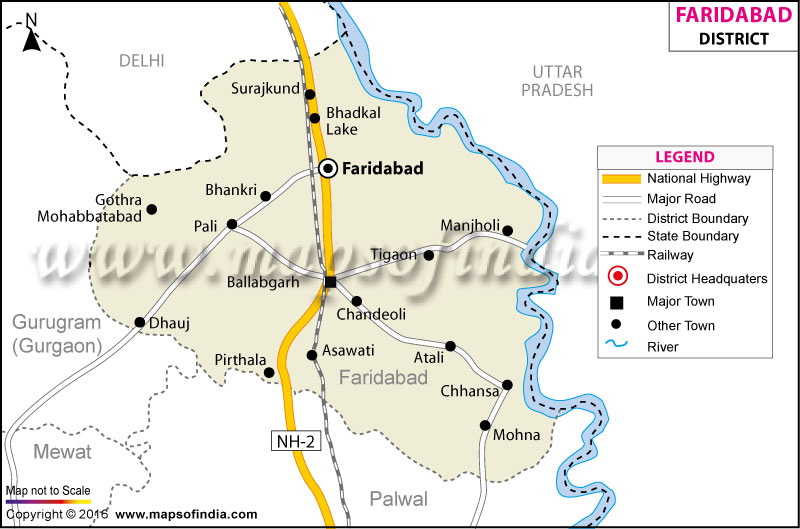
Standing at the edge of Delhi and facing south reveals something shifting. From here, the sleek finish of a planned city fades into something louder, tougher - Faridabad takes over. Between rapid urban growth and stone-still hills older than memory, this place balances past grit with factory smoke. Today, Faridabad spans about 741 square kilometres - evolving far beyond its origins as a modest military post. Once quiet, it now stands recognized among India’s Smart Cities, shaped by steady growth rather than sudden leaps. Broad roads shaded by trees cut through neighbourhoods where glass towers rise beside older structures. History lives under tyre tracks. Ambition roars without apology. To the north, it meets Delhi’s vibrant NCR; on the western flank spreads Gurugram, known for offices and enterprise; below, Palwal stretches, marking southern reach. Along the east, something calmer defines the boundary - the steady presence of the Yamuna River, tracing a liquid line between states. This river separates Faridabad from Uttar Pradesh without fanfare. Though steel frames rise high, a quiet spiritual thread runs beneath the surface.
History and Culture
Back then, life looked different here - centuries before concrete towers rose, the land bore traces of the Tomar rulers from the 900s, their remnants still hidden among hillside rocks. Instead of traffic noise, silence ruled; instead of steel frames, stone markers told stories. Sheikh Farid started it in 1607. Founded under the direction of Sheikh Farid - a spiritual figure and royal treasurer during Jahangir’s rule - the settlement began as a planned outpost. Protection of trade routes guided its creation; defense, worship, and supply shaped its core structures. A fortress rose first, followed by sacred space for prayer, beside a pool meant to sustain weary passersby. Positioned on the Grand Trunk Road, it served movement across regions, quiet yet essential. Purpose defined every stone laid.
Post-Partition Resettlement 1947–1950s:
After India split, Faridabad became a key hub for people arriving from Pakistan. To create jobs for those uprooted, authorities launched small-scale industries - sparking change that slowly turned the town into an industrial base. Though quiet at first, growth picked up as factories took root, reshaping its identity over time. One reason Faridabad emerged? It split from what used to be the Gurgaon district. That shift marked a turning point - making it Haryana’s twelfth standalone region. Growth didn’t just happen; rising economic weight pulled governance in new directions. After the 1947 partition, Faridabad began changing - not slowly, but fast, driven by crisis. Millions uprooted; more than fifty thousand found themselves here, empty-handed yet unbroken. Dusty ground became home through labour few expected. Survival demanded invention, persistence, daily effort. Colour floods the old stone arena when artisans gather every February. Among scattered stones, artisans gather - hands shaping wet clay while melodies drift from weathered instruments. Weavers move between stalls, fingers tracing cloth born of old methods. Music spills without pause, carried by voices raised in songs passed generations deep. The land, often silent, now hums under footsteps lightened by joy.
Economy
What powers Haryana’s initial wealth? Look closely, and it points straight to this region. Over many years, one district stood unmatched - leading all others in production strength. Morning arrives here with loud whistles cutting through the air, machines already moving. Heavy vehicles roll steadily along roads long before sunrise.
Government Sector
Rooted firmly in this region, state involvement shapes much of the local economic landscape. Home to major public sector entities, Faridabad hosts central offices alongside sprawling industrial sites. Notable names such as NHPC and Indian Oil operate extensive facilities within city limits.
Public Sector
Out in these fields, tractors turn soil under morning light - many born on nearby factory floors. Picture an excavator tearing into urban earth, its parts likely shaped by machines running nonstop just kilometres away. Motorcycles humming along dusty highways? Chances are, their frames were welded in this district. Big names anchor the landscape: Escorts stamping metal, JCB drilling designs, Yamaha fitting engines, while Bata moulds soles and Goodyear wraps rubber around rims. Switchgears with intricate circuits roll out beside bulky refrigerators, each item forged through rhythm rather than rush. Night brings no pause - overhead lights glow across sprawling units where labour and logistics lock step. What hums here isn’t magic; it’s routine built on calloused hands feeding industrial motion.
Services Sector
Though factories once defined the city, services have surged ahead in recent years. Not far from the Agra Canal, a building frenzy has reshaped what locals now call Greater Faridabad - or Neharpar. High-rises rise where fields once stood, drawing thousands of young households seeking fresh starts. Surprisingly, even within zones thick with steel and pavement, farming maintains an unexpected economic role. This area ranks among India's top regions for cultivating and shipping premium henna, known locally as mehendi. Expansive plots devoted to this plant generate significant income through harvests. Such success shows a clear ability to link industrial effort with rural cultivation without tipping the scales too far either way.
Tourism
Hidden among the Aravalli hills’ rough terrain lies a stretch often overlooked - a place where quiet corners sit just beyond factory gates. Though few picture steel beams when planning getaways, some discover charm in these unpolished edges. Life hums steadily here, yet peace slips through between shifts and smokestacks. Not far from assembly lines, green patches breathe slowly under thick dust. A fusion of Rajput boldness with Mughal grace defines its structure, carefully brought back to life. Now, open courtyards welcome music under stars during seasonal gatherings. Dinners held here offer more than food - they serve memory on porcelain. Surrounding the old sunken basin rise craggy ridges, forming a quiet backdrop. This ninth-century structure - crafted under royal patronage of Surajpal - takes form as a stepped bowl carved into earth and stone. On cool seasonal mornings, families gather along its terraced edges. Once filled by natural springs, the water now stays absent, yet visitors keep returning anyway. Nearby sits what used to be Badkhal Lake, slowly drained through time due to land shifts and nearby excavation work. Instead of open water, rolling grasslands meet distant slopes of the Aravallis today. A well-kept golf field spreads across former lakeside terrain. People often arrive before sunrise, walking trails lined with shrubs and birdsong. Escaping dense city air leads many toward these quieter outskirts on weekends
Demographics
Among India's many districts, few match this one for variety of background and layers of past. According to data collected in 2011, about 1,414,050 individuals live within Faridabad’s boundaries - more than any other area in Haryana. When looking at gender distribution, there were 874 girls for every 1,000 boys. Among people aged seven and older, nearly four out of five could read and write, placing literacy at 83.83%. Members of Scheduled Castes formed 10.57% of the overall population, totalling 133,395.
Each square kilometre holds more than 2,400 souls, packed tightly together. Such crowding does not happen by chance; it reflects what draws so many toward this place: chances that feel real, work that seems reachable, futures imagined anew. Among everyday routines, education holds firm as a central value, shown by a literacy level staying near 82%, well above the country's overall figure. Strolling through busy lanes reveals Hindi spoken widely, used daily by close to 88% of residents. Yet thanks to migration after partition - and steady movement of job seekers since - Punjabi lingers at roadside teashops, while Haryanvi and Bhojpuri add texture to market chatter. Female presence numbers about 873 per thousand males, an imbalance rooted in past patterns now met with persistent efforts via neighbourhood learning drives and support initiatives.
Administration
Running a region so vast, crowded, and economically layered demands coordination sharp enough to handle constant pressure. Under the guidance of a Deputy Commissioner - always an experienced IAS appointee - the city finds direction through one central figure. This official steers operations that stretch across property systems, public order, and large-scale infrastructure growth without pause. Though titled modestly, their role anchors nearly every major civic function in motion. Running local operations relies on splitting the district into three parts - Faridabad, Ballabgarh, and Badkhal - each called a tehsil. Overseeing daily public concerns in one of these areas falls to a Sub-Divisional Magistrate. Though small in name, each unit plays a large role in administrative function. From resolving complaints to maintaining order, their work forms the backbone of routine governance.
Managing city services like roads, water, and waste falls to the Municipal Corporation of Faridabad, which operates continuously across dense infrastructure networks. Still, beneath its modern skyline, farming traditions run deep throughout the area. Scattered within the district are around 144 villages, each rooted in agrarian practice. From these settlements come key harvests, including widely recognized henna yields, managed locally through elected village councils known as Gram Panchayats. Because of this setup, even as urban zones push ahead with high-tech development, rural concerns retain space alongside industrial growth.
| Facts of Faridabad District | |
|---|---|
| State | Haryana |
| District | Faridabad |
| District HQ | Faridabad |
| Population (2011) | 1,414,050 |
| Growth | 32.54% |
| Sex Ratio | 873 |
| Literacy | 81.7 |
| Area (km2) | 742.90 |
| Density (/km2) | 2298 |
| Tehsils | Ballabgarh, Faridabad |
| Lok Sabha Constituencies | Faridabad |
| Assembly Constituencies | Prithla, Faridabad NIT, Badhkal, Ballabgarh, Faridabad, Tigaon |
| Languages | Hindi, Haryanvi, Punjabi, Brajbhasha, Bhojpari |
| Rivers | Yamuna |
| Lat-Long | 28.314053,77.333937 |
| Travel Destinations | Badhkal Lake, Surajkund Tourist Complex, Shirdi Sai Baba Temple, ISKCON Temple, Surajkund Lake, Raja Nahar Singh Palace, Dhauj Lake etc. |
| Government Colleges/Universities | Govt College for Women (Faridabad), Govt. College (Tigaon), PT. J.L.N. Govt.College (Faridabad), Aggarwal College (Ballabgarh), D.A.V. Centenary College (Faridabad), G.G.D.S.D College (Palwal), KL Mehta Daya Nand College for Women (Faridabad), Saraswati Mahilla Mahavidyalaya (Palwal) etc. |
FAQs
Q1: How many villages are there in the district?
Far from the factory gates, around 144 villages dot the landscape of Faridabad district. While steel mills hum nearby, fields still stretch wide under open skies.
Q2: What is the population of the district?
The 2011 government count recorded 1,414,050 people living in the district - topping Haryana's list for highest population. Though other areas grew, none matched its numbers during that survey period.
Q3: Faridabad Known For Industrial Activity And Proximity To Delhi?
Home to vast factories building large industrial equipment, the region draws attention worldwide. Automobile plants stretch across its landscape, shaping much of its economic identity. Instead of relying solely on industry, farms thrive here too - especially those growing henna, a crop gaining steady demand. Each year, cultural energy surges when artisans gather for the Surajkund crafts fair, drawing visitors from distant places. This mix of metal, soil, and tradition defines the area’s character.
Last Updated on : June 11, 2026
