

|
||||||||||
| ||||||||||
|





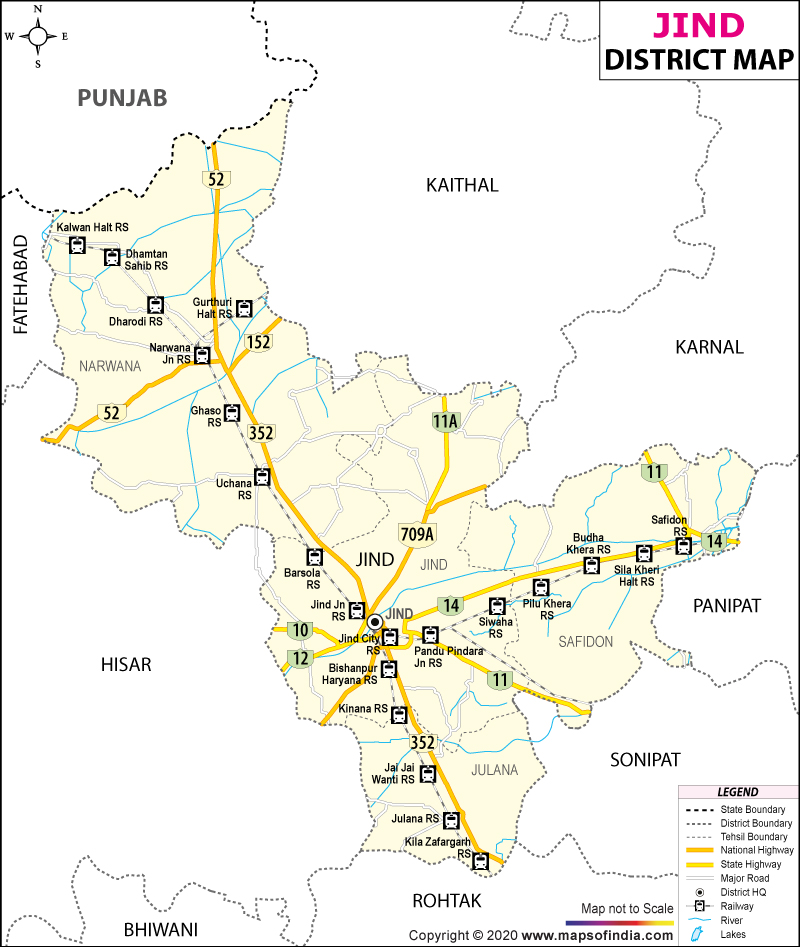
| *Jind District map showing National highways, district headquarter, roads, towns, etc. |
About
Jind District belongs to a one of historically important districts of Haryana and lies as a central district in the state. The district consists of Jind city which has been always an administrative and trade center of the region, agriculture and commerce. The frequent use of Jind district map can be done by students, travellers, planners and researchers that can be an indication of the importance of this district, featuring as a way of comprehending the geography, transport options and settlement pattern of the area.
The district has plenty of fertile land and is predominantly agricultural and includes wheat, rice, sugarcane and cotton production. The agricultural output by using irrigation canals and tube wells has been a significant boost and the better connectivity in the roads has had positive impacts on the economic growth. The district is also economically important for markets and government offices, which made them more important than they would have been fifty years ago. Jind district map is a frequently looked up term that is used by people looking to find Tehsils, villages, roads, railway lines or urban centres in Jind. Road and rail transportation systems are also connected with important towns like Chandigarh, Rohtak, Hisar and so on as well as with the major cities of northern India like Delhi herewith other regions of the district are also connected.
History and Culture
The past of Jind is closely related to the ancient age, medieval kingdom and princely rule. Historical customs link the area to Mahabharata era and local beliefs state that the name ‘Jind' is derived from ‘Jayanti Devi'. Many of the rulers of the medieval era – such as the Rajputs, Mughals and later the Sikh rulers – affected the area. Eventually, it evolved into one of the leading Phulkian states under Sikh rule in princely state of Jind in the eighteenth century. The rulers of the Jind State had a big influence on the regional politics, before the Jind Princely States were integrated into independent India in 1947. To this day the historical context of the district can be researched well by having access to the references referenced to the Jind district map, which features the old settlements and the historical towns and the traditional trade routes.
Local character of the district is rooted in its culture, which is influenced by the culture of the district whereas having its own unique aspects. Haryanvi is widely used by the rural people around the area and Hindi is used for administration and education. Traditional music like folk songs, raginis and dances remain a vital aspect of life inside the villages. Worship is lavish on religious fest days like GREAT FOUR (Diwali-Holi-Dussehra-Janmashtami) in the district. But also important to the culture are wrestling competitions and cattle fairs and rural sports. Local customs, food and community events encourage interaction and strengthen relationships between the people living in the area. The district is also a famous district for its strong rural tradition, agriculture tradition, and the respect for community institutions like khaps and village panchayats. The Jind district map is utilized by researchers to study settlement distribution, history of villages and culture and geography of the region of Haryana frequently.
Economy
The main economic activity in the district that can be observed is agriculture, and it still remains greatly remains paramount in the livelihoods of local people. Agriculture is overwhelmingly the main activity, mainly wheat and paddy are grown, farmers also cultivate mustard, sugarcane, cotton and pulses. Farm businesses and animal husbandry add value to the farm incomes of rural households. Grain market located in Jind, Narwana and Safidon are utilized for agricultural grain trading and related commercial activities. Irrigation infrastructure has played a key role in revolutionising agricultural production and productivity. The government authorities are often referring to the Jind district map in the planning of irrigation networks -- rural roads, agricultural development schemes in various Tehsils and/or villages.
For the administration, public education, health and rural development role played by the government sector is crucial for the economy of the district. Residents get jobs working in schools, colleges, district offices, police headquarters and public health centres. The public sector encompasses electricity distribution, transport services and irrigation departments/cartering co-operatives linked to the agricultural sector, as well as farming co-operatives. There are also other small industries like rice mills and flour mills, cotton processing units and agro-based manufacturing which is contributing towards economic activity.
During past decades, the dominance of service activities has increased continuously as various business sectors like the banks, retail/sales, transport, telecommunications, educational, and other service activities have expanded. The city's commercial activities have also been growing in certain locations, including Urban centres in Jind and Narwana, and the transport and logistics sector has been growing, thanks to the improved connectivity and accessibility. The Jind district map is consulted by the development planners and investors to determine the existing zones of the district and other economic activity and transport pathways.
Tourism
While agricultural and rural culture are its main attractions, the district also hosts some landmarks of religion and history. The old temple of Jayanti Devi at Jind city is one of the most important of the place to which devotees come from various parts of Haryana and adjoining areas. Rani Talab is another significant site that retains religious significance, along with local myths and practices. There are also a few gurudwaras and temples in the district in connection with the old ruling period of the Princely States. These are often used by visitors to check on Jind district map to see their location with respect to other nearby towns and transport services.
The vicinity of Safidon is also of religious and historical significance, as it is related to some ancient traditions. There are several villages in the district which have retained old architectural styles, traditional water bodies and community land, which were the characteristics of the rural way-of-life of Haryana. The local festivals and seasonal fairs shorten the distance between the locals and the visitors, and visitors are eager to learn about the local folk culture and local usage. Narwana town is a crucial centre in the District with the growing urban facilities and agricultural markets. The Jind district map has been utilized by travellers and historians to locate historic sites, past settlements and historic routes associated with the preceding princely areas.
The district is also easily accessible by road and rail, making it a viable tourist destination. If one is traveling from Delhi, Chandigarh or any other city of state Haryana then it is easy to reach out to Jind. Over the years, tourism, particularly in rural areas, cultural and religious visits have exhibited some degree of growth, especially for its citizens interested in central Haryana tradition. The mix of historic monuments, farmland and deep-rooted traditions make the district a unique destination for those looking for a true taste of rural northern India. Researchers, tourist planners and the local people are still using the Jind district map for planning of their travel paths, providing information on tourist facilities and marketing new destinations of Jind district.
Demographics
Jind district is demographically diverse with a large share of people being from rural backgrounds. The Census 2011 Population Count estimate of the district was 1334152 with males exceeding 713,000 and females exceeding 621,000 persons. The population density was approximately 494 persons/km2. The district is mostly rural, with a large proportion of population living there. The district has literacy rate of approximately 71.44 per cent, with some differences in the rural areas versus the urban areas. Most common language spoken is Hindi and Haryanvi and some areas understands Punjabi/Braj. The Jind district map is very widely used by demographic researchers for analysing patterns of rural settlement, population distribution and urban growth in the district.
The district is diverse with a range of farming, servicing and business communities, who have all made contributions to the economic and cultural life of the district. The prevalence of Scheduled Castes is considerable in the district and gradually increase in urbanisation in the towns of district like Jind, Narwana, Safidon, etc. With the establishment of schools, colleges, technical institutions, etc. there has been improvement in educational development over the years. Research related infrastructure, transport and communication networks have also grown continuously. The administrators and census authorities rely on the map of Jind district to determine the changes in its population, year wise due to which they plan Welfare programmes and develop public infrastructure in various area of Jind district.
Administration
From administrative point of view the district of Jind is divided into several tehsils to help in administration, collection of revenues and rural administration. These major Tehsils are Jind, Narwana, Safidon, Julana, Alewa, Uchana and Pillukhera. The district has many villages and towns which assist in its agricultural and commercial activities. There are over 300 villages mapped in the district according to official records, with rural plains and a growing road network providing linkages between them. The Jind district map is used for administrative planning, managing elections and rural development projects, which are often organised by territorial divisions and by the location of the villages.
Village panchayats have a lion's share in village governance and development. The district administration monitors and regulates civil welfare programmes, education programs, health services, agricultural assistance and infrastructure building in rural and urban area. Jind city is the administrative headquarter of the District and commands various government offices. The district's administrative departments work in different functional areas to coordinate the law enforcement and public works and transport activities. Government officials, planners, researchers often want to extensively refer to the Jind district map for very crucial governance related matters, expansion of infrastructure, monitoring developmental activities in the tehsils and villages of Jind district along with many more such stuff.
| Facts of Jind District | |
|---|---|
| State | Haryana |
| District | Jind |
| District HQ | Jind |
| Population (2011) | 1334152 |
| Growth | 12.13% |
| Sex Ratio | 871 |
| Literacy | 71.44 |
| Area (km2) | 2702 |
| Density (/km2) | 493 |
| Tehsils | Jind, Julana, Narwana, Safidon |
| Lok Sabha Constituencies | Sonipat, Sirsa, Hisar |
| Assembly Constituencies | Julana, Safidon, Jind, Uchana Kalan, Narwana (SC) |
| Languages | Hindi, Haryanvi |
| Rivers | ----- |
| Lat-Long | 29.363027,76.371059 |
| Travel Destinations | Pindara, Ramrai, Dhamtan Sahib, Hansdehar, Narwana, Uchana, Negesvara Mahadeva Temple , Nagadamni Devi Temple and Nagashetra Temple |
| Government Colleges/Universities | Chhotu Ram Kisan College, Hindu Kanya Mahavidalya, Kamla Memorial Govt. College (Narwana), Sanatan Dharam Mahila Mahavidalya (Narwana), Govt. College (Safidon) etc. |
FAQs
Q1: How many villages are there in the district?
Jind district has more than 300 villages distributed across its various tehsils.
Q2: What is the population of the district?
According to Census 2011, Jind district has a population of approximately 1.33 million people.
Q3: What is this district famous for?
Jind district is famous for its agricultural economy, historical heritage and religious sites such as the Jayanti Devi Temple.
Last Updated on : June 11, 2026
