







About
Among India's northern states lies Jhajjar, a slice of Haryana shaped in 1997 from parts once under Rohtak’s administration. Though marked by steady change, farming remains central to daily existence here. Progress arrived quietly - roads expanded, factories opened - not far from fields where crops still define routines. Because it sits near the NCR, movement between towns grew easier, drawing subtle shifts in how people lived. While city influences seep into village rhythms, traditions hold ground without resistance. Closeness to Delhi did not erase local character; instead, new layers formed slowly. Growth appears not through sudden leaps but gradual additions across time.
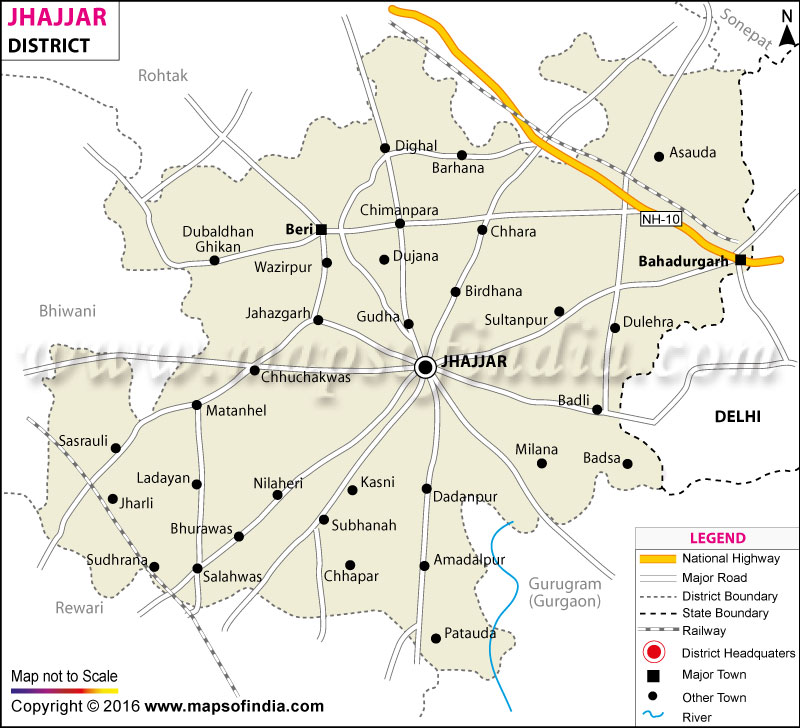
Nearby lie key parts of Haryana - Rohtak, Gurugram, Rewari, Sonipat, along with Charkhi Dadri - forming boundaries around the region. Position on the map has quietly guided how jobs form and cities spread here. At the center stands Jhajjar town, functioning as an administrative core. Meanwhile, Bahadurgarh grows into a hub where factories, homes, and markets cluster tightly. Being close to Delhi brings steady movement: machines hum louder, buildings rise higher, shops multiply across streets.
History and Culture
Over time, patterns in Jhajjar’s past mirror those seen throughout Haryana - farming practices, regional rule, troop activity, and rural customs guided daily existence. Well prior to official boundaries being drawn, people settled on rich soil, relying upon crops and herds for survival. Rooted in cultivation, economies grew slowly, while settlements built routines tied to ownership, kinship, ties among neighbors. From harvest cycles emerged ways of living that endured through generations.
At times long ago, control over areas near today’s Jhajjar shifted among multiple dominions. Owing to rich soil and closeness to pathways vital for movement through northern India, early communities in Haryana engaged heavily in farming and commerce. Under medieval rule, Rajputs first shaped life across the region, followed by governance shifts into Delhi Sultanate control. With time, power passed onward toward Mughal dominance, altering how regions were managed. Administrative changes emerged alongside evolving commerce routes and village expansions.
Despite these shifts, country dwellers held to agriculture as their main way of living. Through centuries of political change, rural existence remained rooted in land cultivation.
Later shifts in power elevated the area’s standing through actions taken by nearby leaders and royal authorities. Under homegrown guidance, Jhajjar began rising as a hub of influence from the 1700s into the next century. Chronicles link the town to Nawabs who oversaw adjacent lands when governance structures shifted repeatedly.
Under British rule, new structures emerged across the landscape. Though gradual, changes touched transport networks first. Markets grew alongside these routes, shaped by movement and exchange. Long after 1947 brought independence to India, Jhajjar moved ahead - farms turned more efficient, roads reached farther, schools opened wider. Across Haryana, farming methods began shifting notably; Jhajjar shared in that change due largely to the Green Revolution's reach.
In districts, festivals shape daily rhythms. With Holi, neighborhoods come alive through shared moments instead of isolation. Lights appear in doorways and market lanes when Diwali arrives, replacing ordinary evenings. During rains, Teej takes form in song, fabric, and circles of women honoring custom. Participation grows around Dussehra just as it does for Janmashtami. Gatherings define these times more than silence ever could.
Still present in daily routines, religion shapes how people connect. From temples to small shrines, places of worship form quiet centers where neighbors meet. Mosques stand alongside them, hosting moments that bind residents together. Gatherings shift the usual pace, marking time through shared belief. Seasonal festivals emerge each year, carrying forward ways long known. These occasions pass down patterns without announcing they do. Tradition lives within gestures that repeat without explanation.
Economy
Farming shapes part of Jhajjar's economic base, while factories add another layer. Manufacturing stands alongside commerce, each supported by shifting city landscapes. Services grow where roads meet new housing, driven by steady local change.
Farming continues to serve as a primary means of income, particularly in countryside regions. Because soil quality is high, fields yield wheat, mustard, rice, bajra, sugarcane, vegetables, alongside fodder crops. Over the past few decades, efficiency has risen where updated watering systems meet machine-assisted practices. Pasture-based animal care brings extra earnings to countryside households. Across the region, customs around milk production still shape local financial patterns.
Government Sector
Across regions, job opportunities emerge mainly within public structures. Schools provide roles just as much as health centers do. District management employs people at administrative levels alongside welfare divisions. Police forces hold positions comparable to those found in city-run offices. Municipal functions support livelihoods similarly to educational governance. Public service jobs spread widely through these established frameworks.
Across the district, public administration continues to support many jobs. Education services contribute steadily to local hiring patterns. Government-backed construction efforts also sustain workforce demand. Employment opportunities often follow where these sectors are active.
Public Sector
Among those involved in boosting regional economies are public sector banks, hospitals, transit networks, schools, and aid-focused organizations. Progress on state-backed construction projects steadily improves access routes, waste management setups, along with shared service areas.
Services Sector
Steadily, the services sector grows as cities spread and the NCR exerts its effect. Not only do retail outlets play a role, but schools also add value across job markets. Transport firms follow closely behind, while medical care providers maintain consistent demand. Among these, lodging facilities stand alongside dining venues, both supporting income opportunities widely. What emerges is a network of commercial activity shaping local livelihoods in measurable ways.
Among Haryana's growing hubs, Bahadurgarh holds notable industrial weight.
Because of their closeness to Delhi and strong transport links, industrial zones help create jobs while drawing in capital. Location near a major urban center enables economic activity that sustains workforce growth alongside investor interest. Access to transit networks plays a role not just in job formation but also in financial inflows. Nearness to infrastructure shapes both labor markets and funding decisions across these regions.
Tourism
Among quiet lanes of Jhajjar district lie remnants of old temples alongside places tied to long-held beliefs. A walk through green spaces reveals stories shaped by time. Heritage unfolds where tradition meets landscape, not in grand displays but subtle traces.
Besides its quiet location close to Beri, the Mata Bhimeshwari Devi Temple draws visitors from across Haryana along with nearby regions. Though often overlooked on maps, it remains prominent among spiritual sites within the area due to steady footfall throughout the year. While not grand in structure, its presence holds weight for those who travel far despite simple surroundings.
Beri carries weight through time, shaped by ancient communities and enduring spiritual practices. Its presence emerges quietly, rooted in long-standing ways of life that linger across generations. What stands today grows from layers beneath - customs held close, places settled early, beliefs passed without pause. Time folds into the landscape here, marked by rituals unchanged and homes built long ago.
Adjacent to Badli Lake, open areas allow residents to enjoy quiet outings. Beyond mere scenery, these zones support informal gatherings. Near water edges, walking paths invite relaxed movement. With space to roam, people find moments away from routine. Through seasonal shifts, the site maintains steady appeal. Among urban stretches, such spots offer rare pauses. Following daily patterns, visitors return without announcement.
Far from city growth, fields stretch wide where farming shapes daily rhythm. Beyond roads and buildings, old ways survive in quiet routines of country homes. Here, land and labor tell stories older than modern change. Life moves slowly beneath open skies, shaped by seasons rather than speed. In these places, heritage stays rooted without fanfare. Though not as prominent as in large cities, travel activity in Jhajjar holds steady due to enduring landmarks. Cultural practices, meanwhile, quietly sustain appeal over time.
Demographics
With around 9.6 lakh residents, Jhajjar district spans diverse settlements as per Census 2011. While some areas host industrial activity, others remain rooted in farming life.
Across the district, Hindi appears frequently in speech; meanwhile, rural areas rely on Haryanvi forms during routine exchanges. Though standard usage spreads, local patterns persist where fields meet homes.
With around 81% of people able to read and write, learning opportunities have grown both in cities and villages. Progress appears steady where schooling reaches households distant from major centers. Farming still shapes how people spread across regions, even though city growth and factory jobs have slowly shifted where populations settle over recent years.
Because of expanding NCR regions, movement of people alters community structures along with job patterns. Shifting populations reshape daily life together with income distribution across areas. As numbers rise in cities, new arrivals influence housing markets followed by changes in service demand. Growth triggers relocation that adjusts traditional roles alongside workplace expectations. Movement shaped by urban increase affects education access paired with healthcare availability.
Administration
Home to the main offices of local rule, Jhajjar runs the daily affairs of its district while guiding policy and civic management. From here, officials monitor growth efforts, safety, support plans for residents, schools, medical care, roads and buildings, along with countryside progress - both in towns and smaller settlements. Instead of working alone, agencies link up under one system so tasks like distributing aid or launching national and regional policies move smoothly.
Running through the region, Jhajjar district organizes its governance via multiple subdivisions. Key among these are the tehsils of Jhajjar, followed by Bahadurgarh, then Beri, Badli, and Matanhail. Each unit oversees tasks like maintaining land data, gathering revenue, delivering welfare aid, while managing community-level oversight.
Among the farmlands and scattered settlements lie over 250 villages shaped by rural life. Governance takes root not in distant offices, but through locally chosen gram panchayats guiding daily affairs. While state frameworks exist, real influence often emerges from these grassroots councils shaping progress. From clean water access to waste handling, their reach extends into practical needs.
Though small, places like Bahadurgarh and Jhajjar city rely on local councils to handle roads, trash collection, lights on streets, clean public spaces, along with layout design for buildings and zones. As more people move into regions tied to the National Capital Region, pressure builds to widen systems and organize construction carefully. Growth doesn’t wait - neither should planning.
| Facts of Jhajjar District | |
|---|---|
| State | Haryana |
| District | Jhajjar |
| District HQ | Jhajjar |
| Population (2011) | 958405 |
| Growth | 8.90% |
| Sex Ratio | 862 |
| Literacy | 80.65 |
| Area (km2) | 1834 |
| Density (/km2) | 522 |
| Tehsils | Bahadurgarh, Beri, Jhajjar, Matenhail |
| Lok Sabha Constituencies | Rohtak |
| Assembly Constituencies | Bahadurgarh, Badli, Jhajjar (SC), Beri |
| Languages | Hindi, Haryanvi |
| Rivers | ----- |
| Lat-Long | 28.627925,76.678677 |
| Travel Destinations | Bhindawas Complex, Pratapgarh Farms, Bua Wala Talab, Archaeological Museum of Gurukul etc. |
| Government Colleges/Universities | Chaudhary Dheerpal Govt. College (Badli), Chaudhary Hardwari Lal Govt. College (Chhara), GC (Bahu), Government College (Bahadurgarh), Govt College (Jhajjar), Govt. College (Dujana), Govt. College for Women (Bahadurgarh), Govt. College for Women (Jassaur Kheri), Govt. College (Matanhail), Govt. College (Dubaldhan), Govt. College (Birohar) etc. |
FAQs
Q1: How many villages are there in the district?
There are more than 250 villages in the district.
Q2: What is the population of the district?
The population of Jhajjar district is 958405 according to the 2011 census.
Q3: What is this district famous for?
Jhajjar district is famous for agriculture, industrial development, Bahadurgarh industries, traditional Haryanvi culture, and the growing importance within the National Capital Region.
Last Updated on : June 11, 2026
