

|
||||||||||
| ||||||||||
|





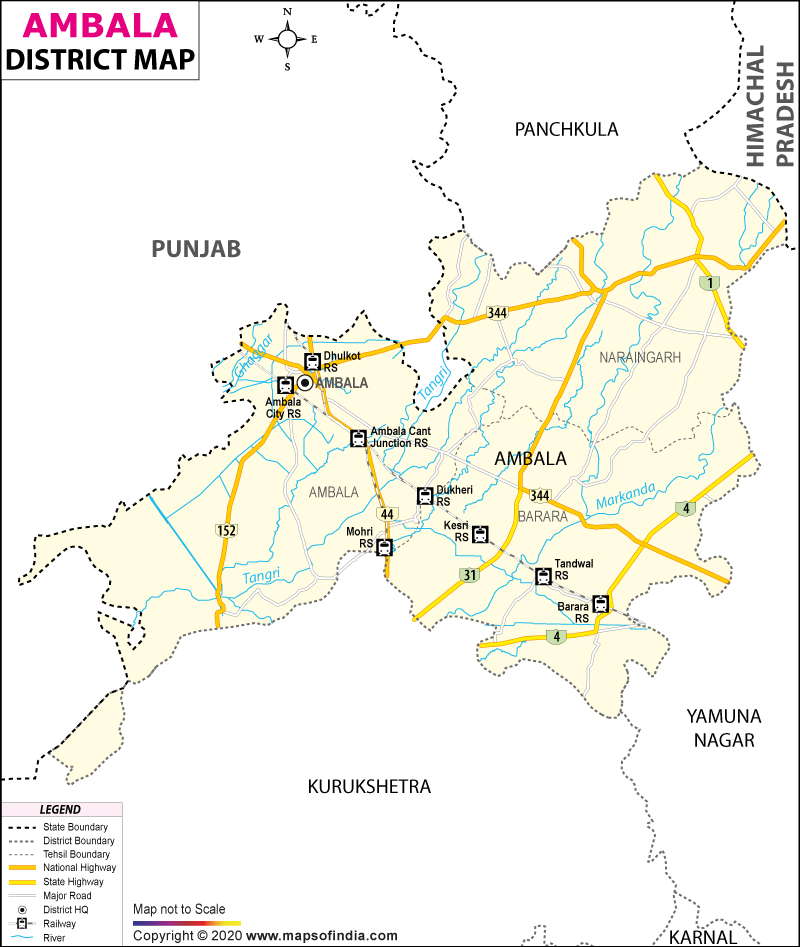
| *Ambala District map showing National highways, district headquarter, roads, towns, etc. |
About
Besides lying in northern Haryana, Ambala district holds notable historical weight along with steady economic function. Military sites appear alongside trading zones and learning centers, contributing to its distinct role across the state. Strategic positioning supports transit flows that link wider parts of northern India together. Rather than standing apart, it blends utility with access in quiet but persistent ways. From fields to factories, life here follows different rhythms. Where crops define daily routines, harvests shape the calendar. Yet roads lead into towns where shops open early, workshops hum steadily. Economic activity shifts without erasing what came before. Instead of replacing one path with another, both exist at once. One relies on soil and season; the other on supply chains and schedules. Neither overshadows the other completely. Stability emerges quietly, built across landscapes that serve separate purposes. Change progresses without wiping out tradition entirely.
History and Culture
Long before cities rose, fields fed families here. Positioned where flatlands meet hills, this part of northern India drew people through steady harvests and movement of goods. Centuries shaped Ambala into a hub, not by chance but location. Life began simply - villages rooted in soil, growing slowly beneath open skies. Long before modern times, shifting dominions shaped life across the area - kingdoms rose, Mughals governed, Sikhs left their mark, then colonists arrived. Situated close to key movement routes, Ambala grew quietly into a point of consequence.
Later on, the area gained prominence under colonial administration. In the 1800s, a military base took shape at Ambala, slowly growing into a key hub for armed forces in the northern region. Because of defense setups, train routes, and government offices, towns expanded alongside trade activity. Thanks to rail links, the town became more significant, tied closely to large urban centers throughout northern India.
In the years of India's struggle for independence, Ambala saw a rise in political consciousness alongside active nationalist efforts. Much like areas across northern India, its people joined campaigns aimed at ending colonial control. Gathered crowds filled public spaces where voices rose in debate and demands took shape. Schools expanded their reach, quietly shifting how society thought and connected. By the 1900s, conversation itself had become a force reshaping everyday life.
Years after partition, Ambala felt shifts due to movement across new borders. Close to Punjab, it absorbed waves of people displaced by changing maps. New residents found homes in open neighborhoods, slowly reshaping community life. Growth came quietly, built on small efforts rather than grand plans. Over time, daily work and steady presence wove fresh patterns into older ways. Settlements expanded not through policy but through lived experience.
Though rooted in Haryana, Ambala carries echoes of Punjabi culture too. In speech, meals, celebrations, and routine interactions, this blend shows clearly. Village areas hold fast to farming ways shaped by community rhythms. Meanwhile, towns lean into trade and schooling as markers of change.
Still today, marriage rituals carry forward long-standing practices tied to kinship and community belonging. Across towns and cities alike, traditional melodies, nuptial chants, and regional festivities hold steady as meaningful forms of shared life. While places shift, these sounds and gatherings persist - rooted, recognizable, quietly shaping who people become together.
Besides farming roots, Ambala carries echoes of military history alongside rising trade activity. Though cities grow here, old rural habits hold steady within daily routines. Instead of fading, local character gains shape through contrast - between fields, barracks, markets. Even as roads widen and towns spread, community ties stay rooted in a shared background. Not uniformity but balance defines how past and present meet across the district.
Economy
Farming shapes part of Ambala's economic landscape, while factories contribute alongside commerce and movement of goods. Learning institutions play a role, too, woven into broader service networks across the area. Transport links help sustain commercial activity, balancing rural output with urban-based industries. Even today, farming holds steady as a key part of the economy, particularly where cities do not reach. Because soil here is rich, it grows wheat alongside rice, sugarcane, maize, greens, and feed for animals. Over years, better water supply systems together with updated growing methods have slowly raised output on fields.
Government Sector
Across both towns and villages, government jobs form a core part of Ambala's economic structure. From clinics to classrooms, public sector roles span multiple fields. The district offices operate alongside hospitals, creating positions for many residents. Military bases add further stability through steady hiring. Welfare programs extend work options into remote regions. Municipal workers keep essential services running every day. What makes the region stand out is how military setups play a key role, mainly due to the presence of Ambala Cantonment alongside related facilities. Though often overlooked, these installations shape local development in quiet but lasting ways.
Public Sector
Though often overlooked, public banks and transit networks play a role in shaping regional economies. Schools, hospitals, and rail services contribute by offering access and stability. Where roads are built, learning opportunities grow - infrastructure lifts more than concrete. Investment in clean water or power grids quietly enables progress. Growth follows where the government commits resources steadily.
Services Sector
Most jobs in Ambala’s city area come from service-based work. Schools, clinics, and hospitals employ many people. Stays for travelers support livelihoods through guesthouses and lodging spots. Shops selling goods form another steady source of income. Places serving meals contribute significantly to daily hiring. Movement of items across locations keeps delivery firms active. Getting around town fuels demand for travel options. Office spaces and market hubs add further opportunities.
Among Indian cities, Ambala stands out due to its focus on making tools for science. Production includes lab gear, teaching aids, microscopes, along with materials used in technical fields sent nationwide. Much of the city's economic movement ties back to this kind of work. Trade thrives because these goods are consistently supplied. Over time, medical care and learning opportunities have grown without pause. From clinics to universities, private ventures shape communities while adding value to economies.
Tourism
Besides temples, old forts pull people into Ambala district. Military history lives on in its museums and barracks there. Green spaces offer quiet escapes amid city movement. Centuries-old buildings stand where stories unfold slowly. Shops bustle with activity, drawing those who seek daily goods or small treasures alike.
Home to a key military legacy, Ambala Cantonment stands out within the district. Its presence traces back to times shaped by colonial rule and strategic needs. History lives in the layout and structures found across the area. Under British control, this zone served vital defense functions. Even today, remnants of that past remain visible throughout. Military activity continues here, rooted deeply in long-standing tradition.
Still today, pilgrims come often to Badshahi Bagh Gurudwara, drawn by its deep ties to Sikh heritage. Though quiet at times, the site holds steady as a place of worship across seasons.
Among churches built during colonial times, Holy Redeemer stands out for those drawn to old religious buildings. Its design pulls attention from travelers curious about history and architecture alike.
Open green zones in Ambala serve as spots for relaxation along with drawing nearby travelers. Shopping hubs pull people in thanks to available items, notably tools used in labs and general trade products. Travel patterns into the region grow as visitors move beyond Ambala to nearby destinations via its transit links.
Demographics
Some 11.3 lakh individuals live in Ambala district, as recorded in the 2011 Census. While towns here host trade and services, farming shapes life across many villages. Though connected economically, these areas differ in daily rhythm and structure. Across the district, Hindi finds frequent use in daily communication. Owing to long-standing traditions, Punjabi appears regularly in local life. In village areas, people often speak variations of Haryanvi.
Besides showing progress, Ambala's roughly 82% literacy rate signals stronger schools and learning systems taking root throughout the area. Shaped through centuries of movement, people settled here from distant regions. Trade brought new ideas along with goods across shifting borders. Education opened paths for some, while others worked the land to survive. Military presence left its mark on community structure and daily life. Together, these forces molded a society marked by difference. Even as city limits grow bit by bit, rural places hold on to farming roots and close-knit ways of life.
Administration
Running across its territory, Ambala district organizes work via subdivisions handling local rule, growth strategies, alongside citizen support systems. Though shaped by regional needs, each unit adjusts tasks based on community demands rather than fixed templates. Ambala holds the role of district hub where governance is managed. Its central function supports local operations across the region.
Among the main subdivisions are those of Ambala, alongside Barara, while Naraingarh appears further west, with the cantonment zone near Ambala forming another key unit. Around 400 villages lie scattered through farming areas and spots blending country with town life. While some settlements sit deep in open fields, others edge closer to developed hubs where urban traits begin appearing. Each community fits within a landscape shaped by crops, local movement, and gradual change. Scattered layouts reflect long-standing patterns tied to land use and access routes.
Despite their differences, municipal bodies work alongside Panchayati Raj setups to shape how communities are run. Focused efforts go toward schools, medical services, roads, waste management, farming aid, along with job growth initiatives. Among efforts by authorities, support for countryside communities stands alongside projects advancing gender equity. Health services reach farther into towns through state-backed clinics. Meanwhile, city layouts adapt to growing populations. Women gain access to resources via targeted schemes. Rural areas receive attention through infrastructure upgrades.
| Facts of Ambala District | |
|---|---|
| State | Haryana |
| District | Ambala |
| District HQ | Ambala |
| Population (2011) | 1128350 |
| Growth | 11.23% |
| Sex Ratio | 885 |
| Literacy | 81.75 |
| Area (km2) | 1569 |
| Density (/km2) | 722 |
| Tehsils | Ambala, Barara, Naraingarh |
| Lok Sabha Constituencies | Ambala |
| Assembly Constituencies | Nariangarh, Ambala Cantt, Ambala City, Mullana (SC) |
| Languages | Punjabi & Hindi |
| Rivers | Tangri, Markanda |
| Lat-Long | 30.292275,76.967068 |
| Travel Destinations | Hanuman Mandir, Patel Park, Tille Wala Mandir, Sis Ganj Gurudwara, Badshahi Bag Gurudwara, Gurudwara Manji Sahib, Holy Redeemer Church, Rani Ka Talab, Ambika Devi Mandir, Jain Mandir etc. |
| Government Colleges/Universities | Arya Girls College, Gandhi Memorial National College, MDSD Girls College, Sanatan Dharam College, Sohan Lal DAV College of Education, S.A. Jain College, M. M. College of Pharmacy, Ambala College of Engineering And Applied Research, DAV College, M.M Institute of Computer Technology and Business Management, AIMT (Shri Atmanand Jain Institute of Management & Technology), K.C. Govt. Polytechnic for Women, Govt. Polytechnic Ambala(GPA), ITI Ambala City etc. |
FAQs
Q1: How many villages are there in the district?
There are 499 villages in the district.
Q2: What is the population of the district?
According to the 2011 census, the population of the district is 1128350 .
Q3: What is this district famous for?
Ambala district, located in Haryana, stands out due to its long-standing military presence, places of worship, and economic activity across farming and manufacturing sectors. Known especially for housing one of India’s earliest army establishments - Ambala Cantonment - it also draws attention through revered Sikh shrines alongside ancient Hindu temples.
Last Updated on : June 11, 2026
