

|
||||||||||
| ||||||||||
|





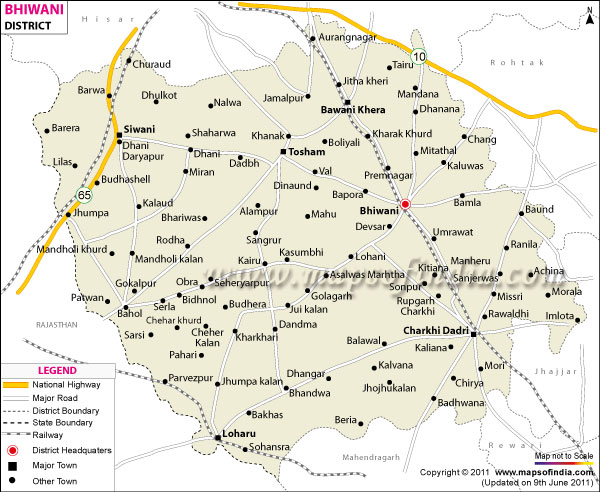
| *Bhiwani District map showing National highways, district headquarter, roads, towns, etc. |
About
The district has an area of 4777 km² with semi-arid climate. The land is largely level, dotted with local rocks, particularly in the several areas around the Tosham Hills. Since early history, agriculture, availability of water resources and livestock operations have been fundamental to the prosperous economy and settlement pattern. The district has gradually improved in connection through roads, schools, colleges, etc., which have made it a primary educational hub in the region. The major cities in the Bhiwani district which are beneficial for the district economy and society, can also be identified on the Bhiwani district map such as Loharu, Tosham, Siwani and Bawani Khera.
Bhiwani is known not only due to its boxing achievement but also because of all other achievements. The district is the birthplace of several internationally recognized boxers who have made the state and the country proud. Apart from sports, Bhiwani is also famous for traditional culture of Haryana, Historical temples, Educational development. Special features of the district are its rural tradition and slow urbanization to the modern era which makes the district an interesting example to Haryana's transformation in the modern era.
History and Culture
Bhiwani's origin and history can be traced around many centuries, and has been moulded by the cultural experiences of the larger region of Haryana. The area has been for the past many centuries governed by some Rajput rulers and then by the Mughals and lastly by local chieftains too. During the Middle Ages, the area was a commercial route and settlements and markets developed there. Other politics occurred in the district during the British colonial period when district political machinations were impacted by administrative changes in the late 18th and 19th century. The Bhiwani district map is also highly sought-after for historians and researchers exploring the heritage and history of the district and people of the Bhiwani district for its use in understanding Bhiwani's historical path and relationships in trade and migration.
Bhiwani also have a significant contribution in freedom movement of India. Many nationalists and citizens conducted activities related to the nationalist movement in many Levels. Bhiwani has been the top one of all districts in India since the Independence of India and Haryana's establishment in 1966. As the years went by portions of the Bhiwani district were shifted to Charkhi Dadri district, leaving Bhiwani being of historical and administrative significance. The Bhiwani district map remains applicable to the assessment of changes like administrative changes and territorial boundary.
Bhiwani has strong cultural values which follow the traditions of Haryana. Folklore is the integral part of daily life in the village – including the music and dance aspects – that continue to play a major role in social life. Traditional arts such as the "Ragini" singing are popular in the villages as well as in the fairs. Festivals, such as Holi, Diwali, Teej, Gangaur and Makar Sankranti are celebrated with enthusiasm both in urban and rural areas alike.
Haryanvi is the main language of the district with Hindi being widely spoken in the district for administrative and teaching purposes. The food is called local cuisine which is cuisine of the agricultural lifestyle such as bajra roti, churma, kheer and local dairy products. The educational institutions and sports academies have also enhanced Bhiwani's reputation as a hub for sports excellence in Haryana.
Economy
It is a predominantly agricultural economy with mining, public administration and trade and service activities as prominent features for Bhiwani district. Agriculture still plays a leading role and has crops like wheat, mustard, bajra, cotton and gram to a larger extent. In addition to this, cattle keeping plays a major role in improving the income of the households in villages. Modern agricultural equipment, irrigation system and government support schemes are increasingly relied by the farmers. The Bhiwani district map is generally utilized by agri-planning and workers to learn the areas for irrigation, transportation routes and rural development.
The government sector has a significant contribution to the economy of the district. Thousands of people reside here and work in administrative offices, schools, hospitals, and the police. Government schools, colleges and rural welfare schemes play a role in contributing to the social and economic development. Several sections of the district are now more connected and have better living conditions, thanks to the improvement of public infrastructure, including roads, water supply networks and electricity networks. The district map of Bhiwani is used often for infrastructure expansion and administration of Bhiwani district by the development agencies.
The public sector also plays a role, such as in providing transport services, banking facilities and agricultural extension programmes. Co-operative societies help farmers in getting seeds, fertilisers and agricultural loans. Public health institutions and rural employment schemes provide benefits for rural communities and contribute to income generation. Mining activity in the surroundings of Tosham Hills region has also contributed in the economic framework of the district, mainly in extract of stone and minerals.
The service sector grew consistently over the past few years. Increasing number of hospitals, financial institutions, transportation, retail shops, educational coaching centres and healthcare services have sprung up, particularly in big cities like Bhiwani city and Loharu. There are also some small scale industries in the district such as metal works, textile, food processing and agricultural tool works etc. Agricultural products and household goods are still the focal point of the local markets.
With its reputation for sports prowess, particularly boxing, there has been the development of extra economic opportunities through sports training centres. Numerous young athletes have professional coaching and compete nationally from the district. There are also some other businesses involved with tourism, hospitality and transport, which add a small amount to the district economy.
Tourism
Historical, cultural and natural sites of Bhiwani district are quite interesting for tourists, history lovers and pilgrims. Bhiwani district map is used by visitors to the area to help them understand the importance of the religious sites, hills, lakes and heritage sites located throughout the district.
The most interesting place to see is the area of Tosham Hills that features old rocks and religious values. Excavations reveal human use of the area which dates to many hundreds of years ago. The hills are popular with trekkers, pilgrims and visitors to learn about the geology, history or the origins of the soils. The surrounding area offers also scenic landscapes and nature photographing. Travellers often use the Bhiwani district map that helps them to navigate on a route towards the Tosham region and associated villages.
Another popular place of Bhiwani where it remembers the bravery of the local soldiers who lost their lives in the First World War is the Star Monument in Bhiwani city. The building has character to it as a whole from the Colonial period and is an important site of interest as a heritage monument. Devotees also flock to religious tourist places like Devsar Dham temple and religious places in the villages all year round. The pilgrims try to identify these temples with Bhiwani area map to find facilities nearby.
The district also has a reputation for its sporting history. Boxing academies and training centres in Bhiwani are well-known across the country as many Indian boxer come from here for participating in International Boxing competitions. Popular destinations are for the sports lovers to get an insight into the contribution the district make to Indian athletics.
Demographics
According to the data of Census 2011 the population of Bhiwani district was 1,634,445 people. The overall literacy rate was about 75.21 per cent obtained in the district showing mild enhancement in the education of the people in the past years. The density of population was nearly 342 persons per km². The Bhiwani district map is a most crucial map for demographers or those having administrative roles to analyze the district in rural and urban areas so as to know the distribution pattern of the population in both rural and urban areas of the district.
The district is predominantly rural, with steadily increasing urban population in Bhiwani city, and Loharu. The official language of administration and education is Hindi and daily language/haryanvi is widely spoken. Due to cultural interaction with the neighbouring area, Punjabi and other area languages are also understood in some areas. The Bhiwani district map is useful for the government to track population growth and help design schemes with welfare activities, and to enhance the infrastructure of the region.
Progress has been made, albeit small, in the development of the educational facilities of the district, such as Government schools, colleges and Technical institutions. The social life or activities of the district is still closely tied to the village community, agricultural activities and traditional practices.
Administration
The district is administrative divided into seven tehsils and sub-division in order to impart good Governance. Some important tehsils are Bhiwani, Loharu, Tosham, Siwani, Bawani Khera and Bahal. These are offices that are engaged in administration, coordination of land records, revenue collection, rural development and local governance. The Bhiwani district map is beneficial to officials and planners for coordinating and executing development projects, transport infrastructure and public administration in the specific context of the tehsils in the Bhiwani district.
It has hundreds of villages as its bases of rural economy and social system. The major activities of the village are such as agriculture, animal husbandry and domestic commerce. Panchayati Raj institutions is playing a significant role in executing welfare programmes and administration of villages. The main reason that the Bhiwani district map is used extensively for administrative planning is in its ability to clearly map the boundaries of villages, transport infrastructure and public facilities.
Bhiwani district has a wide infrastructure of roads and railways with communication link with big cities of the state of Haryana and neighbouring Rajasthan. In the district the administrative offices, police stations, health institutions and educational establishments are spread around to provide access for the public to vital services. A renewed emphasis on infrastructure and governance has built up the region, promoting better living standards both in urban and rural communities.
| Facts of Bhiwani District | |
|---|---|
| State | Haryana |
| District | Bhiwani |
| District HQ | Bhiwani |
| Population (2011) | 1634445 |
| Growth | 14.70% |
| Sex Ratio | 886 |
| Literacy | 75.21 |
| Area (km2) | 5140 |
| Density (/km2) | 341 |
| Tehsils | Badhra, Bawani Khera, Bhiwani, Dadri, Loharu, Siwani, Tosham |
| Lok Sabha Constituencies | Hisar, Bhiwani-Mahendragarh |
| Assembly Constituencies | Loharu, Badhra, Dadri, Bhiwani, Tosham, Bawani Khera (SC) |
| Languages | Hindi, Haryanvi including Bagri |
| Rivers | ----- |
| Lat-Long | 28.796546,75.990829 |
| Travel Destinations | Sri Hari Har temple, Jain temple, Maa Durga temple, Jogi Wala Mandir, Star Temple, Shree Shyam Mandir etc. |
| Government Colleges/Universities | Adrash PG College (for Girls), Bansilal Govt. Girl College, Govt. College, Govt. College (Baund), Govt. College (Bawani Khera), Govt. Girls College (Bhiwani), Govt. Post Graduate College (Loharu), Govt. Polytechnic (Loharu), Kirori Mal B.Ed. College (Bhiwani), Vaish PG College (Bhiwani), B.R.C.M.College of Engineering, Behal (Bhiwani), Bhiwani Institute of Technology & Science, J.V.M.G.G.R.Inst. of Computer Application, Kidar Nath Aggarwal Institute Of management etc. |
FAQs
Q1: How many villages are there in the district?
Bhiwani district has more than 400 villages.
Q2: What is the population of the district?
The population of Bhiwani district is approximately 1.63 million.
Q3: What is this district famous for?
Bhiwani district is famous for boxing, agriculture and Haryanvi culture.
Last Updated on : June 11, 2026
