

|
||||||||||
| ||||||||||
|





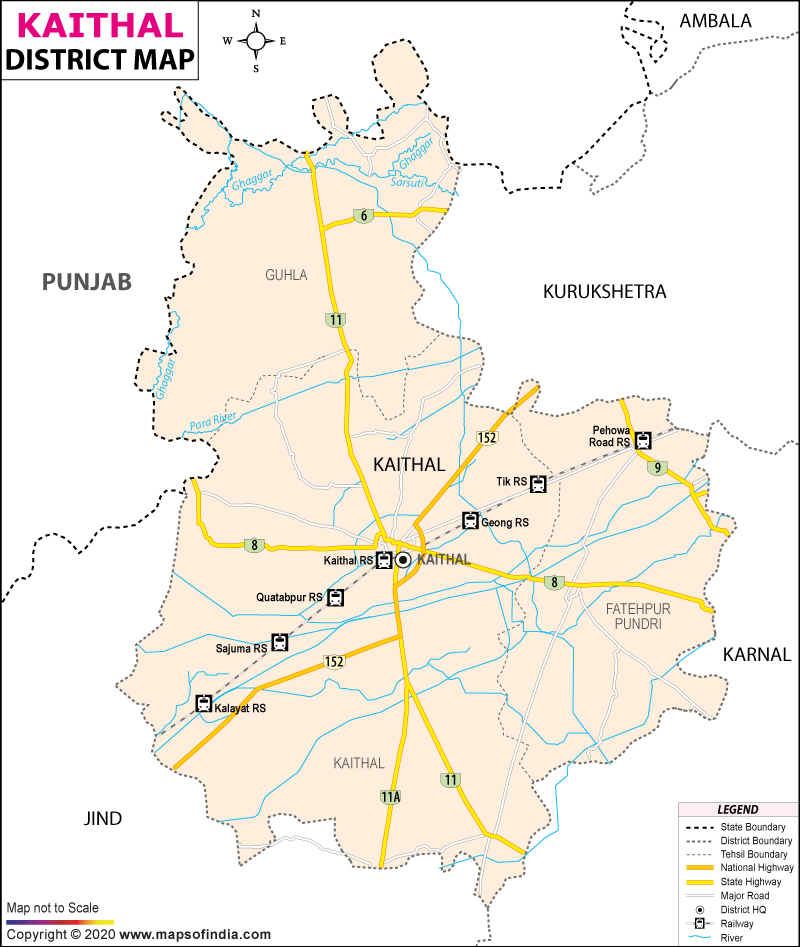
| *Kaithal District map showing National highways, district headquarter, roads, towns, etc. |
About
Deep in northwest Haryana lies Kaithal, a stretch of land shaped by old tales, forgotten kingdoms, yet alive with fields that feed today. Touching Punjab, it sits between places such as Kurukshetra and Karnal - more than mere geography. Here, even quiet corners speak through crumbling walls, still water reflecting skies older than memory. Hidden in the quiet corner of northwest Haryana lies a town breathing its past like morning air. This is Kaithal - where old stories walk through streets instead of staying buried in pages. Walk these streets, then pause - beneath honking cars lies something older. Before sunrise, hands already move across the soil - families tilling what history forgets but feeds us still. Not kings or legends pulse here, just farmers bending into rhythms older than stone. Fields stretch wide, swapping gold for green as monsoon breathes life back in. Each harvest grows not just rice or wheat, but continuity, quiet and unboastful. This land lives because they return to it, day after day.
History & Culture
Should the roads of Kaithal speak, their words might skip mere textbook entries - instead unfolding a long, vivid tale stretching across ages. Out of misty legends it emerges - the place once called Kapisthila, meaning home to monkeys in Sanskrit. For people here, this soil carries weight, tied to the arrival of Lord Hanuman . Years later, under medieval rule, Kaithal shifted from a forgotten legend to a key crossroads. During the Delhi Sultanate, religious teachers and mystics made it an intellectual hotspot. Yet nothing matched what unfolded in 1240 - the year tension peaked sharply. Escaping revolt, Razia Sultan moved fast through the region, unmatched in courage, breaking norms as the sole woman on Delhi's throne. Out of breath, surrounded by enemies, the last clash came on Kaithal’s dusty ground - there, life slipped away. Now, a small grave rests between houses nearby, unmarked yet steady, holding memory of one who once led with fire.
Economy
Its strength spreads into shifting service roles, supported widely by stable government jobs. Resilience emerges quietly here - rooted not in skyscrapers but in fields, offices, and civic posts that hold daily life together. Among its foundations lies a trio of central components shaping the local economy. One part ties closely to service industries, supporting many jobs across towns. Another draws strength from manufacturing activities spread through industrial zones. A third finds footing in agriculture, especially on lands beyond urban edges
The Government and Public Sectors
Among locals, government roles stand out - offering predictable pay, long-term stability, not just a path but a framework for professional development. These positions anchor the area's economic flow, shaping how money moves through households month after month. Thousands work here because it serves as a key administrative center. Jobs come via the Haryana Public Service Commission along with Staff Selection channels. People find positions across the District Administration, Civil Courts, and the Revenue Department - commonly known as Patwaris. Safety services also offer employment, like those within Haryana Police forces. Among state-run jobs, power distribution stands out through Dakshin Haryana Bijli Vitran Nigam (DHBVN). Electricity services operate under its authority across southern Haryana. The Public Works Department manages construction and maintenance tasks throughout the region. Local governance finds expression via urban bodies in towns like Kaithal. Cheeka also hosts a municipal council overseeing civic matters locally. Kalayat is another such town where administrative functions are carried out at city level.
The Services and Emerging Sectors
With farm-based riches moving toward younger heirs, Kaithal’s towns are seeing sharp growth in service industries. This shift has turned the area from a rural economy into one shaped by rising local demand. Because farm earnings have risen, shops now fill streets at an extraordinary pace. Inside central market zones, phones, clothes, and vehicles dominate space - particularly motorcycles alongside large tools such as tractors and harvesters. Where once only small stalls stood, showrooms now stretch across wide plots. Electronics blink beside fabric rows, drawing crowds daily. Tractor suppliers sit near clothing racks, forming odd but busy pairings. Money from crops flows into shopping lanes, reshaping how towns look. New dealers appear each season, drawn by steady cash from farmland profits. Farm-linked logistics thrive where private fleets, storage hubs, refrigerated units, alongside chemical suppliers align locally. Movement across fields to markets gains reliability when these pieces connect beyond central oversight.
Tourism
Historical and Royal Sites
Rising slightly above narrow lanes, the tomb marks where power once wore a woman’s face. Not far from daily market bustle rests this unassuming structure - built of weathered brick, holding centuries without drama. Her reign ended abruptly in 1240; memory lingers slower than stone erosion here. Forgotten by many, it stands apart from grand monuments meant to impress. Instead, quiet persistence tells its story - one of defiance shaped into architecture.
Spiritual and Religious Landmarks
Perched within the quiet lanes of Kalayat lies a cluster of stepped brick shrines from the 700s, honoring Lord Shiva. Their tiered forms rise subtly, shaped by skilled hands long ago. Ornate patterns pressed into fired clay catch light differently each hour. Believed to be where Lord Hanuman first drew breath, it honors his mother, Mata Anjani. Temples nearby hum with activity, yet keep an air of calm persistence. A spot touched by time - this old shrine stands where Guru Tegh Bahadur, the ninth Sikh leader, once rested and prayed. Beneath a leafy neem tree his presence lingers, villagers say its foliage holds cures. Faith grows thick here, fed by stories passed through years.
Demographics
Rooted in custom, Kaithal's people live close together, shaped by long-held ways. Yet slowly, learning spreads through homes and streets. Change moves quietly alongside old rhythms. Education grows without breaking ties to land and lineage. Life here shifts - step by step - not in leaps. Tradition holds firm even as classrooms rise.
Some 144,915 people live in Kaithal district, based on government2011 census data. Out of which , 76,794 were males and 68,121 were females. One hundred thousand nine hundred forty-four people could read and write in Kaithal, making up nearly seventy percent of its residents - males at seventy-five point three percent, females at sixty-three point three. Largely shaped by village life, the region counts nearly 80.6% of its residents in rural settlements. Towns hold a smaller share - about 19.4%. Growth appears slowly across these urban pockets.
Across the district, 70.6 percent of people can read and write. Urban areas perform better - reaching about 77.9 percent - but rural schools are gaining ground fast. More males than females complete basic education, with their rates at nearly 78.0 versus 59.2. Because of this difference, government-supported programs now target schooling access for girls throughout the region.
Most people in Kaithal speak Haryanvi every day - over 61% rely on it, shaping much of the area's lively culture. Though not everyone uses it formally, it remains central to daily life. For government work and business settings, Hindi takes precedence; around 26.5% use it regularly. Because the district sits close to Punjab, Punjabi has also taken root, particularly in places such as Guhla-Cheeka up north, where roughly 10.4% converse in it. Language patterns here shift subtly across neighborhoods, reflecting layered influences.
Administration
Structured administrative units form the backbone of Kaithal's organization, enabling orderly infrastructure growth. Governance flows more easily when responsibilities are clearly mapped across divisions. Public services reach residents through carefully arranged frameworks that support consistency. Each unit functions under a broader plan meant to maintain balance. Clarity emerges where planning meets execution on the ground. Located within the broader Karnal Division, administration here runs through the District Magistrate - also known as Deputy Commissioner - who guides operations across sub-divisions, tehsils, and numerous grassroots-level village councils.
Centered on local needs, they support both city populations and countryside communities. Their structure reflects practical organization rather than theoretical design Centered within the region, Kaithal serves as the main hub for governance and oversight . Guhla lies in the northwest, sharing a boundary with Punjab
Villages
Most of Kaithal's daily life unfolds beyond city limits. Across the district, 278 villages each align with a single revenue unit. Administration splits these into seven zones for better oversight. Water access, farm support, and job initiatives are handled block by block. Organization at this level shapes how services reach residents.
| Official Name | Kaithal |
| Location | Haryana |
| Area | 2317 sq. km |
| Population | 144,915 (2011 census) |
| Language | Hindi, English, Haryanvi |
FAQs
Q1: How many villages are located in Kaithal district altogether?
Exactly 278 revenue villages make up Kaithal district, each falling within one of 278 Gram Panchayats spread across seven community development blocks.
Q2: What is the total Population of Kaithal District?
Some 144,915 people live in Kaithal district, based on official 2011 Census figures. Most - around 80.6 percent - dwell across its fertile countryside where farming shapes daily life.
Q3: What are famous Aspects of Kaithal District?
Home to vast fields of fragrant Basmati, Kaithal earns its nickname as Haryana’s rice heartland through thriving grain trade at local Anaj Mandis. Not far from these market hubs lies a deeper legacy - stories claim this land once bore the name Kapisthala, where Lord Hanuman first appeared. Stone temples made of baked brick rise quietly near the town, built long before the 800s during an era few recall clearly. Among them stands another relic: the resting place of Razia Sultan, Delhi’s sole woman sovereign, laid to rest here after her rule ended in the 1200s.
Last Updated on : July 17, 2026
