

|
||||||||||
| ||||||||||
|





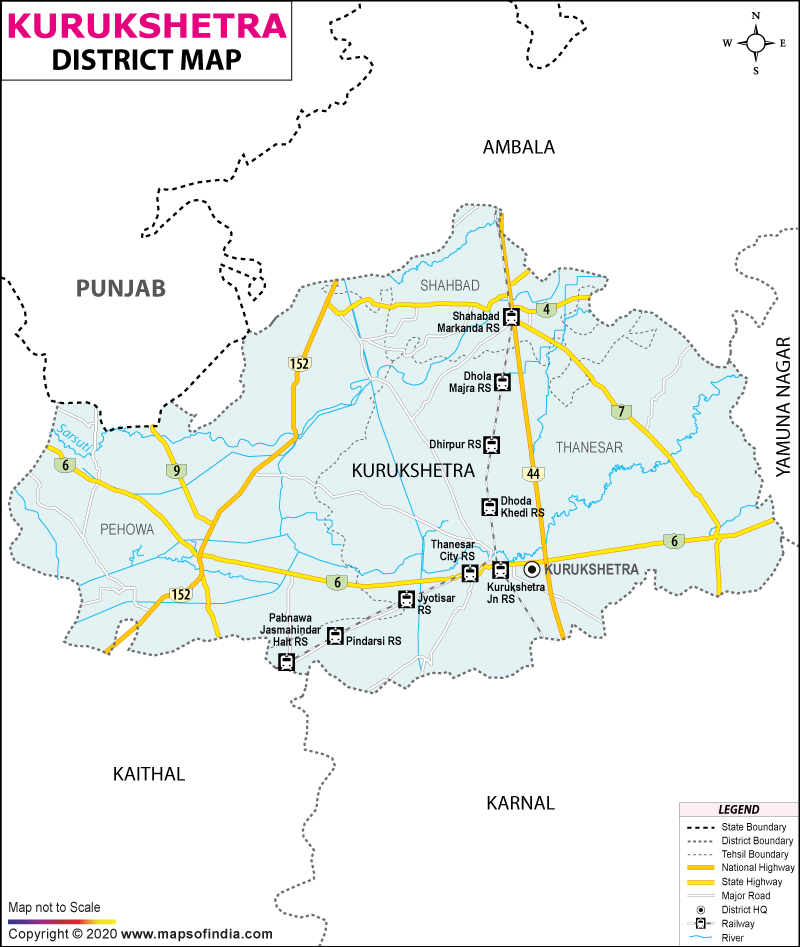
| *Kurukshetra District map showing National highways, district headquarter, roads, towns, etc. |
About
Among ancient sites, Kurukshetra stands apart - not merely for soil or stone, but for stories shaped by choice and consequence. Its name draws breath from King Kuru, said to have fasted beneath bare skies, seeking virtue's strength where fields now stretch wide. Though centuries pass, the ground remembers conflict - brother against brother - the moment thunder fell silent before wisdom rose. Here, under that same sky, words later called the Bhagavad Gita first stirred into speech. Not temple nor monument gives it weight; instead, memory does - carried through generations like an unbroken flame.
History & Culture
Long before recorded empires rose, people already lived where Kurukshetra now stands. Early Vedic texts speak of the Bharatas and Purus calling this land home, later merging into what became the Kuru state. Far beneath today's surface, buried layers tell silent stories through fragments pulled from earth - discoveries made during digs by India’s archaeological team.Beneath the soil of Harsh-ka-Tila close to Thanesar, time folds into itself through stacked remains of past lives. Deep within, fragments of fine Painted Grey Ware first appear, slowly shifting toward sturdier objects shaped during Kushana rule. Rising higher, traces emerge of elegant craftsmanship typical of Gupta times, followed by built foundations left behind under Vardhana leadership. One after another, these levels connect across centuries without break. Most days bring meals built around plants, using what grows nearby. Bajra flatbreads - dense, warm - form the base, often paired with whatever greens are ready for harvest. Ghee appears regularly, made just hours before eating, rich and golden. Yogurt rests in clay containers, cool and firm, shaped by age-old methods. Each serving carries traces of routine rooted in soil and season.
Economy
Though rooted in farming, Kurukshetra now leans steadily into services. Fields stretch wide across the Trans-Gangetic plains, fed by canals that run deep through fertile ground. Because of rich alluvial deposits, harvests here fill much of the state's storage. Growth shifts slowly, yet clearly, beyond crops toward broader economic roles.
Government Sector
Stability in jobs, city planning, and governance often flows from how the public sector operates. District offices lead staffing needs, followed by urban governing bodies, law enforcement units, health centers funded publicly. Then come large educational institutions backed fully or partly by state budgets: consider Kurukshetra University, NIT Kurukshetra, NID - all adding weight through salaries paid into household incomes nearby. These payrolls do more than support workers - they sustain spending patterns across neighborhoods over time.
Public Sector
Most public companies run services like farming aid, storage, or utility systems.Power supply flows smoothly thanks to operations led by UHBVN in northern areas. Transport needs rely heavily on Haryana Roadways, whose main hub supports many jobs through daily transit work.
Services Sector
Nowhere more than in Kurukshetra does the services economy grow faster within today’s marketplace. Fueled by constant flows of pilgrims and visitors drawn to heritage sites, lodging options span everything from guesthouses to eateries across town.
Tourism
Among dusty paths and still lakes, Kurukshetra holds temples old enough to whisper alongside glass-walled museums. Not just faith moves through these streets - curiosity does too, slipping into rooms where history wears new light. Where epic tales once echoed, now hushed corners wait, built not for crowds but slow thought. One moment you face a relic older than memory; the next, an open plaza asks nothing at all.
Brahma Sarovar
Legend says its creation began with Lord Brahma shaping the basin by divine act. During solar eclipses, people gather in large numbers - drawn by belief that washing in its clear water removes deep-seated flaws. Along its edges run smooth concrete steps down to the surface, joined by curving footbridges overhead. At its heart rises the Sri Sarveshwar Mahadev Temple, glowing vividly when oil lamps rise each dusk amid chanting rituals.
Jyotisar
Just off Pehowa Road, five kilometers from Thanesar, lies Jyotisar - believed to be where Krishna shared the Bhagavad Gita’s teachings with Arjuna ahead of battle. At its heart grows an ancient banyan, known as Akshay Vat, rooted long before memory. This tree remains standing through ages, said to have silently observed the divine exchange. Now, visitors find a sculpted marble chariot resting there, placed deliberately among stone pathways. In the evenings, beams of colored light rise above, unfolding the tale through sound and image across the darkening air.
Sthaneshwar Mahadev Temple
Deep in Thanesar stands an old shrine honoring Lord Shiva. There, the Pandavas sought his favor - granted before their battle in the Mahabharata. Healing powers have long been tied to the temple's water body. Ancient tales tell how just a splash freed King Vena from crippling leprosy.
Modern Educational Exhibits
A two-level space where old stories meet new discoveries stands out through its design. Inside, a tall round room draws attention immediately - filled with detailed three-dimensional figures showing scenes from an 18-day battle of the Mahabharata. Sound wraps around listeners, sharp and deep, pulling them into each moment. History moves here, not just on walls, but through light, form, and voice. This place does not separate past wisdom from present knowledge - it connects them quietly, without fuss. Among the stars she once studied, Kalpana Chawla is remembered through a planetarium bearing her name. Though rooted in tribute, its purpose stretches beyond memory into education. Instead of static displays, visitors encounter moving images of distant galaxies alongside hands-on experiments in motion and force. Because curiosity drives learning, the space emphasizes experience over lecture. While focused on youth, its lessons remain open to all who enter.
Demographics
A closer look at Kurukshetra shows people grouped in structured patterns, shaped by education levels and strong countryside roots. While cities grow slowly, most still live where farming shapes daily life. Learning matters here - schools and colleges mark many lives across generations. Rural identity remains central, even as new jobs emerge beyond agriculture. Based on the 2011 demographic records, Kurukshetra district is home to 964655, residents, a population size that roughly mirrors the nation of Fiji or the state of Montana. On a national scale, it occupies a middle-tier position, ranking 452nd out of India's 640 districts. Every square kilometer holds about 630 people, making the area highly populated. Dense settlement patterns shape daily life across the region. During the decade between 2001 and 2011, numbers rose steadily - growth reached 16.81%. This climb marked a clear pattern of increase throughout the years.
For each thousand males, only 889 females are recorded in the area's population data. Though numbers shift across regions, here the gap stands clear. Females make up a smaller share than expected when compared to males. This imbalance appears consistently within current demographic records. While some places near equilibrium, this one leans male. Numbers suggest fewer women reside here relative to men. The difference shows plainly in recent counts. Not every location mirrors this pattern - this does. Most people in the district can read, with literacy standing at 76.7%. This figure reflects broad availability of schools and learning materials throughout varied local populations.
Languages Spoken
Traveling between neighborhoods reveals slight changes in how people speak. Though Hindi dominates in classrooms and administrative buildings, other local forms of speech remain common. Where one dialect fades out, another often slips in without notice. Official signs appear in Hindi, yet conversations on street corners follow different patterns. Across market lanes, voices blend into a layered soundscape shaped by history and movement. In daily life, multiple ways of speaking occupy space without conflict.
Administration
Splitting the area helps handle duties more smoothly. Four parts take charge of daily operations. Each section runs its own revenue work. Tasks spread out this way stay organized . Buried in the heart of Thanesar lies a hub where governance meets paperwork. Here, district offices rise without fanfare, managing records and decisions alike. Administration unfolds quietly behind unmarked gates. This is where ledgers stack high under dim lights. Routine pulses through corridors lined with files. Authority rests not on show but function. Officials move between desks like tides - steady, unseen. Pehowa sits westward, a place of old spiritual importance along with administrative role. Its history runs deep, yet it functions today as part of the region's economic framework. Not just temples mark its identity - land records and local governance tie into its present duties. Its reputation grows from production lines as much as playing fields. Not just machinery shapes its name - athletic history runs deep here too. Two smaller administrative units, Babain and Ismailabad, back up the main tehsils. Positioned deliberately, they help extend local oversight. Across the countryside, authority flows through seven Community Development Blocks - Thanesar, Shahabad, Pehowa, Ladwa, Ismailabad, Babain, and Pipli. Each block guides progress at ground level. These blocks jointly supervise 404 Gram Panchayats. Villages receive attention via this layered structure. Governance reaches farthest points by design.
| Official Name | Kurukshetra |
| Location | Haryana |
| Area | 1,530 sq. km |
| Population | 964,655 (2011 census) |
| Language | Hindi, Punjabi, Haryanvi |
FAQs
Q1: How many villages are located within the Kurukshetra district?
Kurukshetra district includes 483 villages. Their arrangement follows a decentralized pattern shaped by administrative needs. Each block hosts a share of these village councils, aligning governance with regional distribution. From one end to another, rural management relies on this network of elected bodies. Organizationally, the system reflects long-standing community-based frameworks.
Q2: How many people live in Kurukshetra district altogether?
Some 964,655 people live in Kurukshetra district, based on official Census records. Of these, males make up 510,976 while females number 453,679. Spread across the area, that works out to about 630 persons in each square kilometer. The distribution appears fairly even when viewed regionally.
Q3: What is the Kurukshetra district famous for?
Besides being honored as the ancient battleground of the Mahabharata conflict, Kurukshetra is a major centre of faith . In addition to its rich Hindu legacy and ancient temples , area also has striking features of Mughal monuments .
Last Updated on : July 10, 2026
