

|
||||||||||
| ||||||||||
|





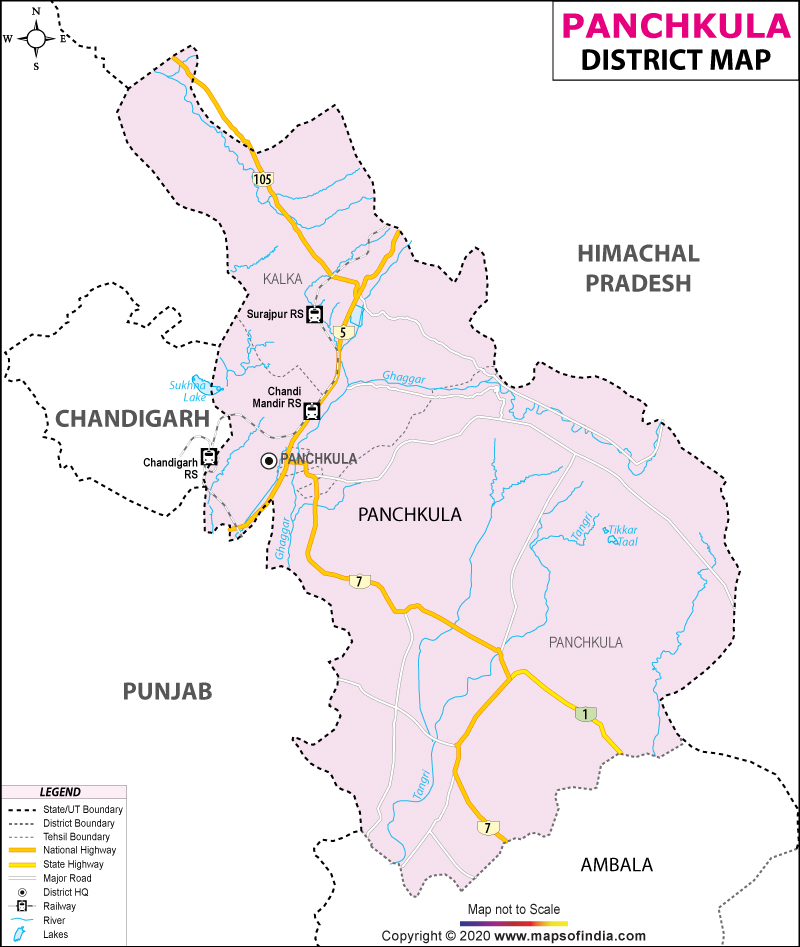
| *Panchkula District map showing National highways, district headquarter, roads, towns, etc. |
About
Panchkula district is an important part of the Chandigarh Tricity region along the two cities of Chandigarh and Mohali, and is well planned and fast growing in Haryana. The district is sited in the north-eastern part of Haryana State and is surrounded by the State of Himachal Pradesh, Ambala district, Yamunanagar and Punjab in the neighboring districts. Administration of the state and development of planning, the city's serene surroundings and a rise in its economic significance. Panchkula district map is a commonly used tool by students, travellers or researchers to know the geographical location, transport facilities and settlement pattern within the district.
The total area of panchkula is approximately 898 square kilometres which includes urban habitation, the rural villages, forests, and tourist destinations. The topography of the district is a gradient of plain areas increasing towards the Morni Hills. Several temporary waterfalls and Ghaggar river affect the topography and farming crops of the region. The district of Panchkula is regarded as having one of the cleanest and best planned districts and has seen a tremendous infrastructural development in the past few decades.
The district got its name from “Panch-Kul” denoting the five irrigation channels that used to run through the region. In pursuant of better administration and development of the region, Panchkula was bifurcated from Ambala district in 1995 to become a separate District. Since then it has developed itself into one of most developed and urbanised district of Haryana. Due to strategic location near Shivalik Hills and connectivity of Panchkula district with the Northern Indian states.
History & Culture
Panchkula historical background is quite related to the trade routes of ancient Indus civilisations of the region. Knowing about the impact on this land of several Dynasties that ruled over it for centuries such as Mauryas, Guptas, Rajputs and then to Mughals. During the medieval period a few trade routes were established there, which linked the Punjab region with the areas of the Himalayas. Historian and research scholars are using the Panchkula district map to study Historical settlements and the ancient paths in the district.
The area was a part of Ambala administrative division under the British rule. Panchkula slowly emerged as a planned urbanisation, after the Independence of India (1947) followed by the creation of Haryana (1966), added to Chandigarh. In the formation of government offices and residential apartment complexes, the district turned into a central administration and residential district area. The Panchkula district map was proving to be useful for urban development projects for urban planners and for the development authorities in the city because of its quick growth in the number of people and infrastructure development plans.
Geographically located near the borders of various states, culturally Panchkula's reflects much of the Haryanvi, Punjabi and Himachali culture. The district celebrates several festivals with great enthusiasm like Diwali Festival, Holi Festival, Baisakhi Festival, Navratri Festival and Teej Festival. Divine harmony is noticed in the presence of temples, gurudwaras and shrines in urban and rural areas. The district has a number of places of worship in which thousands of devotees visit each year and are of considerable importance to the district's spiritual life, Mansa Devi Temple.
Modern urban and education have also given an impact on Panchkula in a considerable measure. The district has well known educational institutions, colleges and schools which are an educational hub of the surrounding areas. In urban districts, cultural events, exhibitions and recreational activities are found, providing linkage with traditional heritage, and supporting the contemporary life.
Economy
The economy of Panchkula district is diversified and is growing at a steady rate with the support of Administration, Trade, Tourism, Agriculture and Services. The district is well connected with urban infrastructure and investment opportunities with Chandigarh. The Panchkula district map is often utilized in planning industrial corridors, transport projects and urban development schemes all over the Panchkula region.
The government sector is an important contributor to the economy of the district. There are a number of Haryana Government departments, Administrative offices and Public Institutions in Panchkula. There's a significant proportion of the population with stable income through government administration as well as policing, education and public services. The city's development of its city center has also spurred residential and commercial development in the city due to the presence of state offices.
The public sector makes an active contribution via utilities and infrastructure/public development agencies. There are a wide number of organisations connected with power supply, irrigation, health and urban development that are active in the district. Significant investment of roads, housing colonies, water supply, and transport facilities have been done over a wide area in Panchkula. The Panchkula district map is just as important when looking at expansion projects or civic infrastructure, and is examined by analysts and planners regularly.
The district's economy is essentially based on the service sector. Several large sectors of the urban population are employed by the banking sector, information technology services, education, healthcare, hospitality and retail. The last two decades have seen a significant increase in the size of shopping complexes, educational institutions and private hospitals. Infrastructure and connectivity between the Chandigarh metropolitan area and Panchkula has improved the commercial opportunities as well as professional opportunities for the residents.
In rural areas of the district agriculture is still significant particularly in Barwala, Raipur Rani and Morni. Wheat, rice, maize, mustard and vegetables are grown as per the climatic conditions and irrigation facilities of the farmer. In addition to agriculture, horticulture and dairy farming contribute to rural livelihoods. There are a number of places where seasonal rivers and fertile plains are helping agricultural productivity.
Tourism
The District of Panchkula is famous for its amazing natural beauty, religious sites and planned urban attractions. The Panchkula district map is frequently used by tourists to explore the district, especially the rough and tumble sites.
The Mansa Devi Temple is one of the most popular tourist locations that is a popular Hindu pilgrimage site dedicated to Goddess Mansa Devi. During Navratri's, the temple is visited by thousands of devotees. The temple complex is also a convenient place to take in the panoramic views of the surrounding area, and makes an important spiritual hub in northern India.
Apart from this, there is another of the tourist attraction - Pinjore Gardens, or popularly known as Yadavindra Gardens. The gardens' architecture is in that of the Mughal, with terraces, fountains, pavilions and well laid out lawns. Here, every year, a mango-festival and other cultural programmes are conducted here which attracts people from various states. The Panchkula district map can be used as a tourist ride map of the activity points in and around Pinjore.
Nada Sahib Gurudwara is one of the important gurdwaras of Sikhism which is located on the banks of Ghaggar River and is related to it with Guru Gobind Singh. It is a significant religious center, with its tranquil atmosphere and religious significance. Some of the other important places are Kaushalya Dam, Cactus Garden, Gurudwara Nada Sahib, Tikkar Taal and Bhima Devi Temple Complex.
Demographics
Based on Census report 2011, there are around 561,293 people in Panchkula district but after urbanisation and migration it is believed to be much large. During studies regarding the district the Panchkula district map is mostly used to analyse the pattern of urban growth and rural settlement distribution within the study area.
The literacy rate of Panchkula district, at around 81.88 per cent (based on census figures) is one of the highest in Haryana. High educational attainment is found in urban areas as it has reputed schools, colleges and professional institutions. Government organisations also conduct studies for educational planning and resource allocation for the Panchkula district map.
The major language spoken in the district is Hindi and the other major language which is used in day to day communication is Punjabi and Haryanvi. Because of its close proximity to the states of Punjab and Himachal Pradesh, the linguistic diversity can be seen to be rampant in all parts of the district. The most commonly-used language in an educational institution, government agency and business is English.
Due to its relationship to Chandigarh Metropolitan Region the district has been witnessing a consistent urbanisation trend. The improved facilities, availability of job and better standard of life in the neighboring states has attracted migrants. Rural communities continue to have their cultural lifestyles, but are being impacted gradually by urban centers.
Administration
The district administration under the deputy commissioner administers Panchkula district. The district is a part of the Government of Haryana and has a number of administrative subdivisions for ease of administration. Various developmental projects, public welfare schemes and activity plans for the transportation infrastructure are planned in the Panchkula district on the basis of this Panchkula district map.
The tehsils of Panchkula and Kalka are the main part of the district and the administrative subdivisions and blocks of Barwala, Morni, Pinjore and Raipur Rani also have significant roles in the governance of the district. The urban administration and action are handled by municipal bodies and the rural administration and development activities are handled by the village panchayats.
Based on different administrative records and village database, there is more than 150 villages in the district. The rural settlements are clustered particularly in Barwala, Raipur Rani and Morni areas. The Panchkula district map facilitates the village level monitoring of village connectivity, along with land use, land infrastructural needs in the villages.
Panchkula city is the headquarters of district and important administrative offices and courts are also located in the city. The district has very good road connectivity with the other national and state highways setup in the district which connects with Chandigarh, Ambala, Shimla and Delhi. Railway facilities to and from Kalka and around Chandigarh add an added mileage to the ease of transportation and administration.
FAQs
Q1: How many villages are there in Panchkula district?
Panchkula district has more than 150 villages.
Q2: What is the population of Panchkula district?
Panchkula district had a population of around 561,293 according to Census 2011.
Q3: What is Panchkula district famous for?
Panchkula district is famous for Morni Hills, Mansa Devi Temple and Pinjore Gardens.
Last Updated on : July 17, 2026
