

|
||||||||||
| ||||||||||
|





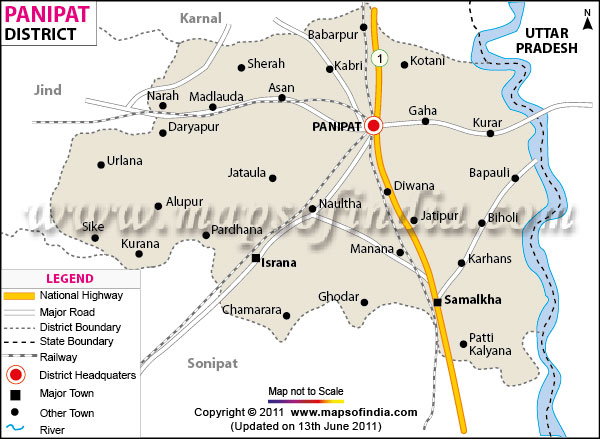
| *Panipat District map showing National highways, district headquarter, roads, towns, etc. |
About
Known as the "City of Weavers" and sometimes called India's Textile City, Panipat holds deep roots in Haryana’s past while playing a strong role in its present economy. About 90 kilometers from New Delhi - and nearly 169 from Chandigarh - it sits across rich farmland in northern India. Along what used to be Sher Shah Suri Marg, today NH-44, it runs close to the eastern edge where the Yamuna River forms a border between Haryana and Uttar Pradesh. On its sides lie neighboring areas: Karnal up north, Jind toward the west, Sonipat below to the south. While geography shapes part of its identity, history weaves through too - its name likely stems from 'Panprastha,' mentioned long ago in the Mahabharata as one among five key towns requested by the Pandavas before conflict erupted. Nowhere else does history weigh so heavily on present-day output quite like here. Covering about 1,268 square kilometers, this region moves goods and people just as it once moved armies. Its nickname - “cast-off capital” - comes from mountains of used garments arriving daily, transformed into tough recycled yarn few others can match. Soldiers across India depend on its blankets, rugs, and winter gear, linking current industry to long-standing national needs. Roads pulse with freight while farms circle the edges, feeding both city and factory. Old battles shaped its name; today’s production lines secure its role. Time folds in on itself where looms never stop.
History & Culture
Across centuries, Panipat's name echoes through stories of war and power shifts, shaped each time an empire rose or fell on its soil. Well before swords clashed in the Middle Ages, legends already tied it to sacred tales - known then as 'Panprastha,' a land sought by the Pandavas in India’s great epic. Yet what once stood quiet in myth later drew armies like magnets, pulled by location alone. Sitting right on the main path invaders took toward Delhi, these open fields slowly hardened into ground where futures were wagered, again and again.
In 1761, the next violent phase began when the growing power of the Marathas met the advancing forces of Ahmad Shah Durrani's Afghan alliance. Though ambitious, their campaign ended in disaster - a loss so deep it shattered regional defenses. Power broke into pieces after that moment, leaving northern India scattered among competing claims. What makes Panipat matter today lies within this tangled past, where each tomb, marker, or old arch silently speaks of rulers who once held sway - then vanished
Economy
Government Sector
Although often overlooked, governance structures in Panipat anchor economic function through large-scale utility management serving local enterprises and nearby zones. Meanwhile, far-reaching public projects extend beyond power, such as the IOCL-run refinery complex positioned in Baholi. Since inception, it has ranked among South Asia’s leading state-owned refineries by technological standards. Supplying raw materials like synthetic compounds, liquefied gas, and fuel blends, its output feeds countless follow-on industries across North India.
Public Sector
Out here, employment gets a strong push from government-run companies and state-supported cooperatives in Panipat. Moving goods across regions relies heavily on developed transit links, while storage units managed by the state keep pace with growing demand. Farmers benefit through steady prices, their incomes flowing directly after processing. For many rural families, this link means dependable returns, tying fieldwork closely to market outcomes.
Services Sector
Not far behind industry, Panipat’s service economy has surged since the early 2000s, shaped by rising production demands across sectors. Because goods move constantly, dedicated freight systems now coordinate truckloads - hundreds each day - hauling textiles and chemical consignments toward seaports abroad. On another front, financing solutions come through independent banks, credit cooperatives, and small-scale lending groups aiding entrepreneurs. Hospitals offering advanced care operate alongside schools teaching practical engineering skills; one such center, PIET, turns out capable technicians year after year. Meanwhile, near the highway stretch cutting through town, property development grows quietly beside hotels and stores aimed at visitors arriving for commerce.
Tourism
Travelers find Panipat full of quiet surprises - temples steeped in devotion stand near weathered markers of old battles, while libraries hold pages others have long forgotten. Historians arrive from distant cities. Pilgrims follow paths shaped by time. Each site speaks without loudness. Within hushed enclosures, the area’s deep past stays alive - carved into old stone, sheltered by weathered archways, held gently in still inner spaces where time slows. Older than seven centuries, the resting place of Sufi mystic Bu Ali Shah Qalendar offers quiet refuge. People from every background come here, drawn by stillness rather than spectacle. Though time passes, the flow never slows - pilgrims keep arriving, one after another. Because of this constant presence, the site breathes with shared humanity. Where differences might divide elsewhere, connection takes root within these walls. Out beyond the city’s edge sits Kala Amb Park, a quiet tribute marking the exact site where the fierce and pivotal Third Battle of Panipat came to its devastating end. The site, carefully preserved, carries quiet dignity amid greenery and memory. At its heart stands an aged brick obelisk, built long ago to honor Maratha fighters who showed extraordinary courage. Each stone seems to echo stories of resistance and loss. A victory at Panipat gave rise to a mosque - Babur built it, marking conquest through stone rather than song. Its name recalls a queen, distant yet honored, Mussammat Kabuli Begum lending her title to history’s quiet echo. Not grandeur alone shaped its form, but memory, fixed in arches and courtyards where triumph settled into stillness. Built close to government buildings, Ibrahim Lodhi’s Tomb stands as a quiet, refined structure made of stone. Its rectangular shape draws attention without shouting. This site marks where Delhi’s final sultan was laid to rest. He fell during combat, choosing resistance over retreat. Though modest, the monument carries weight through simplicity. History lingers in its walls, told not by grand gestures but presence.
Hidden among quiet streets, Panipat Museum holds centuries of conflict in its walls - rusty blades beside fragile paper trails, cannons that once shook earth now standing still. Each object found nearby tells tension between survival and conquest. Not just storage of old things, but memory shaped by dust, war, time. Armor hangs like silent witnesses. Manuscripts whisper strategies long abandoned. What was lost on battlefields lives again here, piece by fractured piece. Standing tall through time, Salar Gunj Gate is an old stone entrance rooted at the city's center.
Demographics
Looking at who lives in Panipat reveals a fast-growing region turning steadily into an urban hub, pulling workers from various parts of India. Back when census counters moved through every household in 2011, they counted precisely 1,205,437 people living there. Spread out over relatively small land space, that comes down to around 951 persons sharing each square kilometer - far denser than most areas across the country. Between 2001 and 2011, numbers rose by nearly a quarter - specifically 24.60%. For every thousand men, women accounted for 864 during that period. Literacy stood at 75.94%, showing progress through education. Though one might expect uniformity in such proximity, tongues remain distinct yet entwined, neither fully merging nor splitting apart. After 1947, displaced families brought Punjabi into neighborhood exchanges, embedding it quietly into household life. Work pulls people too: weavers from eastern states carry Bhojpuri accents, while spinners from Bengal hum phrases their ancestors spoke. Each thread of sound adds texture without dissolving borders. What emerges is not fusion but coexistence, stitched loosely by routine.
Administration
Overseeing daily affairs in Panipat district is a system built for steady function - keeping order, applying rules without delay, ensuring services reach towns and villages alike. Leading this setup sits the Deputy Commissioner (DC), an experienced civil servant from the IAS cadre. Authority flows through them when handling land records, community support programs, maintaining peace - working parallel to the District SP on legal matters. To keep coordination smooth, Panipat operates within the Karnal Division framework. Broken into smaller units, it spreads across several subdivisions, each splitting again into one of five working Tehsils.
- Panipat Tehsil
- Samalkha Tehsil
- Israna Tehsil
- Madlauda Tehsil
- Bapoli Tehsil
| Official Name | Panipat |
| Location | Haryana |
| Area | 1,268 sq. km |
| Population | 1,205,437 (2011 census) |
| Language | Hindi, Haryanvi |
FAQs
Q1: Around how many villages fall inside Panipat district's official borders?
Exactly 191 revenue villages fall within Panipat district, divided among its five tehsils. Because of administrative needs, these settlements group into community development blocks. Each block oversees rural infrastructure, farming initiatives, alongside governance at the grassroots level.
Q2: How many people live in Panipat district altogether?
Population figures for Panipat district come from government census records. Official data reports show how many people live there. Numbers are collected through nationwide counting efforts. These totals reflect residents counted during scheduled surveys. Records provide updated counts at regular intervals. Information comes directly from administrative sources. With 1,205,437 people living in Panipat district, official figures from the Census of India highlight a mix of settings. While cities host busy industrial hubs, villages support active farming areas across the region.
Q3: What is Panipat district globally and nationally famous for?
Twice pivotal in shaping a nation, Panipat stands apart - not just for fabric but for fate sealed on battlefields. Home to intricate handwoven textiles, it ships carpets and woolens far beyond its borders, sustaining loom work passed through generations. While threads move swiftly under skilled hands, so once did armies - three times converging nearby. While looms still echo through neighborhoods today, so too does memory of those turning points linger
Last Updated on : July 17, 2026
