

|
||||||||||
| ||||||||||
|





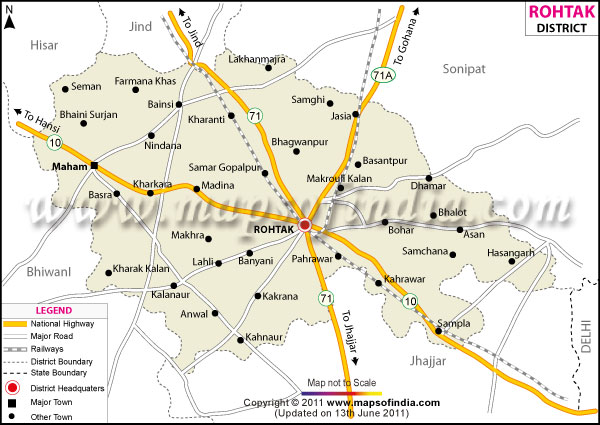
| *Rohtak District map showing National highways, district headquarter, roads, towns, etc. |
About
Rohtak is one the districts of Haryana. It has continued to shape the education, politics, farming, and trade across the region. With deep historical connections, village customs still felt today, newer city frameworks rising, and respected learning centers, it stands out in governance and community activity throughout the state. Growth has come slowly but surely - yet roots in crop-based livelihoods and local Haryanvi ways remain firmly in place.
Among Indian cities, Rohtak stands out for its strong academic offerings. While universities draw applicants from across Haryana, medical and engineering colleges pull in youth from nearby regions too. Because of growing campuses, city life evolved around learning centers over time. Jobs followed - emerging slowly within government offices, then later in private firms linked to education. What began as classrooms now supports entire neighborhoods. Rooted in heritage, daily life here carries forward long-held Haryanvi beliefs and practices. While most people speak Hindi, village gatherings often echo with native Haryanvi speech forms. These traditions thrive especially where rural settings shape community rhythms.
History & Culture
The story of Rohtak district begins long ago, unfolding alongside the wider changes across northern India. Evidence from digs, along with stories passed down locally, points to people living here for ages due to rich soil and a useful position on the map. Life took shape around farming, and where villages formed, yet over time, commerce paths and shifts in power lifted the area’s standing within the region.
Long before modern times, Rohtas found itself tied to multiple early empires. At shifting intervals, power passed through Rajput dynasties, then into the hands of the Delhi Sultanate. Governance shifted again during Mughal rule, followed by control under Britain's colonial regime. Close to the capital, its location along key northern pathways shaped much of its trajectory. Events unfolding across north India frequently echoed within this town due to such positioning. Back then, in medieval times, village life centered daily routines around work and relationships. Across open fields, people grew crops while raising animals - both became vital to survival.
Backed by colonial priorities, Rohtak saw shifts in governance and public works. Though slow, new roads emerged alongside schools and rail links that tied it closer to regional hubs. With each passing decade, political thought deepened - sparked by national unrest against foreign control. Independence demands gained ground as townspeople, teachers, and youth joined boycotts and protests without waiting for orders.
Later came a wave of change across the region following independence. Rural prosperity grew, tied closely to these advances in cultivation practices. As decades passed, towns spread outward, schools multiplied, altering how people lived in Rohtak.
Life in Rohtak still grows from the soil of Haryana’s countryside roots. From morning rituals to evening talk, rhythms echo those found in nearby villages. Though time passes, festivals bring people together just as they once did. Gatherings unfold without fanfare, yet hold steady at the heart of belonging. What happens in courtyards and open fields shapes how neighbors see one another.
Festivals light up life throughout the region with energy and spirit. Bright hues mark Holi, drawing people into song, dance, and shared moments. As evening falls during Diwali, lamps glow in houses and shops alike. Farming shapes how people eat across Rohtak, deeply tied to Haryana’s rural roots. Sturdy dishes built on wheat take center stage - bajra flatbreads appear daily alongside yogurt and tangy lassi. With each season comes a shift toward fresh produce pulled straight from nearby fields. Milk drawn from local livestock feeds into meals in many forms. Even now, cooking at home carries weight far beyond nutrition.
Economy
Farming shapes part of Rohtak’s economic base, while institutions focused on learning contribute too. Health-related operations play a role alongside commerce spread across local markets. Manufacturing units function within the area, whereas service-oriented work completes the mix. Each sector operates in different ways yet fits into the broader pattern. Together, these elements form an uneven but working balance.
Government Sector
Across the district, government-run offices help sustain many jobs. Public education facilities -from primary schools to colleges - offer consistent work for teachers and staff. Hospitals and clinics employ medical professionals alongside support teams. The local administrative body manages daily operations with a broad workforce. Law enforcement units maintain staffing needs across ranks. Social service divisions also absorb labor through various outreach roles.
Government jobs grow more common in Rohto because of its role in education and public administration.
Public Sector
Across the district, public sector bodies - including hospitals, schools, transit networks, and financial services - help sustain economic momentum. Development gains further ground through investments in physical infrastructure alongside social support programs.
Services Sector
Most of Rohtak’s city-based jobs come from service-related work. Schools and tuition hubs contribute alongside clinics, shops, eateries, lodging places, moving services, and network providers. These create income opportunities while boosting daily economic flow across neighborhoods.
Because cities are expanding, links to Delhi and the surrounding areas have improved, boosting trade and drawing more investors. As infrastructure develops, business momentum grows alongside interest from outside funding sources. With easier access comes increased economic movement, creating conditions where commerce thrives naturally. Movement between regions now supports markets in ways that were less possible before recent changes. These shifts quietly reshape how companies operate near metropolitan hubs.
Tourism
Rohtak might come alive around schools, farms, and expanding neighborhoods - yet tucked within are spots people visit just to unwind. Not every corner screams tourist trap; instead, you find green patches where city dwellers breathe slowly. Tradition shows up quietly - in festivals, food stalls, neighborhood gatherings. Learning weighs heavily here, so college towns blend into visitor paths like shared sidewalks. Daily routines play out alongside quiet getaways no brochure predicts.
Tilyar lake is very famous among the tourists and draws a large crowd. It is surrounded by trees and wide open land. It serves as a place for relaxation where not just the tourists but people living nearby go to relax. It is located far from the noise of the city and is a perfect go to for weekends. Learning trips are a part of what this area stands for. Not far away, Maharshi Dayanand University holds a strong standing through much of Haryana, pulling in learners, scholars, besides travelers from many places. With big schools rooted here, Rohtak slowly built its name around study and thought.
Out here in Rohtak, tourism isn’t about grand displays or crowded landmarks. Instead, quiet lakes cradle reflections of sky, drawing those who walk with slower steps. Schools and colleges hum with routine energy, pulling students from nearby towns.
Demographics
Roughly 10.6 lakh individuals lived in Rohtak district as recorded during the 2011 Census. While cities form part of its landscape, vast stretches also support farming villages across the area.
Across the district, Hindi finds frequent use, yet village settings often feature Haryanvi speech patterns. In some pockets, people speak Punjabi instead. Where rural life holds strong, traditional forms of expression stay alive alongside broader linguistic trends. Eight out of ten people can read and write, a sign of progress shaped by learning centers across the region. Colleges, along with local schools, have played a role in lifting these numbers over time.
Farmers, people working in cities, students, market vendors, and factory workers determine the distribution of the population. The economic activity attracts service providers along with production line operators. Each sector of the human resource adds different patterns to the housing needs, transport use and local services. Farming is the major activity in the village areas and has sustained its place despite the growing urbanization process.
Administration
Located in Haryana, Rohtak holds the role of the main government center for its district. The city manages official functions and supports local governance operations. Administration tasks are coordinated here due to the established infrastructure. Key offices find their base within this urban hub. Rohtak stands out among key administrative areas, followed by Meham, where rural governance takes shape. Meanwhile, Sampla plays a role in regional oversight, just as Kalanaur contributes to local structure. Lakhan Majra completes the list, functioning within the same framework.
Around 140 villages lie within the area, scattered through farmland and zones blending rural with urban traits. Though farming shapes much of the landscape, pockets show signs of gradual development beyond purely country living. From health services to road building, district authorities manage daily operations across the public sector. Governance flows through local offices that coordinate schools, medical centers, and farm assistance programs. Sanitation efforts run alongside policing activities under one administrative umbrella. Welfare projects emerge where planning meets community needs. Development work takes shape when resources shift toward rural uplift. Oversight includes everything from emergency response to classroom supply chains.
Though villages rely on Panchayati Raj systems for local governance, town and city regions see urban needs handled by municipal organizations. Governance in rural zones flows from community-based councils, whereas built-up centers depend on structured civic authorities for service delivery. Where decentralized village rule applies, elected panchayats lead decision-making; meanwhile, urban spaces assign such duties to official municipal setups.
| Official Name | Rohtak |
| Location | Haryana |
| Area | 174 sq. km |
| Population | 1058683 |
| Language | Haryanvi and Hindi |
FAQs
Q1: How many villages are there in the district?
There are 147 villages in the district.
Q2: What is the population of Rohtak district?
The population of the district, according to the 2011 census, is 1058683.
Q3: What is the district famous for?
Rohtak is famous for its educational institutes, agricultural economy, Tilyar Lake, and the strong Haryanvi cultural traditions.
Last Updated on : July 17, 2026
