








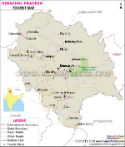
It has a climate ranging from subtropical at the lower parts and alpine in the higher parts of the country. Natural beauty has ensured that Himachal Pradesh becomes the leading destination of nature lovers, researchers as well as tourists.
It has its capital city of Shimla that also became the summer capital under the British colonial rule, and the winter capital is Dharamshala. The state is subdivided in a set of districts and each district has distinct geography and its own culture. People are mostly rural, and most of them live in valleys and terraces, adapted for agriculture.
The state of Himachal Pradesh has been referred to as the Land of Gods by virtue of the many temples and holy places it has. Religion is intertwined with life and the festivals, architecture and social traditions are affected. In spite of being modernized, the area has still remained very much attached to the traditional way of life as shown in local artisanship, garments, and communal customs.
The development of infrastructure has been enhanced much more over the decades and the road connectivity is important with the mountainous nature. There are restricted railway routes, but the air route has limited airports across the region. There has also been improvement in education and healthcare which is contributing to fair human development parameters when compared to most parts of the world.
History and Culture
Himachal Pradesh has a history which can be traced back to the ancient times and past records indicating evidence of early human settlement in the state. It belonged to several ancient kingdoms and republics that are described in texts such as the Mahabharata and the Puranas. The area was dominated by small principalities that were governed by the local chieftains who were often autonomous. During the medieval period, Rajput rulers established several hill states in the region.
When Mughals came, there was a certain degree of political contact, yet mostly the area had retained its freedom. This was followed by the control of the British East India Company following the Anglo-Sikhs wars in the 19th century. The British also built hill stations like Shimla which was used as an administrative center in the colonial era.
Following the independence of India in 1947, the princely states in the area were unified eventually to form a union territory. In 1971, it became a full-fledged state, and a momentous event in its political development. Since then, Himachal Pradesh has been developing without giving up on its cultural heritage.
The region has a rich culture that has different variations in different valleys and communities. Social celebration features folk music and dances like Nati, are part of them. Religion plays an important role and festivals such as Dussehra in Kullu and Shivratri in Mandi are commemorated with a lot of enthusiasm. The community life is highly centered on local deities with temples serving as places of spiritual and social power as well.
Classic clothing also involves wool clothing which fits the cold weather like shawls and caps. Agriculture, Weaving, woodcarving, and metalworking are practiced and have a cultural and economic importance. The food is also simple but unique with the use of local grains, lentils, and dairy products.
Government, Public and Private Sector Economy
Agriculture is still considered one of the primary sources of livelihood and crops like wheat, maize, barley and rice are grown. Nonetheless, horticulture and especially apple production has turned into one of the important economic forces. The state is one of the major producers of apples among other fruits such as pears, plums and cherries in India.
The government is one of the key players in the development sector since it provides infrastructure projects, education, healthcare, and rural development programmes. The hydropower generation is also a major activity of the public sector since the rivers of the state offer massive potential to generate electricity. The hydropower plants are also a major contributor to revenue and energy supply both in and outside the state.
There is an increasing growth in the private sector particularly in the tourism, pharmaceutical and small scale manufacturing sectors. Pharmaceutical companies have established major manufacturing hubs in industrial regions such as Baddi, which is where the companies have invested owing to good policies and tax breaks. This has assisted in diversifying the economic base beyond traditional sectors.
The service industry is growing and the services of banking, education and information technology are slowly acquiring significance. The state government has promoted entrepreneurship and skills building too so as to provide young people with employment opportunities.
Transport and connectivity is a major challenge because of the terrain. As road networks have been continuously improved, it has also made trade and mobility easier. The goal of rural development programs is the improvement of livelihoods which are done by means of self-help groups, cooperatives, and local enterprises.
Tourism
Tourism is among the greatest sectors that provide contribution to the economy and identity to Himachal Pradesh. The state is a tourist haven where millions of people go on holidays annually because of its scenic scenes, favourable climate, and culture. Among the most popular destinations are the hill stations which include Shimla, Manali or Dharamshala which provide a combination of both nature and recreational activities.
Trekking, paragliding, skiing and river rafting are some of the activities that have received tremendous momentum due to the heavy influx of tourists both local and international for adventure tourism. Such activities are especially known in such areas as Spiti Valley and Solang Valley. The wide variety of terrain has made it possible to do year-round tourism with summertime being the time when visitors travel to escape the summer heat and wintertime when they want to enjoy the snow.
Another significant element is religious tourism, and the state has a wide variety of temples and pilgrimage locations. The spiritual importance of the area is strengthened by places such as the temples of Chamba and Kangra, which are the places where the devotees are attracted. The influence of Tibetan Buddhism can be also observed in monasteries in such regions as Lahaul and Spiti that are also popular among the cultural tourists.
Environmental conservation plans in the form of eco-tourism have been encouraged to help conserve the natural environment and also give the local people sustainable livelihood. Nature exploration and conservation of biodiversity happen in national parks and wildlife sanctuaries.
The government has also invested in infrastructure like roads, accommodation and tourism amenities to cater to the increase in the number of visitors. There is also encouragement on homestay programs which enable the tourists to get a closer feel of the local culture and traditions.
Although tourism has expanded, it has had some challenges, which includes environmental degradation, waste management and seasonal overcrowding. There is an attempt to uphold responsible tourism and sustainability of the ecology.
Demographic and Administration
Being a mountain-state with relatively small but spatially dispersed population, Himachal Pradesh state has a multi-tiered administrative system indicating its federal character as a part of India and challenging topography. Demographic profile
The population of Himachal Pradesh according to the 2011 census is 6,864,602 persons, which is approximately 0.5 per cent as compared to the total population of India. The state experienced a decadal growth rate of approximately 12.9 per cent which is less than the national average between 2001 and 2011 which demonstrates a slow yet moderate demographic growth. Projections that are more recent indicate that the population has increased to approximately 78-79 lakh by 2026 indicating a sustained yet slow growth.
The state has a huge unevenly distributed population in the high-altitude valleys, plains along rivers and over the slopes, which are covered in forests. The population density that stood at around 109 persons per square kilometre in 2001 rose to 123 persons per square kilometre in the year 2011 and this is very low compared to the national average, reflecting constraints such as rugged terrain and low arable land coupled with poor climatic conditions. Sex ratio also increased throughout decades; in 2011, it was 972 per 1,000 males, which is a positive indicator, with child sex ratio going up as well; it grew to 909 in 2011 in comparison to 896 in 1991. Administrative structure
The state of Himachal Pradesh is a state of the Indian Union with a parliamentary system of administration with a Governor (appointed by the President of India) and a council of Ministers headed by the Chief Minister taking charge of the daily executive duties. The Shimla state secretariat is the point of coordination of the policy, finance, planning and sectoral departments, and the judiciary is represented by the High court of Himachal Pradesh and a system of district and subordinate courts.
To manage the state, the state is divided into three divisions, which are: Shimla, Mandi and Kangra, each division has several districts to coordinate and monitor. It has a total number of 12 districts, namely Shimla, Kangra, Mandi, Solan, Sirmaur, Kullu and Lahaul-Spiti among others that are further broken down into tehsils, sub-tehsils and sub-divisions
Himachal Pradesh has 12 districts, which are listed below:
Himachal Pradesh at a Glance |
| Area | 55,673 km2 | Population (Census 2011) | 6864602 |
| Females | 3,382,729 | Males | 3,481,873 |
| Urban Population | 6,88,552 (2011 Census) | Rural Population | 61,76,050 (2011 Census) |
| Population Density | 123/km2 (320/sq mi) | Sex Ratio | 974 |
| Literacy Rate | 82.80% (2011 Census) | Female Literacy | 75.93% (2011 Census) |
| Male Literacy | 89.53% (2011 Census) | Districts | 12 |
| Sub Division | 69 | Tehsils | 169 |
| Sub Tehsils | 169 | Towns | 59 |
| Developmental Block | 78 | Panchayats | 3517 |
| Panchayat Smities | 78 | Zila Parishad | 12 |
| Nagar Nigam | 2 | Nagar Parishad | 20 |
| Nagar Panchayats | 33 | Urban Local Bodies | 53 |
| Census Villages | 20,690 | Inhabited Villages | 2868 |
| Educational Institutions | 17000 | Health Institutions | 3835 |
| Motorable Roads | 4587 km | National Highways | 9 |
Himachal Pradesh State Information | |
|---|---|
| Capital | Shimla |
| Date of formation | 25/01/71 |
| Governor | Shiv Pratap Shukla |
| Chief Minister | Sukhvinder Singh Sukhu |
| Tourist attractions | Shimla, Kulu, Manali, Dharamsala |
| Festivals | Pori, Fulaich |
| Major dance and music forms | Mala dance, Rakshas Dance |
| Arts and crafts. | Pahari painting is done in the Basohli and Kangra styles; Kullu shawls and woollen caps are famous; the Chamba Rumal has Kangra style paintings embroidered on cloth. |
| Languages | Hindi, Punjabi, Kinnauri, Pahari |
| Size | 55,673 km2 (21,495 sq mi) |
| Population | 6864602 |
| Rivers | Ravi, Beas, Chenab, Sutlej, Yamuna |
| Forests and wildlife sanctuaries | Pin Valley NP, Greater Himalayan NP, Renuka WS, Chail WS, Kalatope Khajjiar WS |
| State animal | Snow leopard |
| State bird | Western tragopan |
| State flower | Pink rhododendron |
| State tree | Deodar |
| Major crops | Wheat, rice, maize, barley |
| Factoids | The world's oldest democracy is believed to be a tiny, isolated village called Malana. |
| Shimla was the summer capital of british India. | |
| No. of District | 12 |
Maps in Other Regional Languages
FAQs
Q1: How many villages are here?
Approximately 17,000+ villages.
Q2: What is the population of the state?
Approximately 7.5 million.
Q3: What is this state famous for?
Himalayan landscapes, hill stations (Shimla, Manali), temples, apple orchards, adventure tourism, and Tibetan culture.
Last Updated on: March 26, 2026
