

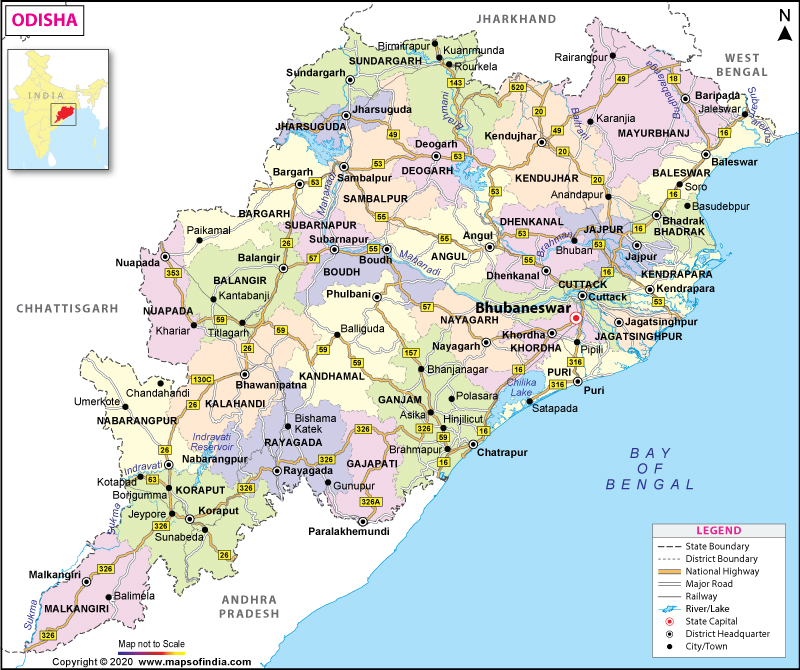



Area and population of Odisha
The total area of the state is 155,707 km2 (60,119 sq mi), while the population of Odisha is 41,974,218 as per the 2011 Census. In terms of population, the state is the eleventh biggest state in India, and in area, it holds the ninth rank.
Demographic features of Odisha
About 50.54% of the population of the state is male (21,212,136 ), and 49.46% of the population is female ( 20,762,082). The density of the population in the state is approximately 270 persons per km². About 93.63% of the population is Hindu, 2.17% is Muslim, and 2.77% is Christian. Other religious communities account for the remaining population, including 1.14% belonging to other religions and persuasions and 0.18% whose religion was not stated. The official language of the state is Odia. Other languages spoken in the state are Hindi, Bengali, Santali, and Telugu. The literacy rate is 72.87% (as per the 2011 census).
Districts of Odisha
The districts of the state are as follows: Angul, Boudh, Bhadrak, Balangir, Bargarh, Balasore, Cuttack (Kataka), Deogarh, Dhenkanal, Ganjam, Gajapati, Jharsuguda, Jajpur, Jagatsinghapur, Khordha, Keonjhar, Kalahandi, Kandhamal, Koraput, Kendrapara, Malkangiri, Mayurbhanj, Nabarangpur, Nuapada, Nayagarh, Puri, Rayagada, Sambalpur, Subarnapur, and Sundargarh. Odisha has 30 administrative districts grouped under three revenue divisions.
Major cities in Odisha
Other than Bhubaneswar and Cuttack, the major cities in Odisha are Rourkela, Brahmapur, Bolangir, Sambalpur, Kendrapara, Balasore, and Puri.
Government of Odisha
At present, the Chief Minister of the state is Shri Mohan Charan Majhi. The Governor of the state is Shri Brajamohan Ram, and there are 147 seats in the Legislative Assembly (Vidhan Sabha) of the state. The Legislative Assembly of the state is unicameral. The apex court of the state is the Odisha High Court, located in Cuttack.
Geographical features of Orissa
The state forms a part of the eastern seacoast of India and is bordered by the Bay of Bengal to the east. The state has a coastline along the Bay of Bengal and features a varied landscape comprising coastal plains, hills, plateaus and river valleys. Physiographically, the state can be divided into the following five major regions:
- The Odisha Coastal Plains in the east, formed by the deltas of major rivers and extending along the Bay of Bengal.
- The Middle Mountainous and Highlands Region, characterised by hills, forests and elevated terrain.
- The Central Plateaus, comprising relatively elevated and undulating landforms.
- The Western Rolling Uplands, featuring rolling terrain and extensive mineral resources.
- The Major Flood Plains, formed by rivers and their tributaries, particularly in the central and coastal parts of the state.
Rivers of Odisha
The major rivers of Odisha are as follows:
The major rivers of Odisha are as follows: Mahanadi (the longest river of the state), Subarnarekha, Kathajodi, Brahmani, Baitarani, Budhabalanga, Rushikulya, Vanshadhara, Nagavali, Kolab, Indravati, and Tel Rivers.
Besides, there are several scenic lakes in the state that are top tourist draws, such as Chilika Lake (a brackish-water lagoon), Ansupa Lake and Pata Lake. The state is also home to important dams and reservoirs, including the Hirakud Dam on the Mahanadi River and the Upper Indravati Dam on the Indravati River.
Economy of Odisha
The state houses a strong economy with plenty of natural resources and an extensive shoreline. The state is rich in natural resources like coal, bauxite, iron ore, and chromite. Steel manufacturing is a major industry in the state. Other industries include mining, mineral processing, aluminium production, transportation, oil refining, power generation and information technology. Agriculture, fisheries and port-based activities also contribute significantly to the state's economy.
Educational institutes in Odisha
Given below are the names of the popular educational institutes in the state of Odisha:
Biju Patnaik University of Technology at Rourkela, Berhampur University at Berhampur, C. V. Raman College of Engineering, Bhubaneswar, Central University of Odisha, Koraput, IIT Bhubaneswar at Bhubaneswar, Fakir Mohan University at Balasore, National Institute of Science and Technology at Berhampur, Kalinga Institute of Industrial Technology (KIIT) in Bhubaneswar, National Institute of Technology Rourkela at Rourkela, National Institute of Science Education and Research, Bhubaneswar, National Law University, Odisha in Cuttack, Ravenshaw University in Cuttack, Odisha University of Agriculture and Technology (OUAT) at Bhubaneswar, Siksha 'O' Anusandhan University, Sambalpur University, Sambalpur, Shree Jagannath Sanskrit University, Puri, Silicon Institute of Technology, M.K.C.G. Medical College, Berhampur, Government Ayurvedic College, Balangir, SCB Dental College in Cuttack, SCB Medical College in Cuttack, Veer Surendra Sai Institute of Medical Sciences and Research (VIMSAR), Burla, Sri Sri University in Cuttack, Utkal University of Culture at Bhubaneswar, Utkal University (at Bhubaneswar) and Veer Surendra Sai University of Technology, Burla.
Tourist attractions in Odisha
The top tourist attractions in Odisha are as follows:
The Lingaraj Temple at Bhubaneswar, Chilika Lake, Daringbadi (Darjeeling of Odisha), Pipli, the Sun Temple at Konark, Jagannath Temple (Puri), Udayagiri and Khandagiri Caves, Satkosia Gorge and Tikarpada, Bhitarkanika National Park, Nandankanan Zoological Park, Sunabeda Wildlife Sanctuary, Belghar Wildlife Sanctuary, Chandka Elephant Reserve, Ushakothi or Badrama Wildlife Sanctuary, Chilika Wildlife Sanctuary, Satkosia Gorge Wildlife Sanctuary, Gahirmatha Marine Wildlife Sanctuary and Simlipal National Park. The well-known Kapilash Shiva Temple is located in Dhenkanal.
The famous sea beaches in the state are also popular tourist attractions and include Gopalpur-on-Sea, Puri, Ramachandi, Chandipur, Astaranga and other coastal beaches along the Bay of Bengal.
Odisha State Information (As per Odisha map) | |
|---|---|
| Capital | Bhubaneswar |
| Date of formation | 15/08/47 |
| Governor | Shri Brajamohan Ram |
| Chief Minister | Shri Mohan Charan Majhi |
| Tourist attractions | Sun Temple, Konark, Puri, Chilika Lake, Lingaraj Temple and Taptapani |
| Festivals | Rath Yatra, Raja Parba, Durga Puja, Bali Jatra and Makar Sankranti |
| Major dance and music forms | Odissi, Gotipua, Chhau and Sambalpuri folk music |
| Arts and crafts | Pattachitra paintings, palm-leaf engravings, Pipili appliqué work, Cuttack silver filigree and Sambalpuri double ikat textiles |
| Languages | Odia (official language), Hindi, Bengali, Santali, Telugu and other regional and tribal languages |
| Size | 155,707 sq. km |
| Population (Census 2011) | 41974218 |
| Rivers | Mahanadi, Baitarani, Brahmani, Subarnarekha, Tel, and so on |
| Forests and wildlife sanctuaries | Similipal National Park, Bhitarkanika National Park, Chilika Wildlife Sanctuary and Satkosia Gorge Wildlife Sanctuary |
| State animal | Sambhar |
| State bird | Indian Roller |
| State flower | Ashoka |
| State tree | Kadamba |
| Major crops | Paddy, wheat, ragi, maize |
| Factoids | The 33 rock-cut caves at Udayagiri and Khandagiri near Bhubaneswar are associated with the reign of King Kharavela. |
| Odisha has 62 recognised tribal communities, including the Santhals, Savaras, Juangs, Gonds and Bondas. | |
| No. of District | 30 |
FAQs
1. What is the capital of Odisha?
Bhubaneswar is the capital of Odisha. It is popularly known as the Temple City of India because of its numerous ancient temples, including the famous Lingaraj Temple.
2. When was Odisha formed as a separate state?
Odisha was formed as a separate province on April 1, 1936, during British rule. It became a separate state after India's independence. The state celebrates Utkal Dibasa every year on April 1 to commemorate its formation.
3. What is the total area and population of Odisha?
Odisha covers an area of 155,707 square kilometres. According to the 2011 Census, its population was 41,974,218, making it the eleventh most populous state in India.
4. How many districts are there in Odisha?
Odisha has 30 districts, which are grouped into three revenue divisions. Some of its major districts include Khordha, Cuttack, Ganjam, Puri, Mayurbhanj, Sambalpur and Sundargarh.
5. What is the official language of Odisha?
Odia is the official language of Odisha and is one of the classical languages of India. Other languages spoken in the state include Hindi, Bengali, Telugu, Santali and several tribal languages.
6. What are the major rivers of Odisha?
The Mahanadi is the longest river flowing through Odisha. Other major rivers include the Brahmani, Baitarani, Subarnarekha, Budhabalanga, Rushikulya, Vansadhara, Nagavali and Indravati. These rivers support agriculture, irrigation and other economic activities in the state.
7. What are the most famous tourist attractions in Odisha?
Some of the most famous tourist attractions in Odisha include the Jagannath Temple in Puri, Konark Sun Temple, Lingaraj Temple in Bhubaneswar, Chilika Lake, Udayagiri and Khandagiri Caves, Similipal National Park and Bhitarkanika National Park. The state is also known for its beautiful beaches, including Puri, Gopalpur and Chandipur.
Last Updated on : November 20, 2026
Travel to Odisha, Places to Visit in Odisha
Places to Visit in Odisha
