

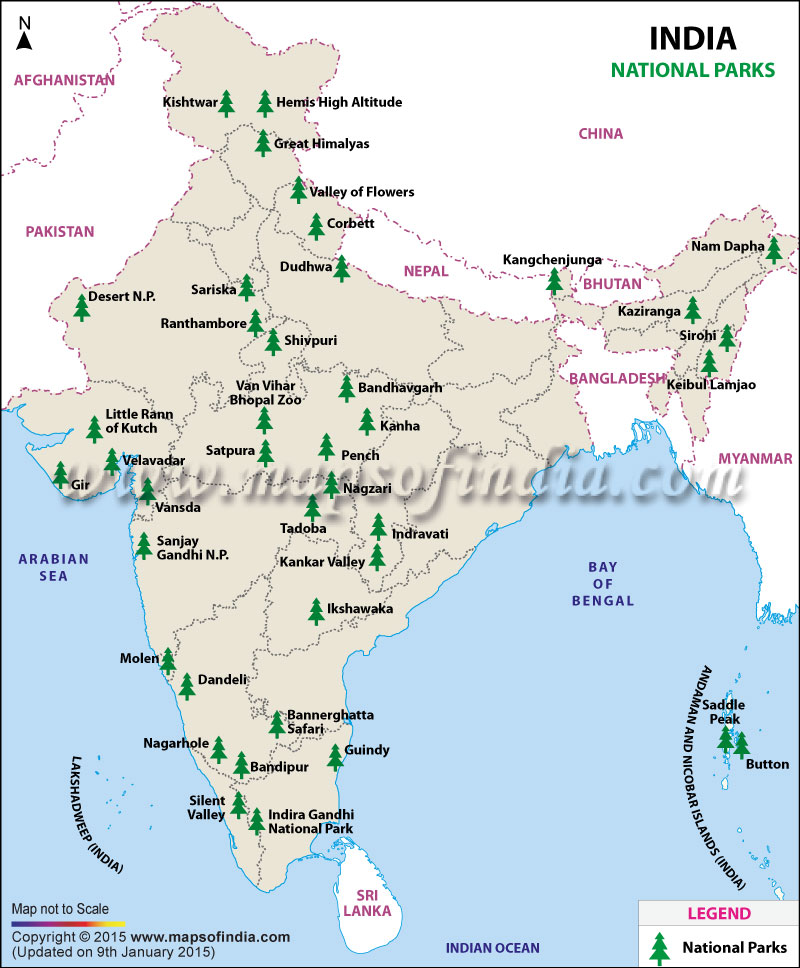



National Parks in India
India boasts an extensive system of national parks that demonstrate the amazing biodiversity of the country, including dense forests and grasslands, mangroves and mountainous landscapes. These reserve zones are crucial in the preservation of endangered species, particularly the Bengal tiger, and provide excellent habitats to numerous species of flora and fauna. Most of these parks have been subdivided into various areas in order to control tourism and conservation. National park maps are extremely helpful for visitors, as they guide them through safaris, forest trails, water bodies, and accommodation areas while ensuring safety and a better wildlife experience.
Jim Corbett National Park
India's one of the first and well-known national parks for tigers, Jim Corbett National Park is located in Uttarakhand. The park has a large area, which is divided into five zones. The Jim Corbett National Park map can help you to go around safely and without getting lost inside the forest. First zone, Jhirna, is open to the public all year round, and the other zones are closed during the monsoon. The elephant safari inside the park is exciting and gives a short and safe trip inside the dense preserve. There are cabins inside the forest, and the reserve around the Dhikala zone is one of the best spots to enjoy wildlife.
In addition, Jim Corbett is part of the larger Corbett Tiger Reserve and is famous for being the first national park in India, established in 1936. It hosts a great diversity of wildlife, such as Bengal tigers, elephants, leopards, and 600-plus bird species. The river, Ramganga, which runs through the park, contributes to its picturesque charm and sustains aquatic organisms such as crocodiles and fish. More Details...
Kanha National Park
Located in the state of Madhya Pradesh, Kanha National Park is a dense and rich area of bamboo forests with beautiful lakes, running streams and wide grasslands. It is a large park and is known for research and conservation programmes to preserve many endangered species, such as white tigers and hippos. The Kanha National Park map at the information centre can guide you to the nearest safari, cabins, lakes and locations around the park.
Kanha is especially famous for its successful conservation of the hardground barasingha (swamp deer), which was once on the brink of extinction. The park’s diverse ecosystem inspired Rudyard Kipling’s The Jungle Book. Visitors can explore zones like Kisli, Mukki, and Kanha core area through jeep safaris, which offer excellent chances to spot tigers, deer, and wild dogs. More Details...
Bandhavgarh National Park
It is located in Madhya Pradesh, and is best known for its scenic surroundings and has the highest population of tigers of any other park in India. The Bandhavgarh National Park map for the forest helps you to get through the dense and eye-capturing valleys, beautiful rocky terrain and an ancient fort. Without a map or a local guide, the way to the forest is quite difficult, but it's one of the best locations to spot tigers and a variety of birds and wildlife.
Historical importance, too, is an element of Bandhavgarh, with the ancient Bandhavgarh Fort situated in it, thought to be more than 2,000 years old. The park has been subdivided into areas such as Tala, Magadhi and Khitoul, where Tala is the most widely used in terms of wildlife viewing. Apart from tigers, visitors may also encounter leopards, sloth bears, and numerous species of birds. More Details...
Ranthombare National Park
It is located in Eastern Rajasthan at the junction between the Aravali Hill ranges and the Vindhyan plateau. The Ranthambore National Park map available in the information centre guides you through the forest and the 10th-century fort amidst the cliffs. It serves as a rich heritage of various plants and animals.
Ranthambore is an excellent national park in India to view tigers due to its open landscapes and water bodies where animals accumulate. Ranthambore Fort is a UNESCO World Heritage site and is also found in the park. There are also other wildlife such as marsh crocodiles, hyenas and a great diversity of bird species. More Details...
Sunderbans National Park
The Sunderbans in West Bengal is a dense mangrove forest, which is a unique and magnificent place to visit. It includes 54 islands and extends to the nearby country, Bangladesh. It is a wide swamp that can be explored only using boats. It is a refuge for migrating birds and a reserve for rare and preserved wildlife. The Sunderbans National Park map is significant in guiding you through these forests.
The Sundarbans is the biggest mangrove forest in the world and harbours the elusive Royal Bengal Tiger which has the ability to swim. It is also a UNESCO World Heritage Site, and it sustains species such as saltwater crocodiles, river dolphins and other reptiles. The tidal waterways, mudflats, and little islands make navigation in this area necessary with a proper guideline using maps. More Details...
UBST020315
EBAKB310315
List of National Parks in India
| Name | State | Established | Area (in km2) | Notability |
|---|---|---|---|---|
| Balphakram National Park | Meghalaya | 2013 | 220 | wild water buffalo,red panda, elephant and eight cat species, including the tiger andmarbled cat |
| Bandhavgarh National Park | Madhya Pradesh | 1968 | 400.85(core are | highest known Tiger population in India,White Tiger, 1336 species of endemic plants |
| Bandipur National Park | Karnataka | 1974 | 874.2 | chital, Gray langurs,Indian giant squirrel,Gaur, leopard Sambarand indian elephants,honey buzzard, red-headed vulture, and other animals. |
| Bannerghatta National Park | Karnataka | 1974 | 106.27 | |
| Betla National Park | Jharkhand | 1986 | 231.67 | Tiger,Sloth Bear,Peacock,Elephant,Sambar, and other animals. |
| Bhitarkanika National Park | Odisha | 1988 | 145 | Mangroves. Saltwater crocodile, white crocodile, Indian python, black ibis, wild pigs, rhesus monkeys, chitals, and other animals |
| Blackbuck National Park, Velavadar | Gujarat | 1976 | 34.08 | |
| Buxa Tiger Reserve | West Bengal | 1992 | 760 | |
| Campbell Bay National Park | Andaman and Nicobar Islands | 1992 | 426.23 | |
| Chandoli National Park | Maharashtra | 2004 | 317.67 | |
| Dachigam National Park | Jammu and Kashmir | 1981 | 141 | Only area where Kashmir stag is found[citation needed] |
| Darrah National Park | Rajasthan | 2004 | 250 | |
| Desert National Park | Rajasthan | 1980 | 3162 | |
| Dibru-Saikhowa National Park | Assam | 1999 | 340 | |
| Dudhwa National Park | Uttar Pradesh | 1977 | 490.29 | |
| Eravikulam National Park | Kerala | 1978 | 97 | Asiatic lion |
| Galathea National Park | Andaman and Nicobar Islands | 1992 | 110 | |
| Gangotri National Park | Uttarakhand | 1989 | 1552.73 | UNESCO World Heritage Site |
| Gir Forest National Park | Gujarat | 1965 | 258.71 | |
| Gorumara National Park | West Bengal | 1994 | 79.45 | |
| Govind Pashu Vihar Wildlife Sanctuary | Uttarakhand | 1955 | 957.5 | |
| Great Himalayan National Park | Himachal Pradesh | 1984 | 754.4 | |
| Gugamal National Park | Maharashtra | 1974 | 1673.93 | Indian rhinoceros,UNESCO World Heritage Site |
| Guindy National Park | Tamil Nadu | 1976 | 2.82 | |
| Gulf of Mannar Marine National Park | Tamil Nadu | 1980 | 6.23 | only floating park in the world |
| Harike Wetland | Punjab | 1990 | 41 | |
| Hazaribagh National Park | Jharkhand | 1976 | 186.25 | |
| Hemis National Park | Jammu and Kashmir | 1981 | 4400 | UNESCO World Heritage Site |
| Indira Gandhi Wildlife Sanctuary and National Park | Tamil Nadu | 1976 | 958 | |
| Indravati National Park | Chhattisgarh | 1983 | 2799.08 | |
| Intangki National Park | Nagaland | 1993 | 202.02 | Dugong, Dolphin, Water Monitor Lizard, Blue Whale |
| Jaldapara National Park | West Bengal | 2012 | 216 | |
| Jim Corbett National Park | Uttarakhand | 1936 | 1318.5 | |
| Kalesar National Park | Haryana | 2003 | 100.88 | |
| Kanger Ghati National Park | Chhattisgarh | 1982 | 200 | important bird area as attributed by BirdLife International, new species frog named Rana CharlesDarwini |
| Kanha National Park | Madhya Pradesh | 1955 | 940 | |
| Kasu Brahmananda Reddy National Park | Telangana | 1994 | 1.42 | |
| Kaziranga National Park | Assam | 1905 | 471.71 | |
| Keibul Lamjao National Park | Manipur | 1977 | 40 | |
| Keoladeo National Park | Rajasthan | 1981 | 28.73 | |
| Khangchendzonga National Park | Sikkim | 1977 | 1784 | |
| Kishtwar National Park | Jammu and Kashmir | 1981 | 400 | |
| Kudremukh National Park | Karnataka | 1987 | 600.32 | |
| Madhav National Park | Madhya Pradesh | 1959 | 375.22 | |
| Mahatma Gandhi Marine National Park | Andaman and Nicobar Islands | 1983 | 281.5 | |
| Mahavir Harina Vanasthali National Park | Telangana | 1975 | 14.59 | |
| Manas National Park | Assam | 1990 | 950 | |
| Mandla Plant Fossils National Park | Madhya Pradesh | 1983 | 0.27 | |
| Marine National Park, Gulf of Kutch | Gujarat | 1980 | 162.89 | |
| Mathikettan Shola National Park | Kerala | 2003 | 12.82 | |
| Middle Button Island National Park | Andaman and Nicobar Islands | 1979 | 64 | |
| Mollem National Park | Goa | 1978 | 107 | |
| Mouling National Park | Arunachal Pradesh | 1986 | 483 | |
| Mount Abu Wildlife Sanctuary | Rajasthan | 1960 | 288.84 | |
| Mount Harriet National Park | Andaman and Nicobar Islands | 1979 | 46.62 | |
| Mrugavani National Park | Telangana | 1994 | 3.5 | |
| Mudumalai National Park | Tamil Nadu | 1940 | 321.55 | |
| Mukurthi National Park | Tamil Nadu | 2001 | 78.46 | |
| Murlen National Park | Mizoram | 1991 | 200 | |
| Nagarhole National Park | Karnataka | 1988 | 643.39 | |
| Namdapha National Park | Arunachal Pradesh | 1974 | 1985.24 | |
| Nameri National Park | Assam | 1978 | 200 | |
| Nanda Devi National Park | Uttarakhand | 1982 | 630.33 | |
| Nandankanan Zoological Park | Odisha | 1960 | 4.006 | |
| Navegaon National Park | Maharashtra | 1975 | 133.88 | |
| Neora Valley National Park | West Bengal | 1986 | 88 | |
| Nokrek National Park | Meghalaya | 47.48 | Tiger, Leopard, Asian elephant, Sambar, Barking deer, Gaur, Jungle cat, Wild boar, and other animals. | |
| North Button Island National Park | Andaman and Nicobar Islands | 1979 | 114 | |
| Orang National Park | Assam | 1999 | 78.81 | |
| Palani Hills National Park | Tamil Nadu | 2007 | 736.87 | |
| Panna National Park | Madhya Pradesh | 1981 | 542.67 | UNESCO World Heritage Site |
| Papikonda National Park | Andhra Pradesh | 2008 | 1012.85 | |
| Pench National Park | Madhya Pradesh | 1977 | 758 | |
| Periyar National Park | Kerala | 1982 | 305 | |
| Phawngpui Blue Mountain National Park | Mizoram | 1992 | 50 | |
| Pin Valley National Park | Himachal Pradesh | 1987 | 807.36 | |
| Rajaji National Park | Uttarakhand | 1983 | 820 | |
| Rani Jhansi Marine National Park | Andaman and Nicobar Islands | 1996 | 256.14 | |
| Ranthambore National Park | Rajasthan | 1981 | 392 | |
| Saddle Peak National Park | Andaman and Nicobar Islands | 1979 | 85 | |
| Salim Ali National Park | Jammu and Kashmir | 1986 | 9.07 | |
| Sanjay Gandhi National Park | Maharashtra | 1969 | 104 | |
| Sanjay National Park | Madhya Pradesh | 1981 | 466.7 | |
| Sariska Tiger Reserve | Rajasthan | 1955 | 866 | |
| Satpura National Park | Madhya Pradesh | 1981 | 524 | |
| Silent Valley National Park | Kerala | 1980 | 237.52 | |
| Simlipal National Park | Odisha | 1980 | 845.7 | |
| Singalila National Park | West Bengal | 1986 | 78.6 | |
| Sirohi National Park | Manipur | 1982 | 41.3 | |
| South Button Island National Park | Andaman and Nicobar Islands | 1977 | 5 | |
| Sri Venkateswara National Park | Andhra Pradesh | 1989 | 353 | |
| Sultanpur National Park | Haryana | 1989 | 1.43 | |
| Sundarbans National Park | West Bengal | 1984 | 1330.12 | |
| Tadoba National Park | Maharashtra | 1955 | 625.4 | |
| Valley of Flowers National Park | Uttarakhand | 1982 | 87.5 | |
| Valmiki National Park | Bihar | 1976 | 898.45 | |
| Vansda National Park | Gujarat | 1979 | 23.99 |
FAQs
Q1: Which is the oldest national park in India?
Jim Corbett National Park was the first national park in India and was founded in 1936. It also happens to be among the best-known parks to conserve tigers.
Q2: What is unique about Sundarbans National Park?
Sundarbans National Park is the biggest mangrove forest in the world and is known to have a unique ecosystem and swimming royal Bengal tigers.
Q3: What is unique about Kanha National Park?
The Kanha National Park is known to preserve the endangered hardground barasingha and to have luxurious sal forests, grasslands, and biodiversity.
Q4: What is the best national park to watch birds in India?
Sundarbans National Park and Jim Corbett National Park are good places to have a look at birds, as hundreds of resident and migratory bird species are found in them.
Q5: Which Indian national park has the most tigers?
Bandhavgarh National Park is also reputed to have the highest concentration of Bengal tigers, hence becoming the best place to visit when seeking wildlife.
Last Updated on : April 17, 2026
