

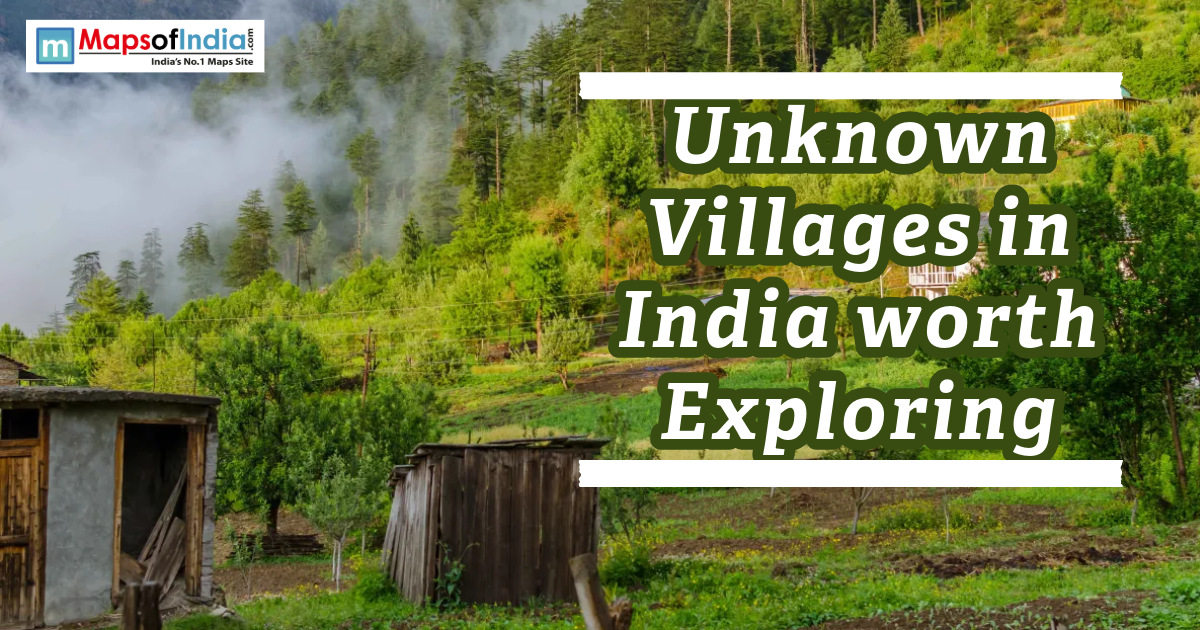
Rather than the tourist hot spots, the corners of India where it is quiet harbour live villages just as they had before. Others are at the edge of misty mountain trails where vestiges of ancient ways still influence everyday life. Some rest beside rivers that have not changed in all the ages. Footpaths meander to earth and wood houses, where modern roads give way. At one location, songs are passed down for centuries, and elders are weaving stories into cloth. There is another village that grows rice in an ancient way. Stone temples may be half-covered by vines, or morning markets may be selling spices raised on surrounding slopes. A few sit by the waterfalls, which are only known to the locals. Both provide something solid in the fast-changing world, moments devoid of noise, plans or screens. These 10 are not on maps, but will be soon.
Mawlynnong, Meghalaya
Deep inside the East Khasi Hills, Meghalaya holds Mawlynnong close a village brushing shoulders with Bangladesh. Sunlight bounces off streets so tidy they mirror the sky. From living roots shaped by years and steady hands, bridges rise like whispers through jungle layers. Because care runs deep among villagers, trash never lingers long enough to take root. Under leafy roofs, guests stay in traditional Khasi homes built close to the ground. Above, pathways dangle between branches, threading through thick green cover. Hidden in hill folds, it sits less than two hours by car from Shillong. Daily ways shape days here: clean rooms, cared-for soil, steady rhythms.
Malana, Himachal Pradesh
At a height of 2,650 metres above sea level in the Parvati Valley, within the Kullu district, lies Malana. It is older than many of the recorded histories, and has traditions that have never been lost, including a language not used anywhere else. It possesses a self-governing system of administration that is believed to have existed for centuries prior to many systems that are in use today. They are descended from a conqueror of old, Alexander. The walk to get there is hard, steady, feet on stone after stone, uphill. There is a noiselessness over the place, which is conditioned by unstated rules. On the high mountain tops where the thin air prevails, old things abide.
Nongriat, Meghalaya
Nongriat is hidden from the hustle and bustle of the roads in the East Khasi Hills, Meghalaya, where thousands of stone steps lead you. It is small, but with green-rooted bridges that become stronger with the passage of years, which attract eyes and attention all over the world. The valley is filled with crystal streams and quiet envelopes around each path, like morning mist. In both cases, tree roots were used to construct the crossings gradually by hand, and they are quite stable, even in the absence of nails or steel. At night, you will hear the sounds of the forest and have simple rooms with no frills, just walls, a bed and all. Only those willing to walk long come; but once there, few can forget how still it is.
Dhordo, Gujarat
The village of Dhordo is located near the border of Gujarat and just a step away from Pakistan in the Banni Grasslands of Kutch. A small town of Maldharis, with houses with white mud on their side walls, is located not far away from this line. Every hut sparkles a little mirror sewn into the walls like tales come alive. People start to come once Rann Utsav comes, for some reason they can’t explain. Within these homes, rhythms resonate, old songs are handed down through hands, feet, voices, open skies. Food comes on the plate, no prompting: flat breads, spices, warm foods, served slowly. A few places are so untouched and ready to give up what’s left. Step in and the air changes, dry wind, laughter, colours bounce off clay.
Ziro, Arunachal Pradesh
Nestled in a sloping landscape of pines and dense bamboo thickets, Ziro Valley shelters a handful of peaceful villages in Arunachal Pradesh‘s Lower Subansiri district. It is the land of the Apatani people, where the olden time of cultivation exists, the wet paddy fields designed by generations. Many faces here are tattooed with stories to tell without words. Beauty is ever-present in every corner, with mist between trees, and a light permeating through terraced plots. But cameras have a million moments, eyes a million more. Roads go into Ziro from Itanagar. This place is sheltered in silence, cherishing tradition above all else, and mountains loom in the background. The population lives much the same way as their forebears, in fields marked by the passage of time. Nature here speaks softly; it folds in green and mist.
Kibber, Himachal Pradesh
Kibber, an isolated group of houses perched in icy stretches of Spiti Valley at altitudes above 4,200 m, is located in the northern part of the valley. The roads leading to it are steep, and some of the highest roads on which human drivers drive on earth. Centuries and wind have fashioned stone-built shelters into a cluster here. A nearby monastery is quiet and weathered and worn away. Around every corner, peaks rise in the sky, bare and jagged, under wide skies. The hikers go through while heading towards Kaza or going on to hike in silence. The ambience here conveys a feeling of being on the outside of anything you know.
Agumbe, Karnataka
Agumbe, nestled among the hills in western Karnataka, is a village in the folds of the Western Ghats. This is the wettest location in South India, like dew drops on the leaves in the morning. The land is covered in thick jungles, and water runs down the rocky cliffs in sudden bursts. One such one is Barkana, and Onake Abbi is another. The scientists walk these trails frequently, in search of frogs, snakes and rare plants that others may overlook. A peaceful research station nestled among green shadows, quietly observing the gradual passing of life. Morning dew has fallen upon trees like folded whispers.
Lachen, Sikkim
Lachen sits hushed among steep slopes, way up in North Sikkim, close to where India meets Tibet. From this spot, most treks toward Gurudongmar Lake begin without delay. Sheltered against biting gusts, homes made of wood follow old ways shaped by Bhutia hands over time. Behind rooftops, peaks rise fast, crisp, glowing when the sun strikes. Out here, peace takes its time waking up. Think neighbourly greetings after long absences, wary but warm. Twisting roads leave Gangtok behind before reaching Lachen.