The US Strike on Venezuela That Led to Maduro’s Capture
Abhishree Sharma January 5, 2026
At the beginning of January 2026, the world awoke to one of the most dramatic geopolitical events in the recent past. The US government organized a surprise military operation within the country of Venezuela, which led to the arrest of President Nicolas Maduro and his wife, Cilia Flores. The operation, which Washington termed a bold move on attacking criminal networks, has elicited a heated debate on sovereignty, international law, as well as the future of geopolitics in Latin America.It was the first move of such a scale in Latin America that the US army became directly engaged in military practices in the region for decades, which essentially changed the relationships between the two countries and caused a strong response from the governments of the world.
How the Operation Unfolded
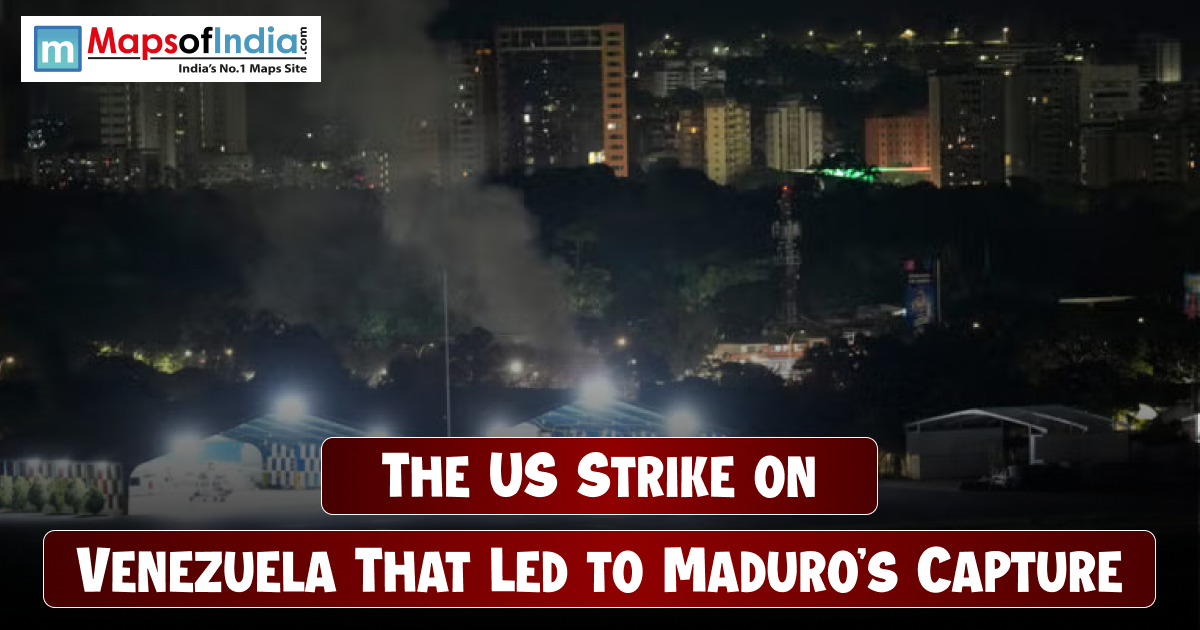
This was performed in the early hours of January 3, 2026. In the pretext of darkness, the US troops undertook an organized military attack on strategic positions in the northern part of Venezuela as well as in the capital, Caracas. It included a lot of air support, electronic warfare and high-end special operations forces.They were reported to use low-flying aircraft, drones and helicopters to counter air defences and capture strategic locations. The US special forces managed to arrive in a heavily fortified presidential compound where Nicolás Maduro was assumed to have resided in just a few hours. The attack was rapid, and the Venezuelan security agencies did not have the time to render any form of effective opposition.Maduro and his wife were rounded up and deported soon afterwards. The whole mission was announced to have been finished in a couple of hours, which is evidence of superiority in military and tactical strategies.
US Justification Behind the Strike
The United States defended the operation by stating that there were criminal charges against Nicolás Maduro dating back long before the operation, such as claims that he headed international drug trafficking cartels and threat to regional security. The American authorities have accused Maduro of misusing state power to stabilize the neighbouring states by engaging in illegal activities.US officials further on the argument had it that years of diplomatic pressure, economic sanctions and negotiations had not resulted in political change in Venezuela. It was the view of Washington that it was time to take direct action in order to defend its interests and bring sanity to the area.In addition to security issues, analysts feel that the oil deposits of Venezuela were strategic. It has some of the largest proven oil reserves in the world, and the possession of energy supply chains is an urgent consideration in world politics.
Immediate Impact Inside Venezuela
President Maduro was captured, and it was a shockwave in Venezuela. During the operation and after, explosions, a disruption of power, and general confusion were reported in Caracas. The amount of the military action taken was realized, and the civilians were taken by surprise.A short time after the ousting of Maduro, the highest judicial officials in Venezuela declared that former Vice President Delcy Rodríguez would lead the country as acting president, but the validity of such an action is still in dispute. The interim government labelled the US operation an illegal invasion and abduction, accusing Washington of having violated the sovereignty of Venezuela.Venezuela's reaction in the public has been divided. When citizens were relieved that the years of economic hardship might be relieved because of the conclusion of the rule of Maduro, others were afraid of anarchy, bloodshed, and alien occupation.
Maduro’s Detention and Legal Future
Following his capture, Nicolás Maduro was transported to the United States, where he is now held in federal custody. He is expected to face serious criminal charges, including narcotics-related offences and conspiracy allegations.The US government has stated that Maduro will be tried under American law, framing the operation as a law-enforcement action rather than a traditional military occupation. However, critics argue that capturing a sitting head of state through military force sets a dangerous precedent.
Global Reaction and Diplomatic Fallout
Nicolás Maduro was captured and taken to the United States, where he is currently imprisoned in federal custody. He will be charged with major criminal offences such as drug-related crimes and conspiracy charges.According to the US government, the operation will be prosecuted in accordance with the laws of the US, which will position it as a law enforcement operation, not a classic military occupation. Nonetheless, critics believe that by using military force to apprehend an incumbent head of state, one is creating a bad precedent.
Legal and Ethical Controversies
One of the most debatable issues of the crisis is the legality of the US operation. The overall use of force against a fellow sovereign state is not authorized or justified by any self-defence, which is against international law.According to the legal scholars, the fact that the strike was not subject to international approval casts grave doubts on the legality of the strike. The ousting of an incumbent president without an international mandate has sounded an alarm among human rights groups and policy analysts.Advocates of the US act, however, argue that the criminal acts of Maduro warrant extremist actions. This conflict of attitudes has rekindled the controversy as to where the boundary between national security and respect for international law lies.
What This Means for the Region
The implication of the US attack on Venezuela is not limited to the ongoing crisis. It indicates the foreign policy change of approach in Washington, where, instead of using sanctions and diplomacy, direct military intervention was used.Such a development is likely to transform the power dynamics in Latin America, predetermine future US operations in foreign countries, and change the way countries react to domestic political crises. It also brings up the issue of tension between the world powers and the possibility of retaliation.In the case of Venezuela, its future is unclear. There is political instability in the country, economic difficulties, and strong social divisions. It is still open to be seen whether the ousting of Maduro will result in reform or more mayhem, as events will continue to unfold in the next several months.
Conclusion
The US aggression against Venezuela and the arrest of Nicolas Maduro is a breakthrough in the history of contemporary international relations. It is the military force, the political strategy and the legal controversy in one dramatic event that will be studied in years to come.The world is keeping a close eye on Maduro, who is awaiting trial in the United States, and Venezuela is grappling to reestablish its leadership. The implications of such an operation will not only lead to the future of Venezuela but can also help remodel the way power is exercised on the international front.