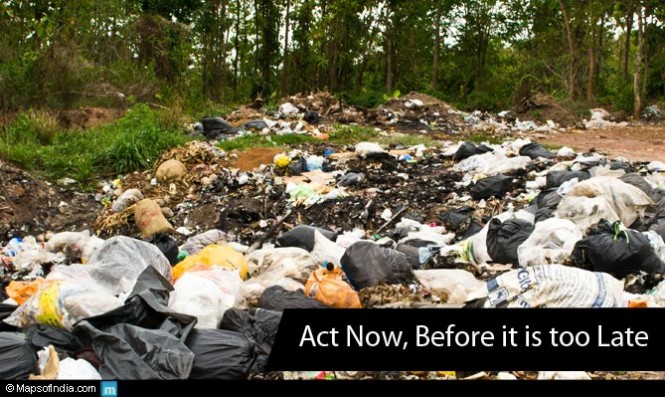
 Plastic is a necessary evil. You can hardly do away with it. The amount of plastic that is disposed off every year can circle the earth four times. Every day we come across plastic in various forms such as garbage and grocery bags, bottles, food containers, computer keyboards, plastic mouse, coffee cup lids and other such products. Though plastic products are very convenient to use, they play a harmful role in polluting the environment. Till the year 2000, the amount of plastic that was manufactured was far less as compared to that made in the first decade of this century. But where is all the plastic going? It would be startling to note that billions of tons of plastic is ending up in the world’s oceans. Discarded plastic products can be found even in extreme polar latitudes.
Actually ocean pollution starts out on land and is carried away by wind and rain to the sea. Plastic gets accumulated in water and it takes thousands of years for it to decay. According to a new study, around eight million metric tons of plastic ends up in our oceans every year. However, if prompt action is not taken, this figure will increase by ten times during the next ten years. Plastic wastes can easily be transported to long distances because of their low density. These are collected and gathered in gyres, system of rotating ocean currents. A vast island of plastic is made as these wastes merge in the ocean where currents unite. An example of this is the Great Pacific Garbage Patch. Located in central North Pacific Ocean, it is twice the size of Texas. Garbage patches can also be seen in the Indian and the Atlantic Ocean and till date five patches have been discovered. Fish and other marine animals mistake the small particles floating on the surface for food.
Plastic is a necessary evil. You can hardly do away with it. The amount of plastic that is disposed off every year can circle the earth four times. Every day we come across plastic in various forms such as garbage and grocery bags, bottles, food containers, computer keyboards, plastic mouse, coffee cup lids and other such products. Though plastic products are very convenient to use, they play a harmful role in polluting the environment. Till the year 2000, the amount of plastic that was manufactured was far less as compared to that made in the first decade of this century. But where is all the plastic going? It would be startling to note that billions of tons of plastic is ending up in the world’s oceans. Discarded plastic products can be found even in extreme polar latitudes.
Actually ocean pollution starts out on land and is carried away by wind and rain to the sea. Plastic gets accumulated in water and it takes thousands of years for it to decay. According to a new study, around eight million metric tons of plastic ends up in our oceans every year. However, if prompt action is not taken, this figure will increase by ten times during the next ten years. Plastic wastes can easily be transported to long distances because of their low density. These are collected and gathered in gyres, system of rotating ocean currents. A vast island of plastic is made as these wastes merge in the ocean where currents unite. An example of this is the Great Pacific Garbage Patch. Located in central North Pacific Ocean, it is twice the size of Texas. Garbage patches can also be seen in the Indian and the Atlantic Ocean and till date five patches have been discovered. Fish and other marine animals mistake the small particles floating on the surface for food.
Plastic is a necessary evil. You can hardly do away with it. The amount of plastic that is disposed off every year can circle the earth four times. Every day we come across plastic in various forms such as garbage and grocery bags, bottles, food containers, computer keyboards, plastic mouse, coffee cup lids and other such products. Though plastic products are very convenient to use, they play a harmful role in polluting the environment. Till the year 2000, the amount of plastic that was manufactured was far less as compared to that made in the first decade of this century. But where is all the plastic going? It would be startling to note that billions of tons of plastic is ending up in the world’s oceans. Discarded plastic products can be found even in extreme polar latitudes.
Actually ocean pollution starts out on land and is carried away by wind and rain to the sea. Plastic gets accumulated in water and it takes thousands of years for it to decay. According to a new study, around eight million metric tons of plastic ends up in our oceans every year. However, if prompt action is not taken, this figure will increase by ten times during the next ten years. Plastic wastes can easily be transported to long distances because of their low density. These are collected and gathered in gyres, system of rotating ocean currents. A vast island of plastic is made as these wastes merge in the ocean where currents unite. An example of this is the Great Pacific Garbage Patch. Located in central North Pacific Ocean, it is twice the size of Texas. Garbage patches can also be seen in the Indian and the Atlantic Ocean and till date five patches have been discovered. Fish and other marine animals mistake the small particles floating on the surface for food.
Plastic is a necessary evil. You can hardly do away with it. The amount of plastic that is disposed off every year can circle the earth four times. Every day we come across plastic in various forms such as garbage and grocery bags, bottles, food containers, computer keyboards, plastic mouse, coffee cup lids and other such products. Though plastic products are very convenient to use, they play a harmful role in polluting the environment. Till the year 2000, the amount of plastic that was manufactured was far less as compared to that made in the first decade of this century. But where is all the plastic going? It would be startling to note that billions of tons of plastic is ending up in the world’s oceans. Discarded plastic products can be found even in extreme polar latitudes.
Actually ocean pollution starts out on land and is carried away by wind and rain to the sea. Plastic gets accumulated in water and it takes thousands of years for it to decay. According to a new study, around eight million metric tons of plastic ends up in our oceans every year. However, if prompt action is not taken, this figure will increase by ten times during the next ten years. Plastic wastes can easily be transported to long distances because of their low density. These are collected and gathered in gyres, system of rotating ocean currents. A vast island of plastic is made as these wastes merge in the ocean where currents unite. An example of this is the Great Pacific Garbage Patch. Located in central North Pacific Ocean, it is twice the size of Texas. Garbage patches can also be seen in the Indian and the Atlantic Ocean and till date five patches have been discovered. Fish and other marine animals mistake the small particles floating on the surface for food.