Arati Saha: The Swimmer Who Crossed the English Channel for India
Vidyut Vardhan December 11, 2025
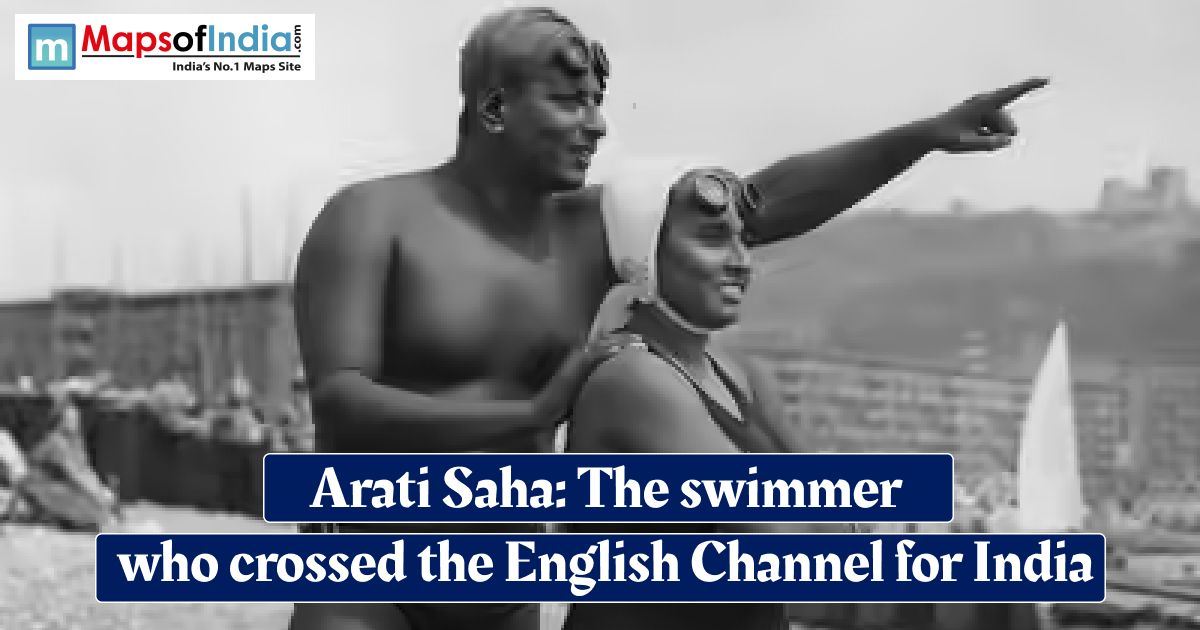
In 1959, a woman from Kolkata, truly a visionary of her time, made history. Arati Saha was the first Asian woman to do a solo swim across the English Channel; a power packed with stamina, time and mettle was the very nature of her accomplishment. Her voyage was more than just about brute strength. It became a landmark of the female sports movement and a major point in the athletic history of India.
Early Life and Beginnings
She was born in 1940 in Kolkata. Arati came into the world at a time when the participation of women in sports was hardly accepted. After her mother died when she was still very young, she was brought up in a middle-class family, mostly by her father. Her father noticed her love for swimming and encouraged her to pursue it seriously. By the age of five, she had started participating in local swimming competitions. Arati's talent showed itself to be so good that she not only became a national-level record breaker but also a winner of numerous medals and a name familiar to the Indian swimming community.
Dreaming of the English Channel
The Channel from England to France, length of around 33 kilometres, is one of the most difficult swims in the open-water swimming world. The challenging and changing currents, icy water, and choppy waves are all hard tests of physical and mental strength. Arati read about Mihir Sen while she was at a loss about how to get the idea of the Channel. After hearing of Sen's achievement, she had the ambition to take the challenge by herself and not let it go down.
Landing the Blow and Solving the Problem
There is no simple way of stating this. To build the stamina that is needed for a long-distance swim, Arati had to endure training in very bad conditions. She exercised regularly in rivers and seas and often swam for hours against strong currents. Money was yet another great obstacle standing in her path. She did not, as a woman in the 1950s, have the same chances of getting support or sponsorships as men did. But, nevertheless, the lady's spirit impressed the Indian Prime Minister Jawaharlal Nehru, who then lent his support to her Channel swim venture.
Trying for the First Time and Encountering Difficulties
In 1959, Arati headed to England for a big swim goal. On August 27 came the first try - she jumped in full throttle. Despite pushing nonstop past 16 hours, wild currents forced her back; France stayed out of reach. That flop hit hard, a gut-punch letdown. Still, quitting didn’t cross her mind - not even close. She didn’t see it as a flop, a solid lesson learned. Arati chose to check the route, tweak her approach, then prepare for round two.
The Historic Swim
September 29, 1959, saw Arati try again. This time, she swam from Dover, England, toward Cape Gris Nez, France. The water was freezing, and the waves were strong, but she was not deterred. She was at it for over sixteen hours, fighting against all kinds of hardship - utter fatigue, and pain. She did the impossible. The English Channel was the first Asian woman to win in history. The moment was a source of pride not only for India but also for the whole of Asia.
Recognition and National Honour
Her triumph was welcomed by the public and a great number of people throughout the nation. Arati became a role model representing the qualities of endurance and bravery. The Government of India conferred on her the Padma Shri award in 1960. Thus, at that time, she was counted among the youngest recipients. Everywhere, people wrote about her as the "Mermaid of the Ganges." The story of her life became like a torch to light up the path for the next generation of athletes, mainly young girls, to dream beyond social constraints.
Breaking Gender Barriers in Sports
Arati’s feat was much more than just a record in swimming. It was a loud voice of defiance against the gender rules of her era. In the 1950s, women in India were hardly ever seen in competitive sports, and the international event was a dream far beyond their reach. Arati's triumph proved that females could be successful in concerned bodies and hard, physically demanding disciplines. Not only did she demonstrate her individual power, but she also confronted the social mindset that was deeply rooted and that limited women's participation in sports.
Balancing Life and Passion
When she was married, Arati turned more to her home life, but she did not entirely give up swimming. On a number of occasions, she mentioned that the sports discipline she had learned helped her in life beyond the swimming pool. Her experience is a great accomplishment and also a gauge that such achievements usually come from normal beginnings and that every challenge you face along the way actually makes your spirit stronger.
Challenges Beyond the Water
One of the hardships that Arati faced was her mental fortitude, which was just as important as her physical one. She encountered condemnation from the community and pessimism. There was a lot of nonsense about why a woman had to do such a challenging thing in the first place. Yet, she was not shaken at all, seeing that the concept of personal goal was not gender-oriented. Her trek is a mirror to the indomitable spirit of iron-willed feminists who fought silently for their rightful place in a male-dominated environment.
Remembering Arati’s Contribution
The Indian government honoured her with a postage stamp in her name in the year 1999. Schools and sports institutions keep inspiring young athletes by narrating their stories. Her name stands as a sign of India's ability and the determination of its women to overcome obstacles.
A Story That Still Inspires
To a certain extent, the imprint of Arati Saha is present in every swimmer who takes the challenge of the English Channel, in every woman who shatters a glass ceiling, and in every young person who is indefatigable. Her story is a success manual that says that it is not through an outlet but through work and struggle that success is attained. Her name is not always there on the front pages, but her spirit is still strong in the waters of the Channel where she made her name.