


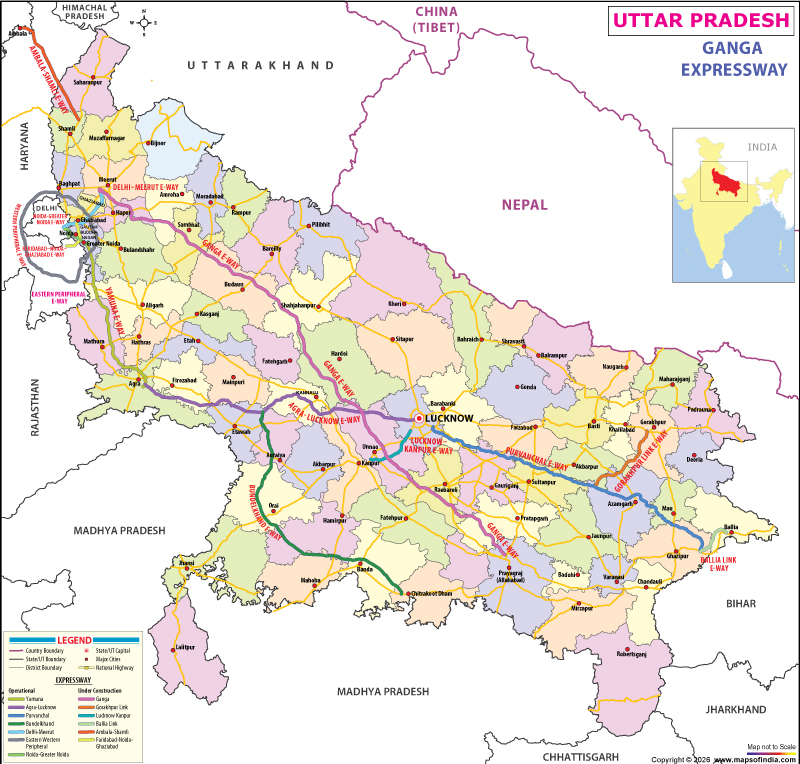





The Uttar Pradesh government, then led by Chief Minister Mayawati, announced the project of building the 1047-kilometre-long eight-lane expressway in 2007. The proposed expressway, the longest in the country, was to connect Greater Noida in east UP to Balia in west UP at its border with Bihar, simultaneously running along the left bank of the Ganga River and connecting the major towns on the route. The towns on the route include Varanasi, Allahabad, Rae Bareli, Kanpur, Shahjahanpur, Bulandshahr and Badaun. The proposed expressway would, in fact, effectively connect east and west UP, traversing the breadth of the state and giving an economic boost to the state with the smooth connectivity between its major towns and cities. The expressway would also reduce the travelling time by road from Delhi to Allahabad and Varanasi, major religious tourist and pilgrimage spots in UP.
However, the original project faced several environmental, legal, and land acquisition challenges. In 2009, the Allahabad High Court restrained the state government from proceeding with the project due to concerns regarding construction on the ecologically sensitive Ganga floodplains. Farmers’ protests over land acquisition further delayed the project.
Updated Status of the Ganga Expressway (2026)
The original 1047-kilometre proposal was later redesigned and significantly modified by the Uttar Pradesh government.
Today, the Ganga Expressway is being developed as a 594-kilometre-long six-lane expressway expandable to eight lanes, connecting Meerut to Prayagraj instead of Greater Noida to Ballia.
Currently, the project is under the development of the Uttar Pradesh Expressways Industrial Development Authority (UPEIDA) and is headed by Uttar Pradesh's Chief Minister, Yogi Adityanath.
The construction process commenced in 2021 and has started at various districts of Uttar Pradesh at a fast pace.
The revised project expenditure is now estimated at ₹36,000 crore as compared to the earlier estimate of ₹40,000 crore.
The expressway now passes through 12 districts, including Meerut, Hapur, Bulandshahr, Amroha, Sambhal, Badaun, Shahjahanpur, Hardoi, Unnao, Rae Bareli, Pratapgarh, and Prayagraj.
The revised alignment was changed to reduce environmental concerns related to the Ganga floodplains.
Strategic Importance of the Ganga Expressway
The Ganga Expressway is not only a road project, but it is a strategic economic corridor. It intends to bridge the gap between the underdeveloped eastern parts of Uttar Pradesh and the western belt, which is more industrialized, in an attempt to minimize the disparities between the regions. Access to markets, health care and education can be greatly improved through better connectivity.
Eastern Uttar Pradesh has historically lagged in terms of industrial development as compared to the western region. The existence of the expressway will see reduced logistics costs and the region will be more appealing to industries, warehouses and areas of investment. This would result in job creation and more income opportunities for the local populations.
The expressway is also strategically important from a defence perspective. An emergency airstrip is being constructed in Shahjahanpur district for use by the Indian Air Force during emergencies.
Economic Impact and Development Potential
The expressway will be a driver of economic growth. A number of industrial corridors, logistics parks and townships were suggested along its path. An improved road network is likely to lead to both internal and external investments, and the Ganga Expressway has not been an exception.
Farming, which is the backbone of Uttar Pradesh's economy, will also gain a lot. Farmers shall also have faster access to markets, which will help minimize the transportation durations as well as the spoilage of perishable produce. This would result in enhanced pricing and livelihoods.
Also, the tourism industry will benefit significantly. The cities such as Varanasi and Prayagraj (Allahabad), which receive millions of pilgrims every year, will be more accessible, increasing religious tourism and other related services like hotels, restaurants, and transportation.
Environmental Concerns and Challenges
With all the promise, the project has had its share of environmental issues. The suggested alignment along the Ganga floodplains caused panic among environmentalists. The floodplains are important in ensuring the ecological balance of the river system.
The project might interfere with the natural water flow in the regions, biodiversity and heighten the risk of floods in areas near these sites. This caused the Allahabad High Court to intervene with these issues emphasizing the need to have sustainable development.
In the revised project, authorities altered the alignment and adopted additional environmental safeguards to reduce ecological impact.
There must be a comprehensive impact assessment involved in the process of environmental clearance, and the development and maintenance of the environment in such huge projects is a significant challenge.
Land Acquisition Issues
Land acquisition has also proved to be another challenge. Infrastructure projects such as airports, ports, railway lines, and similar construction projects may demand large parcels of land, thus causing farmers and the local communities to be displaced. In the Ganga Expressway, demonstrations arose in various districts and stalled development.
Farmers required just fair payment, rehabilitation, and openness in the acquisition process. The agitations are indicative of larger problems in the development of infrastructure in India, where the key issue is the need to strike a balance between growth and social justice.
The revised project had a quicker pace of land acquisition, because of better compensation packages and better negotiations with affected farmers than the original project.
Revival Efforts and Changing Vision
The vision of the Ganga Expressway has changed over the years. The project has been re-examined by successive governments, changing its alignment and solving previous issues. The revival efforts initiated during the tenure of Akhilesh Yadav highlighted the importance of the project in Uttar Pradesh’s development agenda.
The Uttar Pradesh government of the Yogi Adityanath government has been actively promoting the construction of expressways in the state, with the construction of the Purvanchal Expressway and the Bundelkhand Expressway being underway in recent years. This renewed focus on infrastructure has accelerated progress on the Ganga Expressway as well.
Connectivity and Travel Benefits
Among the short-term gains of the expressway, there will be a shortening of the travel time. Presently, travelling by road through Uttar Pradesh may be time-consuming as there is congestion and poor road conditions in some places.
The high-speed expressway will enable easy movement between the major cities. This enhanced connectivity will as well boost interstate travel, particularly among Delhi, Uttar Pradesh, and Bihar.
It is anticipated that the expressway will make a tremendous difference in the time taken for travel between Meerut and Prayagraj, both in the case of passenger and freight transportation.
In addition to travel time savings, the faster travel will make transportation more efficient and cost-effective by leading to lower fuel consumption and reduced vehicle wear and tear.
Future Prospects
The Ganga Expressway is still a symbol of hope and hopefulness. It will be one of the longest and one of the major expressways in India once completed. Future plans include:
- Expansion from six lanes to eight lanes
- Development of industrial and logistics hubs
- Smart toll management systems
- Enhanced safety infrastructure
- Better integration with other expressways and freight corridors
Conclusion
The Ganga Expressway is not only a road, but also a dream of a united, thriving, and harmonious Uttar Pradesh. Although the project has been hit by various setbacks such as legal, environmental and social challenges, the potential benefits of the project are undisputable.
Unlike the stalled proposal of the past, the project is now under active construction and progressing steadily toward completion.
The expressway has the potential to change the landscape of the state, whether it is by increasing its economic growth, completing its connectivity, or facilitating tourism. The trick is that the project should be carried out in a responsible manner so that the development should not be at the expense of environmental sustainability or social equity.
As Uttar Pradesh continues expanding its expressway network, the Ganga Expressway stands as a major example of India’s rapidly evolving infrastructure ambitions.
Last Updated on: May 12, 2026
