

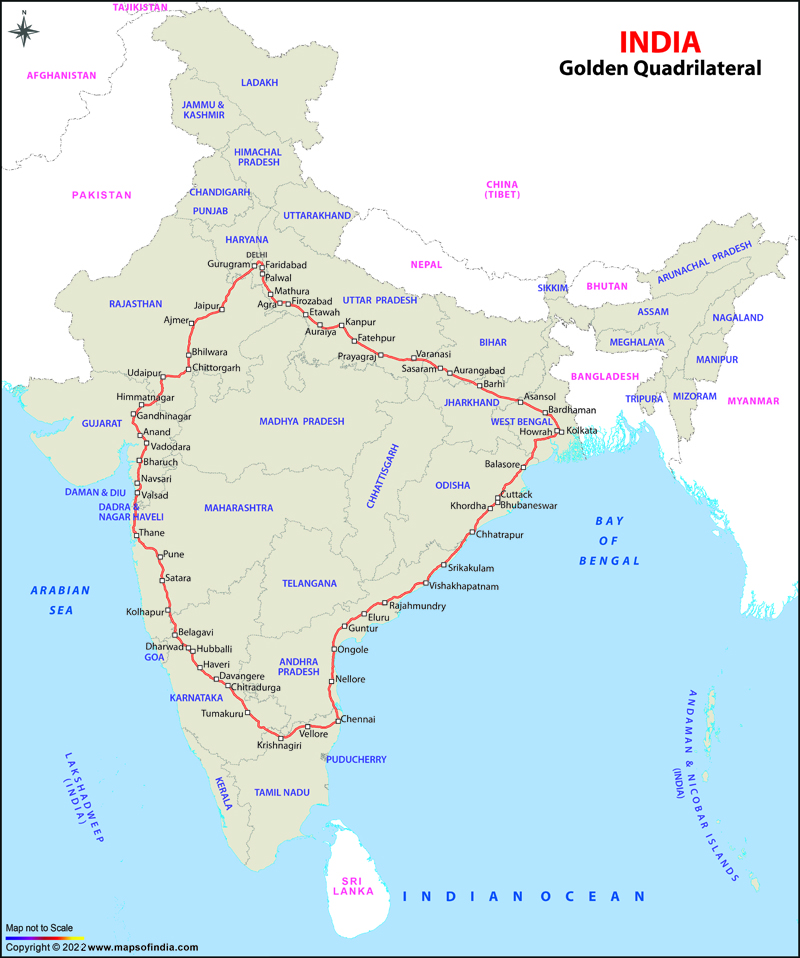



Highways are the most important infrastructure in India, and in view of the high growth rate and growing demand for transportation in India, they play an important role in the growth and development of the country. The Golden Quadrilateral project was officially launched in 2001 under the National Highways Development Project (NHDP). One of the largest and most ambitious infrastructure programs in the country, the Golden Quadrilateral Highway Network has transformed the way people connect the nation's biggest metros. The Golden Quadrilateral (GQ) project is not just a highway; it is a symbol of the development, modernization and revolution in transport in India.
What is the Golden Quadrilateral Highway Network?
Golden Quadrilateral is a vast highway network that is planned to join the four metros of India, namely Delhi, Mumbai, Chennai and Kolkata. These cities are arranged in a quadrilateral pattern on the map, and hence the project is known as “Golden Quadrilateral.”
One of the largest highway construction projects in the world, it was launched under the National Highways Development Project (NHDP). It was started under the leadership of the former Prime Minister of India, A.B. Vajpayee, whose goal was to enhance the transportation system and boost economic integration between the different regions of the nation.
The Golden Quadrilateral highway system of India runs along a distance of approximately 5846 km and is one of the important highway systems in India.
Major Cities Connected by the Golden Quadrilateral
The highway network links four important economic and cultural centres:
- Delhi- The capital of India, which is also the seat of political power.
- Mumbai- The financial and the largest port city of India.
- Chennai- An important industrial and automobile manufacturing centre.
- Kolkata- An old commercial and cultural centre in the Eastern part of India.
Route of the Golden Quadrilateral
The Golden Quadrilateral takes the following major highway routes:
- The distance between Delhi and Kolkata is approximately 1,450 km via NH-19
- The distance between Kolkata and Chennai is approx. 1,680 Km via NH-16.
- The distance between Chennai to Mumbai is approx. 1,330 Km via NH-48.
- The distance between is approx. 1,420 km Mumbai to Delhi via NH-48.
- Delhi
- Haryana
- Uttar Pradesh
- Bihar
- Jharkhand
- West Bengal
- Odisha
- Andhra Pradesh
- Tamil Nadu
- Karnataka
- Maharashtra
- Gujarat
- Rajasthan
Importance of the Golden Quadrilateral Map
The Golden Quadrilateral Highway Network Map is of great significance in the fields of transportation planning, logistics, tourism and economic development. It gives a graphical view of the most critical road corridor in India and enables people to understand how the major cities are connected.
- Improved Transportation
Prior to the Golden Quadrilateral, the movement of people between major cities was poor and slow through road transport. The project has significantly reduced the journey time and enhanced the roads' standard, resulting in more efficient and safer transport. - Economic Growth
Inefficient movement of goods between states was overcome by the highway network, which helped increase trade and commerce. Industries located near the highway experienced significant growth due to improved market access and transportation facilities. - Better Connectivity
The GQ linked remote and semi-urban regions to the major cities. The project enhanced access to education, healthcare, tourism, and employment. - Growth of Logistics and Freight IndustryThe highway project was a great success for the transportation and logistics industries. The movement of the trucks became easier, fuel usage was cut down, and delivery times were shortened.
- Tourism Development
Road travel between the key destinations became easier and more comfortable for travellers. There was an increase in tourist numbers at several of the tourist sites along the way.
Features of the Golden Quadrilateral Highway
The Golden Quadrilateral highway network has a number of features that are advanced features:
- Four-lane and six-lane highways
- Safe driving with divided carriageways
- Flyovers and bypasses
- Improved road signage
- Improved toll collection system
- Service lanes in an urban area
- Modern bridges and road facilities
States and Cities Benefited
The Golden Quadrilateral has made a difference in many cities and industrial areas. The network links some major cities, such as:
- Jaipur
- Ahmedabad
- Surat
- Pune
- Bengaluru
- Visakhapatnam
- Bhubaneswar
- Kanpur
- Varanasi
- Dhanbad
Challenges Faced During Construction
The project was successful, but there were a number of challenges during the construction:
Land Acquisition Issues
In heavily populated areas, it was hard to purchase land for highway development.
Environmental Concerns
There were some concerns about deforestation and environmental impact in some areas due to construction activities.
Funding and Delays
There is a need for massive investments and careful planning in large-scale infrastructure projects. Some sections of the highway experienced delays due to financial and administrative reasons.
Traffic Management
One of the biggest challenges for the authorities was traffic management during the construction period.
Impact on India’s Economy
The Golden Quadrilateral is regarded as the backbone of India's economic infrastructure. Research has indicated that districts with a close proximity to the highway network had higher levels of industrial growth and investment opportunities.
The project facilitated the optimization of the supply chain and promoted businesses to set up factories and warehouses in areas close to the road network. Easier transportation of agricultural products to urban markets was also advantageous to agricultural producers.
Further, the GQ contributed to the integration of the nation, linking different cultural and economic areas of the nation.
Future Developments
India is on a continuous path of expansion and modernization of its highway infrastructure, with several projects ongoing, such as:
- Bharatmala Project
- Delhi-Mumbai Expressway
- Two Dedicated Freight Corridors – Eastern and Western Dedicated Freight Corridors.
- Smart Highway Systems
Conclusion
The Golden Quadrilateral Highway Network Map is one of the best infrastructure achievements of India. The project linked Delhi, Mumbai, Chennai and Kolkata, changing the road transport scenario and boosting the country's economic development. It brought about connectivity, reduced travel distance, enhanced trade, and facilitated the development of the region.
The Golden Quadrilateral remains an important part of India's transportation network today, and is a testament to the power of infrastructure to define a nation's future. The Golden Quadrilateral highways will continue to play a crucial role in India's future as it strives to become a global economic powerhouse.
Last Updated on : May 07, 2026
