

About Fatehpur Sikri
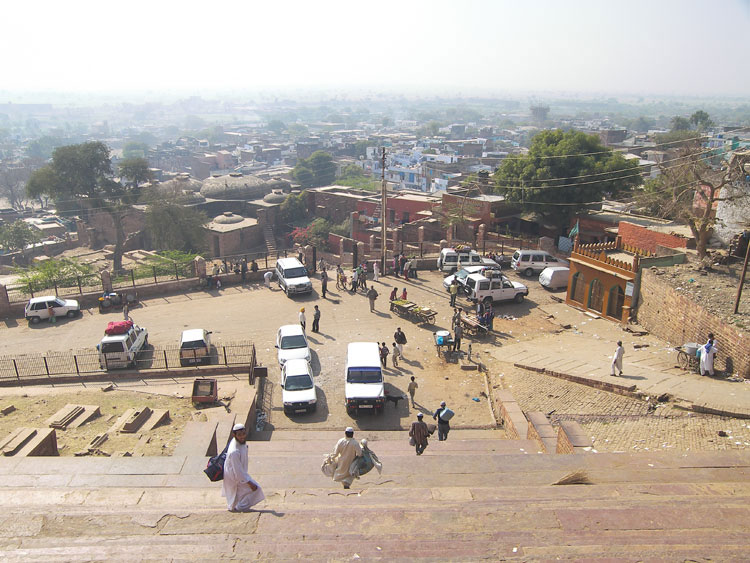
Fatehpur Sikri or 'the City of Victory' is a fortified city in Agra, Uttar Pradesh. It was founded in 1569 by the Great Emperor of the Mughal dynasty Akbar. The palace city atop a rocky ridge, confined within walls on its three sides and a lake in the foreground, was designed by Tuhir Das using Indian principles of art.
The structures in the city have been designed following the styles of Hindu, Jain and Islamic architecture, using red sandstone, which is also called as 'Sikri sandstone'. The city can be entered through several gates that are erected at different points along the wall bordering the fort. The gates are namely the Chandanpal Gate, the Agra Gate, the Tehra Gate, the Lal Gate, the Delhi Gate, the Birbal Gate, the Gwalior Gate, the Ajmere Gate and the Chor Gate.
History and Architecture
The great emperor Akbar had no heir. He visited many places offering prayers and seeking blessings of saints. On one such endeavor he was blessed by a Sufi Saint Sheikh Salim Chishti in the village Sikri and the saint foretold that the emperor will be blessed with a son. After birth of his son the emperor showed his gratitude by building a city in the honor of the Sufi Saint and named it Fatehpur Sikri. "Fateh" in Persian language means "victory".
The city is about 37 km from Agra on the Sikri ridge 3 km in length and 1km wide surrounded by wall covering three sides and a lake on the fourth side. Akbar conceptualized to build the walled city which took around fifteen years to complete and includes royal palaces, private quarters, harems, different utility buildings, court and mosques. Tuhir Das, the architect of the city primarily used Indian principles which includes use of various regional schools of art and craftsmanship specially that of Bengal and Gujarat. Apart from Islamic elements, significance was given to Hindu and Jain architecture. Akbar shifted his capital from Agra to Fatehpur Sikri. Number of gates was built to approach the city namely Delhi Gate, Agra Gate, Lal Gate, Birbal's Gate, Gwalior Gate, Tehra Gate, Chandanpal Gate, Chor Gate and Ajmere Gate. After the death of the Sufi saint, Akbar erected a Tomb of the saint made of red Sandstone. It is this city that gave birth to the legends of the great Akbar and his famed courtiers known as "Navratnas" or the nine jewels.
Persian principles are highly reflected in the complex as Akbar wished to revive magnificence of Persian court ceremonial as was during the time of his famous ancestor Timur. Local abundance of red sandstone was fully utilized in constructing the structures and buildings. The royal palace complex consist series of individual pavilions that were beautifully arranged in geometric patterns inspired from Arabian and central Asian encampments and rests on a piece of level ground. The monuments and structures in Fatehpur Sikri remind one about artistic sense and the holistic approach of the great emperor. Influence of Indian embellishments is highly represented.
Due to shortage of water availability the palatial complex was abandoned by Akbar just after its completion in 1585. The presence of nearby Rajputana areas in the North West and the increasing turmoil also caused shifting of the emperor's base from Fatehpur Sikri to Lahore and thereafter again to Agra in 1598.
Some of the main attractions of the city are:
Diwan-i-Aam :A hall meant to hold public meetings and gatherings was one of the most essential structures of palaces of the ancient times. It was called Diwan-i-Aam or Hall of Public Audience. In the complex of Fatehpur Sikri, it is a multi-bayed structure in rectangular shape. |
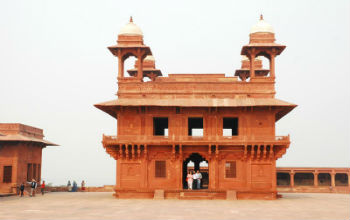
Diwan-i-Khas :Diwan-i-Khas or Hall of Private Audience is the imperial pavilion where the royal members assembled and discussed private as well as business affairs. Built in Persian architectural ornamentation, it is a plain building in square shape with four chhatris on the top. |
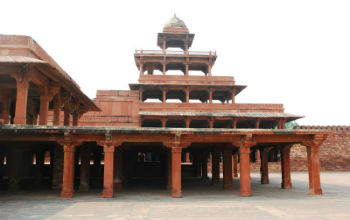
Panch Mahal :As the name suggests, it is an impressive palace-like structure having five storeys that served as an abode of the noble ladies. The top of the structure is a large-sized dome shaped chhatri, with each level down, the size of the tier increases. Total 176 carved columns are supporting the floors. |
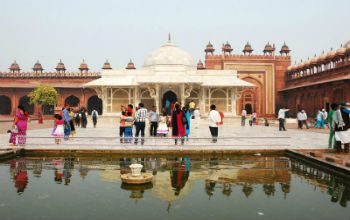
Tomb of Salim Chisti :Within the courtyard of the mosque, there is the tomb of Salim Chishti, a Sufi saint. The grave of Chisti is present under an adorned canopy made up of wood in a chamber at the centre of the single-storeyed structure. On the outer side, there is a passage with impressed latticework and frames having elaborate geometric shapes and patterns.As per legends, it is said that the Emperor Akbar, as a token of gratitude to the Sufi saint Shaikh Salim Chisti, had named his son Salim after the name of this saint; he later became popular as Jahangir. Chisti was the one who blessed Akbar with his heir. Another tomb in the complex is that of Islam Khan I, the grandson of the saint. On the top of the tomb rests a colossal dome along with 36 minor chhatris. |
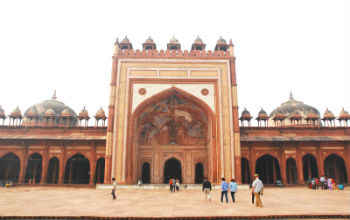
Jama Masjid :Jama Masjid, a congregational mosque, was one of the first buildings that were erected at the historic site. The construction of the mosque was completed in the year 1575 by Sheikh Salim Chishti. Formerly, the late Hazrat Shah Muhammad Mazhar Ullah served as the Imam of the Mosque, but presently his son Maulvi Mukarram Ahmad is playing the key role.The mosque has been erected with the features that of a characteristic Indian mosque, having iwans around a central courtyard. However, it stands out in its design because of prominent chhatris over the sanctuary. |
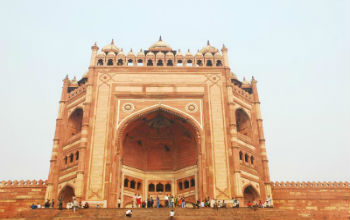
Buland Darwaza :The grand doorway leading to the Jama Masjid at Fatehpur Sikri, the Buland Darwaza is 55 metre in height. It was in AD 1601, that is five years after the construction of the mosque, that the gate was constructed as a 'victory arch'. It was built to mark the success of Akbar over Gujarat. In its arch, it bears two inscriptions; of which one reads: 'Isa, Son of Mariam said: The world is a bridge, pass over it, but build no houses on it. He who hopes for an hour may hope for eternity. The world endures but an hour. Spend it in prayer, for the rest is unseen.' |
Ibadat Khana :Ibadat Khana, meaning the House of Worship was built by the Mughal Emperor Akbar in 1575. This section was included in the city to hold religious gatherings and discussions among the great leaders of spiritual background. The foundations of Din-e-Ilahi were laid by Akbar here. However, the structure was demolished long back. |
Anup Talao :Anup Talao is a red sandstone tank located in front of Khawabagh complex in the palace at Fatehpur Sikri. In the middle of the tank, there is a raised platform which can be reached after crossing small causeways. |
Hujra-i-Anup Talao :Also known as Pavilion of the Turkish Sultana, the Hujra-i-Anup Talao is believed to be the chamber that housed the guests visiting Akbar. However, some of the legends hint that it was a part of the great emperor's study. However, the structure has some significant architectural features, including floral and geometric carvings on dado panels, brackets, friezes and columns. The carvings on every inch of the structure represent some or the other scene from nature. |
Mariam-uz-Zamani's Palace :The palace of Mariam-uz-Zamani, the first Rajput wife of Akbar and the mother of Jahangir, is one of those structures in the city which reflect the elements of Gujarati architecture. |
Pachisi Court :The Pachisi Court was the space made for the royal members to spend their leisure time and play the game Pachisi. The flooring of this courtyard has been designed to resemble the cruciform board of Pachisi. |
Birbal's House :Birbal was one of the gems that Akbar had, and thereby, he was granted a separate chamber. The double-storeyed building, constructed in 1571, is comparatively smaller in size, incorporating only four rooms, but it stands out with its intricate architectural designs. |
Naubat Khana :Naubat Khana, also known as Naqqar Khana means a drum house. It is located in front of the Elephant Gate or the Hathi Pol Gate, from where the noble men entered the complex. It was the place for the musicians to beat drums to mark the arrival of the Emperor. |
Other attractions in Fatehpur Sikri are Diwan-I-Am, Turkish Sultana, Daulat khana-I-khas, Palace of Jodha Bai, Hawa Mahal And Nagina Masjid.
Timings
Open daily from sunrise to sunset.
Foreigners: INR 485
Indians: INR 50
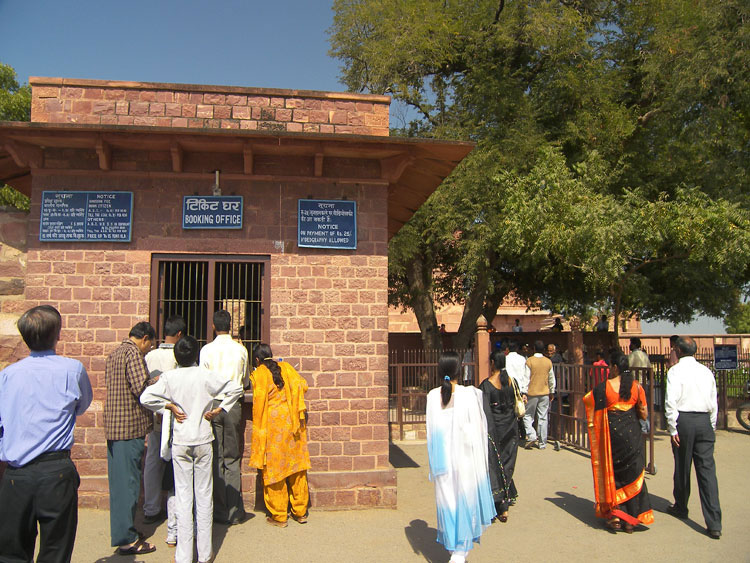
Entry fee for adults and children above 12 years is Rs. 5.00
Entry on Friday is free.
You can visit the city of your own or avail a local guide. The best time to experience and explore this historic extravaganza is from November to February.
Location and how to reach
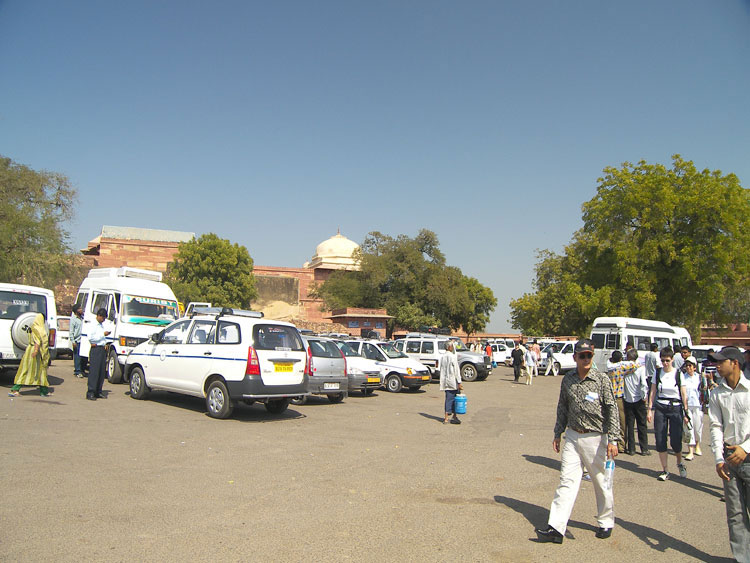
Situated at a distance of about 37 km from Agra this is a must see destination that gives you a feel of the royal and rich heritage of the Mughal Dynasty. Regular bus services of UPSRTC, tourist buses and luxury cab are available. Fatehpur Sikri railway station is just 1 km from the city center. One can avail flight to Agra and then go by road to Fatehpur Sikri.
Location of Fatehpur Sikri, Agra, Uttar Pradesh
Fatehpur Sikri - Entry Fee, Timing, Address, Official Website | |
|---|---|
| Address | Fatehpur Sikri, Agra, Uttar Pradesh - 282005 |
| Entry Fee: | Entry fee for Indians and citizen of SAARC and BIMSTEC countries : 20 Rs. Entry fee for Foreigners : 260 Rs. No Entry fee for Children upto 15 years. |
| Timings: | Visiting Hours - 6:00 AM - 6:00 PM |
| Phone No (Official) | +91-562-2421204 |
| Official Website | asi.nic.in |
| Mobile Phone allowed or not | Not allowed inside. |
Last Updated on : June 15, 2026
