

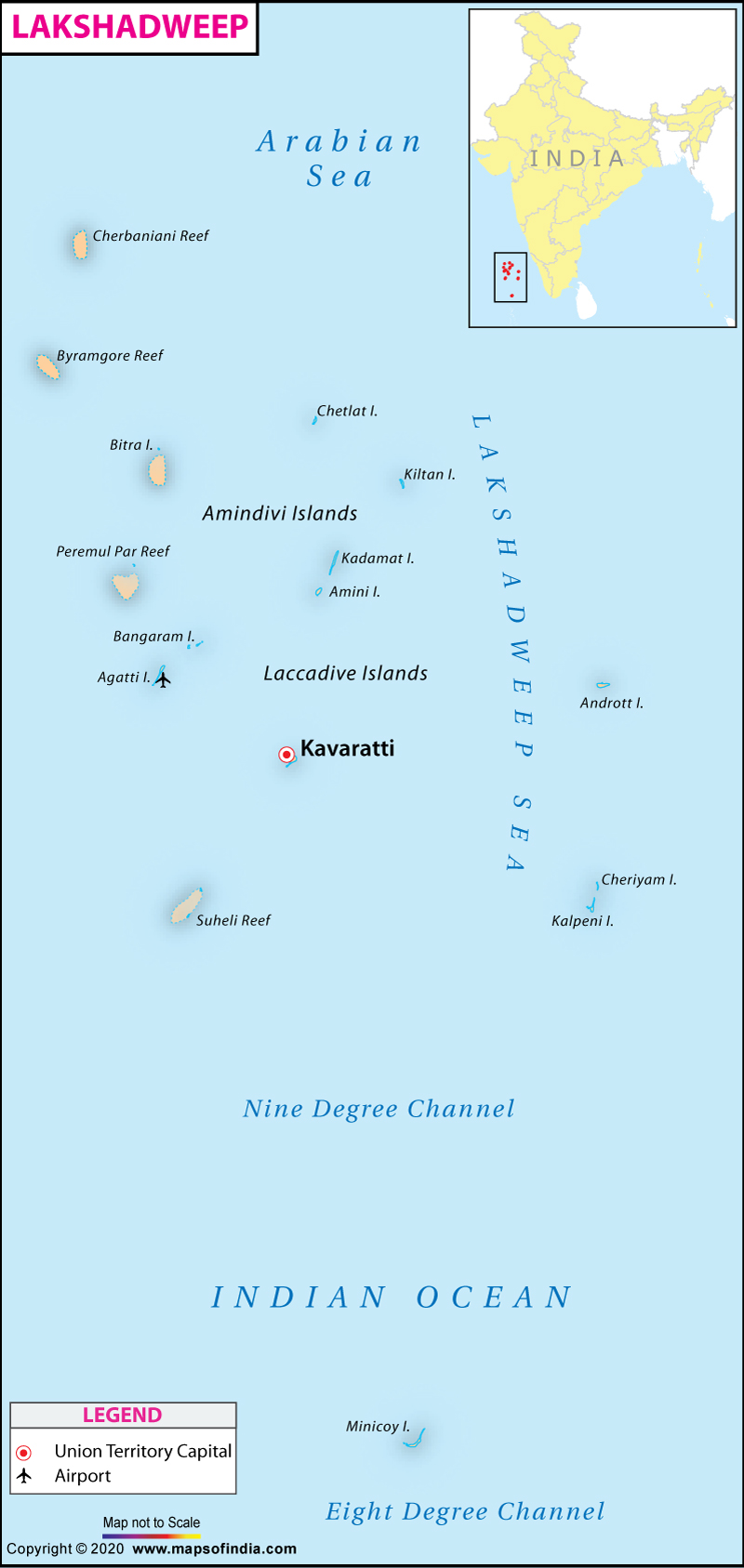



About Lakshadweep
Lakshadweep, in the Arabian Sea, is a part of the Indian subcontinent and is recognised as the smallest union territory of India. Lakshadweep means "hundred thousand islands" in Malayalam and Sanskrit. True to its name, these islands are very picturesque and provide a true vacation for those who love beaches, water sports and sea food.
The whole of Lakshadweep is nothing but a set of small islands situated near each other. It comprises a total of twelve coral atolls, five banks, three coral reefs, and several islets. The location is near the Kerala coast and falls under the jurisdiction of Kerala state and Kerala High Court. Kavaratti is its capital and it is considered one of the most beautiful places in the Indian subcontinent.
The union territory was formed on November 1, 1956. The state animal is the butterfly fish, and the state bird is the sooty tern. The state tree is bread fruit. The languages spoken here are Malayalam, Hindi, Mahi and Tamil.
It is a group of about 36 islands and has a total land area of 32 square kilometers which is scattered over 30,000 square miles of the Arabian Sea. Out of the 36 islands, only ten are inhabited and they are Andrott, Amini, Agatti, Bitra, Chetlat, Kadmat, Kalpeni, Kavaratti, Kiltan and Minicoy. Representing the rich biodiversity of the region, the various facts on the islands enable one to accumulate a wide range of interconnected and sound knowledge about Lakshadweep. Blessed with an unmatched natural beauty, the exotic coral reef island of the union territory is an interesting blend of scenic beauty coupled with modern infrastructural facilities that draw several tourists to this place from across the globe.
More Detail...
| Facts on Lakshadweep | |
|---|---|
| Official Website | www.lakshadweep.gov.in |
| Date of Formation (Declared a Union Territory) | Nov 1, 1956 |
| Area | 32 sq km |
| Density | 2000/Km2 |
| Total Population (2011) | 64,473 |
| Males Population (2011) | 33,123 |
| Females Population (2011) | 31,350 |
| No. of District | 1 |
| Capital | Kavaratti |
| Forests & National Park | Pitti Bird Sanctuary |
| Languages | Divehi, Malayalam, Jeseri, Tamil, Mahi, English |
| State Animal | Butterfly fish |
| State Bird | Noddy Tern |
| State Tree | Bread fruit |
| Literacy Rate (2011) | 92.28% |
| Females per 1000 males | 946 |
| Assembly constituency | 0 |
| Parliamentary constituency | 1 |
History of Lakshadweep
The local traditions attribute the history of Lakshadweep to the last Chera king of Kerala known as Cheraman Perumal. Historians say that he converted to Islam at the behest of Arab merchants and left his capital Craganore, which is today known as Kodungallor in Mecca. Search parties were believed to have gone to various places in search of the king. However, due to a fierce storm, their ship wrecked on one of the islands called Bangarma. After the storm subsided, the party reached Agatti Island and on their way back home came across the various islands of Lakshadweep. Certain soldiers started living in one of the islands called Amini.
Islam in Lakshadweep also dates back to the 7th century, when St. Ubaidullah set sail to places to preach Islam. He reached here after his ship wrecked and found himself on this island. He got married here and successfully converted people to Islam. His grave is still there in Andrott and is now a sacred place.
With the advent of the Portuguese, began the plunder of the Laccadives (as Lakshadweep was earlier known). They were interested in the finely spun coir. However, the Portuguese could not last for many years as they are believed to have been killed through poisoning by the locals.
The modern history says that the ruler of Lakshawdeep was Raja of Chirakkal in the 16th century. Later some islands came under the rule of Tipu Sultan. In the year 1799, British East India Company arrived here. But by 1854 the whole of the Lakshadweep came under the rule of the East India Company. After Independence, the islands came under the Republic of India and formed a separate union territory in 1956. More Detail...
dweep is the smallest union territory of India and has various functioning bodies in the government. The union territory is administered by the governor who is appointed by the President of India. The island comes under the Kerala High Court jurisdiction which is situated in Kochi, Kerala. The district headquarter is located in Kavaratti. The government has developed various departments to develop the land. The various departments work for the upliftment of the people here and are very efficient. The island has 10 subdivisions. While Minicoy and Agatti have subdivisions under the Deputy Collector, the other 8 islands have sub-divisional officers. The collector is also the development commissioner and the District Magistrate who looks into the matters of land, law and order and revenue. Besides, there are also additional district magistrates and ten executive magistrates. More Detail...
Society and Culture
The islands of Lakshadweep have a deep tradition and culture that has existed since the old days. There are diverse traditions and customs. This predominantly Muslim area comprises folk festivals, dance and various traditions that are deeply rooted here. Due to its proximity to the state of Kerala, many religious customs and traditions have been influenced from Kerala. The festivals celebrated here are muharram, bakri id and the milad-un-nabi and eid-ul-fitr. All the festivals are vibrant with a strong sense of integrity. The food here reflects the taste of the people and their preferences. The local cuisine comprises sea fish and coconut. Coconut water is the most consumed drink here. People here prepare their food with the maximum use of coconut, which is very delicious. With lip-smacking seafood to spicy meat dishes, you are going to taste some of the most exotic dishes that you will find in India. Besides, you can taste the mouth watering idlis, dosa, rice, etc. More Detail...
People
People here lead a simple lifestyle. There are four main communities called the Malmis, Aminidvis, Melacheris and Koyas. Aminidivis are the local inhabitants and were first to arrive. The Koyas are known as land owners and Malmis are the working class. The Melacheris is the labour community whose occupation is to collect coconuts. They all live in harmony and work for the development of the islands. More Detail...
Languages
Malayalam is widely used as the local language here. However, Minicoy uses the Mahi language. But today people also speak a little English and Hindi as well. Grandha is the modern script of Malayalam. The Mahi script is written from right to left. More Detail...
Education in Lakshadweep
The literacy rate is quite high and is observed to be 92.28%. The curriculum followed here is that of the state of Kerala. One of the important facts is that creating awareness regarding biodiversity, eco-friendly goods and climate change are taught by an informal community. Children here get education from their parents about fishing, wildlife, sea life, etc. You can find plenty of schools in Minicoy and Kavaratti. Junior college is also found after 10th class. Education provided is only up to 12th standard and for higher studies one has to go to the mainland. More Detail...
Lakshadweep Tourism
The tourism industry here is one of the most successful and newly developed industries. The experience is very different from other tourist destinations. It is raw and very natural, very scenic and totally magnificent.
The long stretched white beaches bordered with coconut palms are a treat to watch. The emerald green waters and peaceful nature surrounding it will make it difficult for you to leave this place. Lakshadweep has very interesting site-seeing facilities. You can visit Kavaratti, the most beautiful island and visit the Ajara and Jamnath mosques or, you can simply relax on the beach. Kalpeni is another attractive destination that comprises scenic beauty along with the huge storm bank of coral debris. Enjoy the reef walk or water sports like sailing, pedal boat and kayaks. Agatti has many water sports that you will enjoy like scuba diving, snorkelling, glass-bottomed excursions, fishing trips and more. The other well-known places are Kadmat, Bangaram and Minicoy. Kavaratti is the most developed island and has the famous Ujra mosque along with 52 other mosques. A marine museum can be found here that provides underwater adventure from the glass-bottomed boats. Lakshadweep tourism is great for a family vacation, honeymoon and adventure. There are various resorts and hotels to accommodate tourists. You can also get good food with local as well as international cuisines. More Detail...
Beaches in Lakshadweep
Some of the popular beaches in Lakshadweep are:
- Minicoy Island
- Agatti Islands
- Kavaratti Islands
- Bangaram Island
- Kalpeni Island
- Kadmat
- Amindivi Islands
Transport
Lakshadweep is an island that is a bit away from the main land. It is considered as a very eco-sensitive place, which is why you see very little transport in this island. As the islands are very small, the people here prefer to walk. Bicycles are also a favourite mode of transport. If you want to move to other islands, you can use boats, helicopters and ferries. The only airport that you find here is at Agatti. There are flights which you can take to reach the mainland. Ships can also take you to Lakshadweep from Kochi and Goa. MOI.AB.24.01.17
Last Updated on: June 23, 2026
| Buy this Map |
|
|
