





About
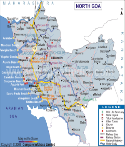
Certain areas are beloved for their enchanting beauty. Others are remembered because history has left its fingerprints on every street, river, and hillside. North Goa is a place in both worlds. It is a district that has been bathed in the waves of the Arabian Sea for centuries and in the coconut palms by the ancient temples and the colourful villages continue to cling to traditions that have spanned different empires. Each stroll through this extraordinary place is a new page that begs to be turned. Just a look at the North Goa district map will be enough to show its extraordinary mashup of coast, rivers, jungle, towns and countryside; particularly tranquil countryside.
North Goa district — Northern division of the Indian State of Goa, bordered by the Arabian Sea on the west, Maharashtra state to North and Karnataka to the east, and South through South Goa district. It is evident from the North Goa district map that for centuries rivers such as Mandovi, Chapora and Terekhol have been landmarks to settlement, trade & culture.
History & Culture
North Goa had been a thriving coastal area under the sway of powerful ruling dynasties even before the Europeans came into sight on the horizon, such as the Kadambas, Chalukyas, Rashtrakutas and the Vijayanagara Empire. Many of these kingdoms were known for their farming and sea trading, building of temples, and federalism practices. They are still celebrated today in the district's ancient shrines, inscriptions, and living tradition and are part of the cultural heritage of the area still today. These historic settlements are visible on the North Goa district map, most of which originated along water courses, where goods and information travelling methods were the lifelines.
In 1510, the Portuguese arrived in the area, sparking a dramatic change. Afonso de Albuquerque led the Portuguese troops to defeat the city of Goa of the Bijapur Sultanate, thus laying the foundation of one of the longest colonial occupations of any country on the Asian continent. Old Goa quickly came to be the seat of Portuguese India, and primarily a place of commerce, learning, religion, and administration. Beautiful churches, convents, monasteries and public buildings sprouted out of the landscape, still drawing visitors from the world, acclaimed, and even legendary. A North Goa district map today shows how Old Goa continues to be one of the greatest treasures of the district.
In December 1961, after 450 years of Portuguese rule, North Goa became an integral part of independent India. After Operation Vijay, north Goa came under Indian control in December 1961, ending more than 400 years of Portuguese rule. The integration of Goa into the Indian Union brought in a new era of democratic administration, the building of infrastructure and education, and subsequent tourism developments. But the district has retained a great deal of its old-world charm through the years, and it has come a long way.
The district is also vibrant throughout the year with spectacular festivals. Carnival sheds light with colourful floats, music, dance, and costumes before the commencement of Lent; Shigmo celebrates spring with colourful floats, music, dance, and costumes in the traditional folk style. Ganesh Chaturthi is still one of the most beloved festivals among the Hindu community in terms of devotion and celebration, uniting people in a spirit of togetherness and unity. Besides the churches, homes and markets turn into picturesque displays of joy and warmth during the Christmas season.
Music and Dance are a part and parcel of the day to day life. These traditional instruments and dance forms like the Fugdi, Dekhni, Corridinho, and Mando tell the story of love and devotion and community. Centuries old techniques are still practised with pottery, bamboo, carpets & carpentry work, wooden works and brass products by local self-employed craftsmen.
Food is another intriguing history. Fresh seafood, aromatic coconut curries, spicy vindaloo, xacuti, sorpotel, bebinca and sannas are all a testament to Indian and Portuguese influences. Meals become an experience of culture as well as just food. On the North Goa district map, every such glance will show the villages in which recipes have been handed down through the generations, keeping alive flavours that are inextricably linked with the district's identity.
Economy
The district's economy of North Goa is one of the most balanced in the western region of India, maintaining a balance between administration, commerce, tourism, fisheries, agriculture, education and small industries, as can be seen in a remarkable manner. The strategic position of the coast has had a long impact on trade in the district, and the current infrastructure under development has seen continued economic growth.
The Government Sector is very important, especially as Panaji is the State Capital of Goa. The role played by major government departments and administrative offices, legislative institutions and courts, education and public authorities creates significant employment. These include thousands of employees in the administration, planning, law, healthcare, education and public services sectors. The theme of governance is particularly acutely visible when looking at the North Goa district map and the central role of Panaji in the administration.
The Public Sector makes a contribution via organisations operating in the areas of infrastructure, electrical distribution, ports, transport, water supply, education and public health. Public investment has improved road and bridge infrastructure, hospitals, education facilities and city services, providing a favourable environment for employment both for businesses and residents.
The services sector continues to be the district's leading economic activity. Tourism generates revenue for hotels and restaurants, transport operators, travel agencies, water sports, event management, retail operations and countless small businesses. Tourism has been accompanied by the rapid growth of other sectors, such as banking, information technology, real estate, higher education, healthcare, and professional consultancy services. Traditional livelihoods like fishing, horticulture, coconut, cashew processing, spice cultivation and handicrafts are still supporting the rural livelihoods. A glance at the North Goa district map reveals how diverse pockets of beaches, rivers, towns, forests, and agricultural areas collectively sustain an economy that is not dependent on one particular industry.
Tourism
Tourism in North Goa isn't only about visiting places – it's about seeing this place add its own chapters to the story of every sunrise and every sunset, in shades of gold. The district is a place that visitors come to know and enjoy for its adventure, its sense of spiritual wonder, its architecture, its food, its wildlife and for resting in tranquil solitude. The cartography of the North Goa district map directs the visitors to the incredible assembly of sites that frequently don't really have a lot in common, but collectively make the district incredibly new and characterised.
Calangute Beach, as it is rightly so called "The Queen of Beaches" with its long stretches of golden sand mingled along charming colourful markets and buzzing cafes filled to the brim by quirky tourists. After dawn, Baga Beach is the nightlife hotspot where restaurants and bars lining the beach attract an international clientele.
The district has magnificent forts that narrate a story of history. Fort Aguada was constructed in the 17th century by the Portuguese, and gracefully perches over the sea and even houses the famous lighthouse. The stronghold of Chapora perches high above the Chapora river, the views from which extend to the sea and the fort has been popularly promoted by Indian cinema. Reis Magos Fort has been beautifully restored and includes narratives of defence, colonisation and sea strategy.
Old Goa, a UNESCO World Heritage Site, preserves some of Asia's finest colonial-era monuments. This Basilica of "Bom Jesus" contains the remains of St Francis Xavier, and draws pilgrims from all over the world. The design of the Sé Cathedral, Church of St Cajetan and several ancient convents are particularly impressive, and have survived for centuries. The North Goa district map showcases its historical significance and construction legacy that are still evident in the region.
Demographics
The district of North Goa is a perfect mix of urban cool and rural tradition. As per the Census of India 2011, the population of this district is 818,008 people, making it the largest of Goa's two districts. The growth of tourism, administration, education and commerce has also come hand in hand with the increase of population and while many villages are yet preserving their cultural distinctiveness, they are all increasingly at danger of losing it.
The literacy rate too is highest in the district of 89.57 per cent, which shows the prevalence of education and social development activities in the district long before. This outstanding educational profile is sustained by the involvement of schools, colleges, universities and professional institutions.
Konkani is the main language and it is a way of life, an inseparable part of the district's culture. Other prominent languages are Marathi, Hindi and English - Portuguese is also still spoken in some communities and historical references. This is what the North Goa district map has to say about linguistic diversity among people, that people belonging to different linguistic groups have lived in peace for centuries side by side in the same area speaking different languages.
Administration
The governance in the North Goa district is well established with provisions to deal with both urban and rural governance. Control centres for different departments of the Government which are involved in their development works, law and order, public welfare, infrastructure and supply of essential services, etc., are located at the district headquarters where this is managed.
In the district, there are five tehsil/subdivisions (talukas) namely Bardez, Bicholim, Pernem, Ponda and Sattari. Every taluka is individual in terms of its geographical attributes, economic resources and cultural heritage and plays its role in the development of the district. The North Goa district map delineates other administrative areas that span along the coast as well as towards the interior areas of the district, overgrown with forests.
There are 120 inhabited villages in North Goa where each village retains their unique customs, architectural designs, agricultural methods and community traditions. In addition to these villages, there are also urban centres—Panaji, Mapusa, Bicholim, Ponda, Valpoi, and Sanquelim and Pernem—which provide commerce, education, administration and public services.
FAQs
Q1: What is the population of North Goa district?
The district has a population of 818,008.
Q2: How many villages are in North Goa district?
It has 120 inhabited villages.
Q3: How many tehsils are in North Goa district?
North Goa district has five tehsils.
Q4: What is the literacy rate of North Goa district?
The literacy rate is 89.57 per cent.
Q5: What is the headquarters of North Goa district?
Panaji is the district headquarters.
Q6: Which language is mainly spoken in North Goa district?
Konkani is the principal language.
Q7: What is North Goa district famous for?
It is famous for its beaches, forts and churches.
Last Updated on : August 04, 2026
