


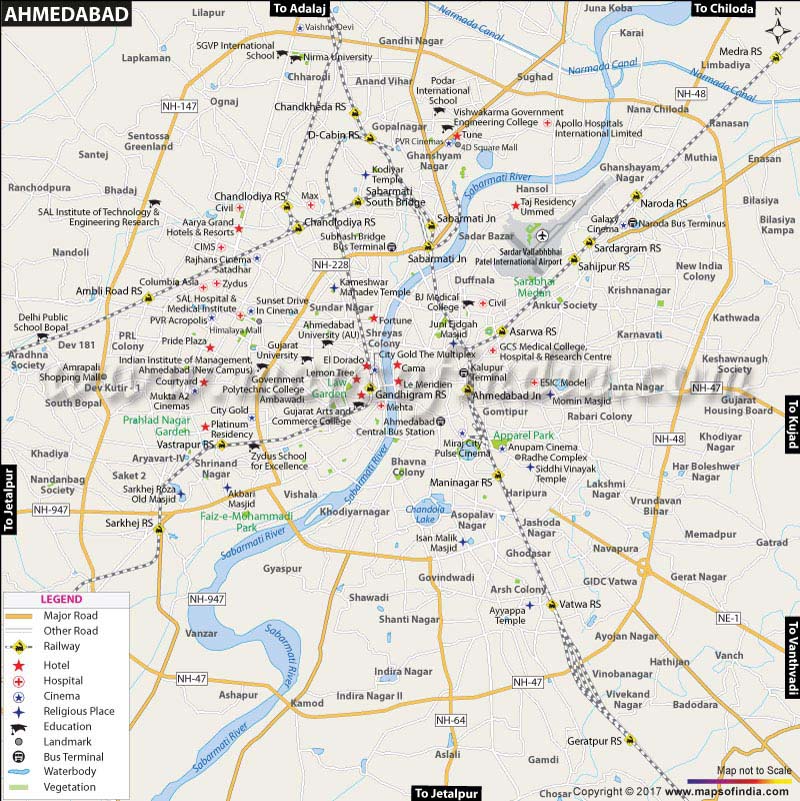





History of Ahmedabad
Ahmedabad seems like a kaleidoscope; it is both ancient and modern. On the one hand, it has spiritual peace and tranquility, but on the other hand it also has a busy modern life. Gandhi Ashram on the banks of Sabarmati River is the symbol of spiritual roots of India. Nowadays Ahmedabad is bustling with life and business activities.
The city has a distinct culture. Apart from the good roads and flyovers, its glitzy shopping malls also add to the glory of the city. Ahmedabad is also known for premier educational institutes of India, such as the Indian Institute of Management. People are warm and hospitable and the local arts and culture are sure to rejuvenate you. If we look to the history, Ahmedabad was the biggest city in terms of area in the pre-British era till Calcutta and Madras Presidency were set up.
In the beginning of 11th century Ahmedabad region was ruled by Bhil king, who was later on defeated was the Solanki ruler of Patan. After 13th century, it fell into the hands of Vaghela dynasty of Dholka. After 13th century entire Gujarat became a part of Delhi Sultanate. It was named as Ahmedabad by Sultan Ahmed Shah in 1411. After 1573 Gujarat came under the Mughal rule of Emperor Akbar. People of Ahmedabad are known to have business acumen and that's reason it is considered to be a prosperous city since the beginning.
Textile Industry of Ahmedabad
During the Mughal period it became an exporting hub of textiles. Cotton, silk and luxury goods were being exported to the Middle East and Europe. The Mughals also turned the city green and made the gardens such as Amraiwadi, Ambawadi and Shahibaag, which reflect Mughal style of gardening and have lush greenery. It fell into the hands of Marathas in 1753 and started disintegrating. Gujarat was split from the State of Bombay in 1960 and Ahmedabad became capital of newly formed Gujarat.
Access
Ahmedabad is home to the most reputed institutes, industries, IT parks, and businesses. It is also a center of art, music and culture. It is also famous for social development organizations.
Ahmedabad is connected with all the main road networks in India. Gujarat state transport buses run their buses to all the destinations in the state. You can get railway tickets from both Kalupur railway station and Gandhigram station. Sardar Vallabhbhai Patel Airport in Ahmedabad is an international airport and you can get flights to major European and Middle East destinations from here.
Festivals and Must See Places
The International Kite Festival is held here on January 14 every year; it coincides with the famous Indian festival of Makar Sankranti. Navratri with garba dance is also a famous tourist attrction. A Rath Yatra is organized in the months of June or July from Jagannath temple in Ahmedabad. It is in the form a procession with a lot of fanfare. The must see religious places of Ahmedabad are Hutheesing Jain Temple, Sidi Sayeed Masjid, Jama Masjid, Mahudi Jain Temple, and Akshardham.
The places of archaeological importance are the walled city and gates, Heritage Walk, Rani no Hajiro, Badshah no Hajiro, Pols of Old City, Dada Harir Vav (Stepwell), Jhulta Minara, The Adalaj Stepwell, Sarkhej Roza, and the House of Mangaldas Girdhardas. The other must see places are Vechaar Utensils Museum, Calico Museum & Sarabhai Foundation, Sanskar Kendra, Institute of Indology, N C Mehta Gallery, Shreyas Folk Museum, Hussain Doshi's Gufa, CEPT Campus, Kanoria Center for Arts, Hutheesing Visual Arts Centre, Community Science Center, Sardar Patel Museum, Science City, and Auto World. Kankaria Lake is also worth visiting.
Ahmedabad City Information | |
|---|---|
| Country | India |
| State | Gujrat |
| District | Ahmedabad |
| Founded by | Sultan Ahmed Shah |
| Area | 464 km2 (179 sq mi) |
| Population | 5570585 as Census January 2011 |
| Population Density | 12,005/km2 (31,090/sq mi) as Census January 2011 |
| Language | Gujrati, Hindi, English |
| Official Languages | Gujrati, Hindi |
| Literacy Rate | 86.65% as Census January 2011 |
| Sex Ratio | 909/1000(Census-2011) |
| Time zone | IST (UTC+5:30) |
| Pin code | 380007 |
| Area code | 79 |
| Lat Long | 23.0300° N, 72.5800° E |
| Religion | Hinduism, Islam, Jainism |
| Festivals | Uttarayan, Navratri, Deepavali, Holi, Ganesh Chaturthi, Gudi Padwa, Eid ul-Fitr |
| University | Gujarat University, Dr. Babasaheb Ambedkar Open University |
| Sister Cities | Astrakhan Oblast (Astrakhan), Jersey City (New Jersey), Ulsan (South Korea) |
| Sports | Sardar Patel Stadium (also known as Motera Stadium, Cricket), field hockey, badminton, tennis, squash and golf. Ahmedabad currently has three golf courses |
| Airport | Sardar Vallabhbhai Patel International Airport |
| Railway Station | Ahmedabad Jn (ADI), Ahmedabad Railway Station |
| Tourist Attractions | Kankaria Lake, Chandola Lake, Bhadra Fort, Jhulta Minar, Sarkhej Roza, Ahmed Shah Mosque, Akshardham Temple, Swaminarayan Temple |
| Nearby Tourist Attractions | Mount Abu, Udaipur, Daman, Indore, Somnath, Dwarka, Ujjain, Jodhpur, Ajmer, Pushkar |
| Popular Things | Hatheesing Temple, Sarkhej Roza (built 1451 AD), Modhera Sun Temple (built 1026 AD), Gandhi Ashram (built 1917 AD) |
| Notable People | Geet Sethi, Parthiv Patel, Narendra Modi |
| National Highway | NH-59,8 |
Last Updated on : May 12, 2026
More About Ahmedabad
- Buses from Ahmedabad
- Airport
- Travel Agent
- Distance Chart
- Gardens in Ahmedabad
- Lakes in Ahmedabad
- Ahmedabad Wildlife
- Religious Places in Ahmedabad
- Hyderabad to Amhedabad
- Jaipur to Ahmedabad
- Goa to Ahmedabad
- Mumbai to Ahmedabad
- Ahmedabad Localities
- Kuber Nagar
- Aslali
- Gurukul
- Raipur
- Juhapura
- Sarangpur
- Khadia
- History
