




Introduction
Known as the Land of Saints, Hoshiarpur stands apart within Punjab due to a quiet harmony between past and present. Greenery lingers longer here, supported by subtle shifts in elevation and soil. Spiritual practice runs deep, expressed through temples, gurudwaras, and spaces devoted to thought and gathering. This focus on reflection and knowledge helps shape how the region sees itself. Time moves differently where hills meet farmland, tradition meets study, and stillness finds space among routine.
Farming shapes daily existence here, rooted firmly in soil and season. Wheat spreads wide, followed by rows of maize, then cane under sun. What stands out, though, is the bright burst of kinnow groves coloring the region’s identity. Beyond crops, hands shape wood into form, weave thread into pattern, craft quiet expressions of local talent. These efforts move quietly but persistently through village lanes and modest workshops.
Spiritual depth arrives through old paths walked by sages long gone. Hills rise gently, lined with fruit trees that bloom in spring silence. Orchards stretch beyond roads, shaping what eyes see first upon arrival. History does not sit in museums; it breathes inside daily routines. Each stone wall, each narrow lane holds a version of the past still used. The land appears shaped by patience more than force. Stories grow like roots beneath surface sight - quiet, unseen, strong. Resilience shows not in words but in how things remain unchanged.
History
Long before modern times, Hoshiarpur held significance during the age of the Pandavas. Evidence points to the Chanderbansi Rajputs as rulers of this area in ancient periods. Confirmation arises through Kalhana’s Raja Tarangini along with writings left by the traveler Hieun Tsang. Centuries passed under tribal self-rule, ending only when shifts came from the west, centered at Jalandhar. Traces even link its roots to settlements of the Indus Valley era. Among the foothills close to Shivalik hotels, signs of ancient human presence emerge through excavation work.
Not far from Hoshiarpur - between 30 and 40 km north - sites like Atbarapur, Rehmanpura, and Takhni yield remnants tied to the Stone Age. From Talwara along the Beas River to Rupnagar beside the Satluj, traces of Acheulian and Soanian traditions appear across the Shiwalik range. Historical imagination links Hoshiarpur to events described in the Mahabharata. Mentioned within that epic is Dasua, noted long before modern records began. Once home to King Virata, the Pandavas lived there during their thirteen-year absence. A stone-built house of worship stands in Lasara, its roots tracing to that distant era.
Lalman notes in verse how Ibrahim, ruler of the Gorian line between 1059 and 1099, took control of Jalandhar near 1088 AD. Though he held the flatlands, mountain zones stayed under local Hindu leaders. By 1192, Sultan Mohammad Ghori seized the Shivalik range along with Ghuram, Hansi, Sarusti, Samana, and nearby tracts. Moving toward Delhi afterward, his advance met pause when a kin of Khandey Rai yielded the city through submission and payment. Authority passed into the hands of Qutub-Ud-Din Aibak, a trusted servant, before the sultan returned to Ghazni. Now Ghuram holds status as the main city center. During 1398–99, damage followed after Timur entered. Rule over Bajwara came under Bohol Lodi by 1501. From 1520 until 1525, movement into India began under Babar. Defeat arrived for Ibrahim Lodi's forces near Bajwara.
Through Malot came Daulat Khan Lodi, taken by Babar between 1525 and 1530, then led past Bajwara toward Delhi. Victory arrived for Humayun’s army in 1555 when Nasib Khan fell at Panj Bhain close to Hoshiarpur. Dasua moved Akbar in 1557, advancing against Sikandar Sur - who lost. By 1560, submission followed as Bairam Khan yielded to Akbar. Beginning in the years that followed, Sikh leadership gained prominence. Under the sixth Guru, Hargobind, military training began, introducing armed resistance toward Mughal authority. In 1675, execution ended the life of Tegh Bahadur, whose actions had shielded Kashmiri Hindus from forced conversion. From this area near Hoshiarpur came one among the initial five chosen followers. Its significance stems partly from that early connection. In 1747 AD, Ahmad Shah Abdali arrived with intent yet withdrew without success. With Adina Beg gone by 1758 AD, power shifted as Jassa Singh Ramgarhia claimed new lands - only to lose them after defeat in 1776. By another turn, Ranjit Singh overcame Ramgarhia in 1808, gaining control of Jaijon years later, in 1815
Following the initial conflict involving Sikh forces in 1846, Hoshiarpur along with additional territories within the Jalandhar Doab came under British control. By that March, administrative oversight began under John Lawrence, assigned as head of French-affiliated principalities, answering straight to central authority until restructured reporting lines placed him beneath Lahore’s representative two years later. Uprising emerged during the subsequent war, led by rulers from Jaswan, Kangra, and Datarpur against colonial rule.
At Pathankot then serving, Lawrence responded swiftly - five hundred troops and artillery units moved to quell resistance. Capture followed: Dattarpur’s ruler was taken; pursuit concluded successfully against Jaswan’s monarch soon after. Exile marked the aftermath - royal figures removed, residences demolished, territory seized without delay. Una’s Bedi Bikarama Singh reacted strongly, aligning himself briefly with insurrectionists until word arrived of Jaswan’s leader perishing - he shifted course immediately, seeking refuge among Sher Singh’s followers. Possessions stripped upon identification by authorities, though settlement near Amritsar permitted post-submission despite earlier defiance.
By 1851, reports reached officials when the Gurdaspur Deputy Commissioner noted a troubling custom among the Bedi community - regarded traditionally as spiritual healers - in parts of Una and Garhshankar within Hoshiarpur District; these individuals bore the grim label "daughter slayers" due to persistent female infant killings. Attention soon shifted toward monitoring such acts across administrative zones following that disclosure. Three years onward, under leadership of John Lawrence - who served as Chief Commissioner of Punjab at the time - a firm decree emerged rejecting the act outright, framing it as unacceptable.
By 1907, resistance toward colonial rule sharpened, especially within towns such as Hoshiarpur, Lahore, and Jalandhar. A press in Hoshiarpur producing the paper Tilik faced legal measures; its equipment seized without warning. Among those linked to dissent, Munshi Raman and Pandit Jagat Ram - both tied to Hoshiarpur - held roles in the Gadar Party’s leadership circle.
During 1917, small Congress groups formed in Hoshiarpur, tying the area into broader political movements across Punjab. Following these developments, delegates made journeys to Lahore for meetings at the regional level - this showed how soon the town joined national activism. Resistance against the Rowlatt Act stood out in intensity; under Govardhan Das, actions included street rallies, work stoppages, along with periods without food.
Following upheavals across Punjab - such as the Komagata Maru incident, the Jallianwala Bagh killings, bloodshed in Nankana Sahib, and tensions over Guru Ka Bagh - activism surged within the region. From locations like Hoshiarpur and Jalandhar, coordination emerged, quietly shaping dissent while keeping protest alive.
With the arrival of 1930–31, economic motives intertwined with nationalist aims in the town. Indigenous marketplaces emerged throughout Hoshiarpur, supporting local production amid broader resistance. Though modest in scale, these efforts aligned closely with swadeshi ideals gaining ground at the time. Participation followed, when delegates from Hoshiarpur attended the fourth Doaba Political Conference in Mukerian. As a result, the district found itself more firmly placed within regional political currents. From that point onward, its role was less peripheral, more woven into collective movements. Even so, Hoshiarpur played a part worth noting in the shift from foreign control to local leadership. What unfolded there shows how minor urban areas, when grouped, helped steer the wider movement toward freedom.
Culture
Hoshiarpur has a distinct place in the handicraft market in Punjab because of its ivory inlay work. Handicraft is the major component of the culture in the area and it has been practiced since ages. Artisans in this city have been engaged in manufacturing beautiful wooden handicrafts with ivory inlay work and are known worldwide for their proficiency. Festivals like Baisakhi Lohri and Guru Purab are the major festivals that are celebrated in Hoshiarpur with immense zeal. These festivals are the epitome of the custom and the rituals celebrated in the region. On such occasions, men and women are expected to dress in the traditional Punjabi attire which is Salvar Kameez for women and Kurta pajama for men. Bhangra and Giddha are the folk dances practiced in the city and it symbolizes the spirit of the people in Hoshiarpur. Makki Di roti, Sarso da saag, and Amritsar kulcha are some of the local cuisines of the city which are famous worldwide.
Language
Hoshiarpur sees Punjabi used widely, serving as its recognized official language. Rooted among Indo-Aryan tongues, this language belongs naturally to those of Punjabi heritage. Across the region, local variations emerge - Dona and Manjki appear alongside broader usage. Literary milestones arise through figures like Shiv Kumar Batalvi, whose works stand with those of Waris Shah, while Amrita Pritam adds enduring voice. Alongside these expressions, Hindi finds space due to movement into the area for employment or commerce. Speakers arrive from different Indian regions, bringing their familiar words. Presence of multiple forms reflects layered histories rather than sudden shifts. Inevitably, as cities expand, English increasingly shapes daily life in Hoshiarpur. Where learning happens, commerce moves, and policies form across India, this tongue holds steady.
Geography
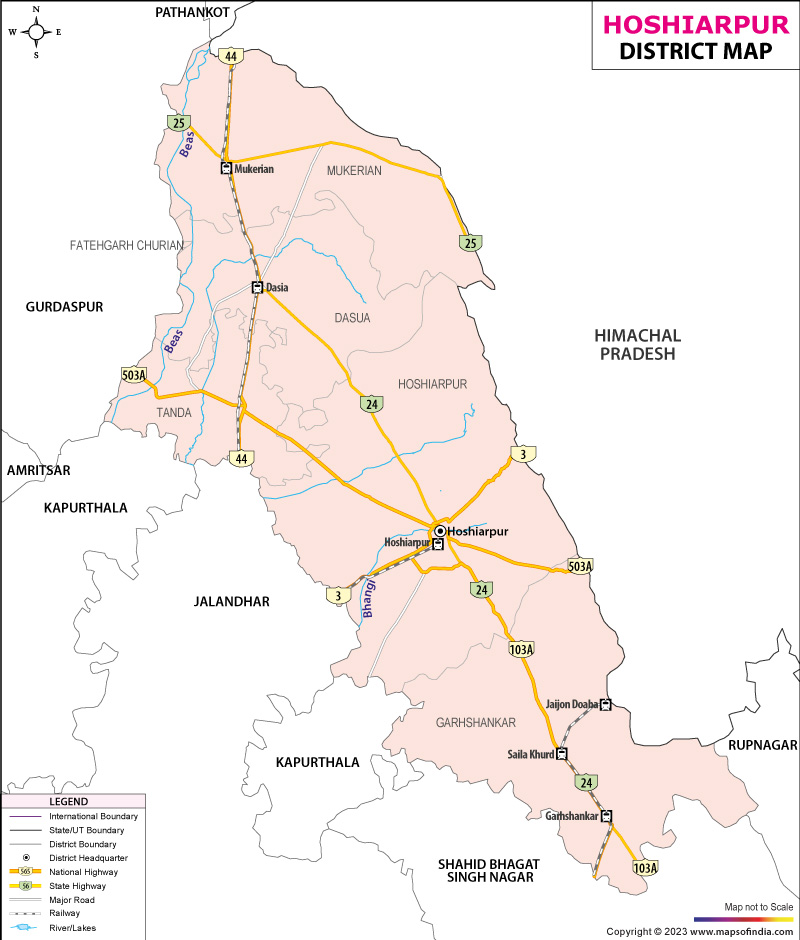
Hoshiarpur lies to the east of Punjab and is at a height of 296 meters above sea level. The climate here is comparatively milder because there is a huge forest reserve and Hilly terrain which surrounds the city. Hushiar city is the district headquarters for Hoshiarpur District and it is divided into four tehsils, five sub-tehsils, and 10 blocks for ease of administration. Hoshiarpur I and Hoshiarpur II are the two major cities here which share borders with the Kangra and Una districts in Himachal. There is 34% forest cover in the area which gives it a moderate climate.
| Facts of Hoshiarpur District | |
|---|---|
| State | Punjab |
| District | Hoshiarpur |
| District HQ | Hoshiarpur |
| Population (2011) | 168443 |
| Growth | 0.00% |
| Sex Ratio | 961 |
| Literacy | 84.59 |
| Area (km2) | 3365 |
| Density (/km2) | 466 |
| Tehsils | Dasua, Garhshankar, Hoshiarpur, Mukerian |
| Lok Sabha Constituencies | Hoshiarpur (SC), Anandpur Sahib |
| Assembly Constituencies | Mukerian, Dasuya, Urmur, Sham Chausari (SC), Hoshiarpur, Chabbewal (SC), Garhshankar |
| Languages | Punjabi, Hindi |
| Rivers | Beas, Nangle |
| Religion | Sikhism |
| Food | Makki Di roti, Sarso da saag, and Amritsar kulcha |
| Major Crops | Maize, Paddy, Wheat, Oil Seeds of Mustard and Sunflower |
| Major Cities | Gurdaspur, Kapurthala, Jalandhar |
| Lat-Long | 31.644029,75.793075 |
| Travel Destinations | Takhni-Rehmapur Wildlife Sanctuary, Tomb of Hazrat Shah Noor Jamal, Kamahi Devi Temple, Gurdwara Tahli Sahib, Gurdwara Akalgarh, Dera of Baba Charan Singh, Sheesh Mahal, Gurdwara Jand Sahib, Gurdwara Harian Velan, Gurdwara Guru Dian Tahalian, Gurdwara Garna Sahib etc. |
| Government Colleges/Universities | SD College, D.A.V. College (Hoshiarpur), D.A.V. College (Dasuya), Government College (Hoshiarpur), Khalsa College (Garhdiwala), Babbar Akali Memorial Khalsa College etc. |
FAQs
Q1: Why is Hoshiarpur known as Land of Saints?
Hoshiarpur carries this name due to enduring ties with holy figures, seers, yet changemakers across generations. Scattered throughout the region stand places of worship - temples, gurudwaras, sacred sites - that serve not only prayer but also knowledge, century after quiet century.
Q2: What makes Hoshiarpur’s geography unique compared to other districts in Punjab?
Foot hills shape Hoshiarpur, where land rises gently beyond Punjab's wide flats. Sloping ground appears here, instead of endless level stretches seen elsewhere. Trees grow thick in some parts, their leaves forming dense covers above narrow paths. Where farms spread across lower areas, fruit trees stand in orderly rows. Scenery shifts often, moving from open fields to pockets of woodland. Nature presents variety within a small region, unlike uniform zones nearby.
Q3: What cultural traditions stand out in Hoshiarpur?
Folk music defines the region, alongside vibrant festivals, craftsmanship too. Rooted in rural Punjab, customs here merge with deep spirituality - daily routines carry echoes of reverence. Life unfolds simply; moments blend work with prayer, seamlessly almost. Devotion shapes habits just as much as tradition guides expression throughout the area.
Last Updated on : May 08, 2026
