|
||||||||||
 | ||||||||||
|





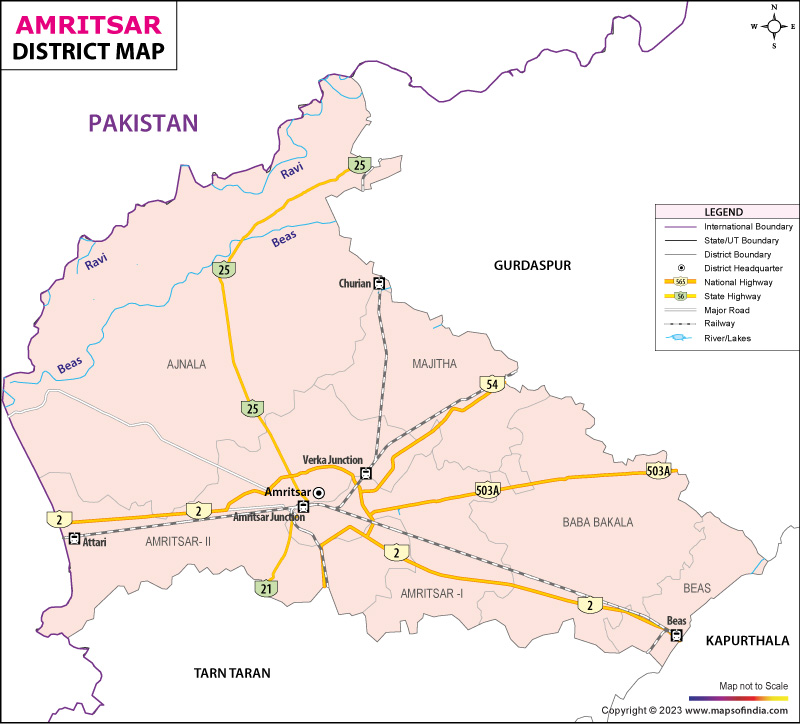
| *Amritsar District Map highlights the National Highways, Major Roads, District Headquarter, etc in Amritsar . |
About
Right in the heart of Punjab’s Majha belt sits Amritsar district, alive with history and energy. Named after its main city, which came into being back in 1574 through the efforts of Guru Ram Das - the fourth leader of Sikh tradition - it carries deep roots. That name, “Amritsar,” breaks down to mean “Pool of Nectar,” drawing from the holy waters known as Amrit Sarovar encircling the Golden Temple. Sitting at the core of Sikh faith, this temple does more than shape the area’s soul - year after year it pulls in crowds from across the planet, seekers and sightseers alike. With time, the presence of this shrine has stamped the region’s character firmly on the world map.
On the map, Amritsar spreads across roughly 2,683 square kilometers, sitting just beside Pakistan's boundary - lending depth to its culture along with strategic weight. This stretch of land hosts a core urban center where business hums, learning thrives, and visitors gather in steady streams. Positioned as it is, movement through here defined much of what came before - people crossing brought change, goods passed through sparked growth, old forces marched in left traces still felt today.
History & Culture
Deep within Punjab’s landscape, long before Amritsar rose to prominence, quiet villages rested among rich farmland. A shift started during the 1500s, following the arrival of Guru Ram Das in 1577. Under his guidance, work commenced on a pool meant for ritual use - what would come to be named the Amrit Sarovar. From that body of water, the city took its identity. Growth unfolded slowly, centered firmly around this religious core. Spiritual importance gathered around it, drawing focus across generations. Eventually, this place stood at the center of Sikh life - not by force, but through steady reverence.
Under Guru Arjan Dev, the city gained greater significance when the Golden Temple finished its construction. Facing every compass point, the shrine's doors were set differently than most holy sites back then - showing access for all without exception. Openness of this kind continues shaping how Amritsar sees itself now. Meals shared without cost through langar practice come to people no matter their faith or origin - one act mirroring long-held values of unity and care.
Under Maharaja Ranjit Singh’s leadership in the 1800s, Amritsar saw notable changes in both buildings and business activity. Growth reached markets, movement along trade paths increased, while sections of the Golden Temple received gold plating - this shift shaped its famous look. Though rooted in faith, the city evolved into a lively node for cultural exchange and economic life across Punjab.
In Amritsar a grim episode tied to Britain’s rule in India. Not far from the city center, an open ground became silent with sorrow after gunfire rang out. Civilians stood together that day - no weapons, only presence - when bullets struck without cause. Shock rippled outward; protest grew stronger because of it. Time passes, yet those stones still speak louder than words ever could.
Amritsar shifted beyond recognition after 1947. Positioned close to the freshly drawn boundary between two nations, movement flooded through - lives torn by unrest and sudden departures. Overnight separations became common; people walked across frontiers weighted only by recollection and necessity. Rebuilding came gradually, though scars remained visible. Cultural life flickered back into motion over time.
Economy
Across Amritsar, farming blends with commerce, while shops and visitor activity shape daily work life. Economic rhythms emerge where fields meet market lanes, sustained by movement of goods, alongside steady traveler presence. Occupying a position along the frontier, Amritsar supports key state functions tied to national boundaries. With proximity shaping its role, agencies managing immigration and territorial oversight are based here. Employment emerges through structures tasked with civil order, supervision, and regional safety checks. Personnel serve across departments responsible for regulation, coordination, and protection duties. Operations extend into areas governed by strategic presence and logistical management of cross-border activity.
Among state-run organizations, Guru Nanak Dev University stands alongside Khalsa College in shaping academic access. Government Medical College forms part of the health infrastructure, serving communities through care services. Employment emerges as a result of their operational needs. Each institution supports economic activity without relying on market-driven models.
Each year, vast numbers arrive at the Golden Temple, shaping much of Amritsar’s service economy. Because of these visitors, lodging providers see steady activity throughout the seasons. Movement through the city increases, supporting taxi operators and rental firms alike. Shops near sacred sites experience consistent footfall, aiding local vendors. Dining establishments benefit as guests seek familiar flavors amid unfamiliar streets.
Still central to life here, farming thrives on rich earth where wheat grows before paddy follows. Thanks to steady water supply, fields stay productive across seasons in Amritsar. Not only crops but workshops shape the economy - cloth making takes place alongside artisan work. Handmade rugs emerge slowly under skilled hands, thread by thread. Phulkari patterns appear on fabric through careful stitching, a tradition passed down. Alongside them, metal craftsmen mold brass into daily-use items. Processing local harvests adds another layer to industry beyond the farm.
Tourism
Amritsar district is famous among tourists for the innumerable tourist spots that the city holds. Some of the popular spots in the region are the Golden Temple, Jallianwala Bagh, Wagah Border and others.
Among sacred sites, Golden Temple stands central in Sikh tradition. Its design draws attention through visual harmony rather than ornamentation. Meals appear each day at the langar, offered without cost to all who come. Thousands gather there regardless of background or status. Shared food becomes a quiet statement on fairness.
A stillness lingers at Jallianwala Bagh, where walls hold traces of April 1919. Bullet marks remain untouched, etched into stone without explanation. Flame burns continuously, set apart from daily rhythms. Enclosure keeps quiet memory alive through silence rather than speech. Visitors arrive by different paths, yet pause alike near the well. History rests here, not performed but observed.
Each evening at Wagah, soldiers lower national flags in a ritual marked by precise movements. Where two countries meet, gestures grow sharp, deliberate, charged with meaning. This event draws observers not for spectacle but for its unwavering routine. Postures stiffen as daylight fades, signaling the close of another day. Borders stand firm, yet bodies perform an odd synchronicity. Discipline echoes louder than words amid silence between crowds. Routine becomes a statement when repeated without pause. A space where memories of 1947 find stillness.
A fortress of ages past stands where echoes of Sikh valor remain. Transformation has brought new purpose without erasing old bones. From martial roots, life flows into gatherings shaped by art and sound. Stone walls once meant for battle now host voices raised in song or story. Purpose shifts, yet memory lingers beneath arched corridors. What was built for defense lives again through shared moments. Time reshapes function while honoring origin. From Punjab's past, knowledge flows through corridors built long ago. What remains is not just masonry, but memory given shape. A structure of worship shaped much like the famed shrine by the lake stands quietly, honoring those who bear many arms.
Demographics
Population figures from 2011 show Amritsar district at 2,490,656 residents. This count places it among Punjab's densest areas. With 928 people occupying each square kilometer, space is tightly shared. High concentration defines its demographic character. Of every hundred people, seventy-six can read; a quiet result of steady change in schools. Though gaps remain, more notebooks open today than before.
Punjabi holds official status here, spoken by many throughout the region. In cities, one may hear Hindi alongside it; English appears too, though less frequently. Communication often shifts depending on location, with rural zones favoring local speech.
Most people follow Sikhism. After that, Hinduism is practiced by a notable number. Other faiths appear in modest numbers - Christianity among some, Islam within limited circles. Among villages and towns alike, Amritsar stands out as the most populous hub within the region. Though scattered farms dot the landscape, it is the city that dominates settlement patterns here.
Administration
Within Amritsar district, structure shapes function through an established system guiding oversight, stability, and progress in towns as well as villages. Housed in Amritsar city stands the core office managing leadership tasks, economic activity, and citizen support operations. Six segments form its internal split - Amritsar I, Amritsar II, Ajnala, Baba Bakala, Majitha, and Lopoke - each carrying distinct boundaries and roles. In charge of every segment sits a Sub‑Divisional Magistrate, responsible for civil affairs, income processes, alongside alignment of state initiatives.
Under city oversight, the Municipal Corporation handles basic services like water, waste management, road upkeep, along with broader urban facilities. Cooperation occurs regularly between local officials and higher-level authorities when rolling out growth-focused initiatives. Across the district, layers of administration - such as tehsils, blocks, panchayats, and municipal entities - carry authority into remote areas. Rooted in village autonomy yet shaped by city needs, this system allows Amritsar to maintain historical identity alongside development pressures.
| Facts of Amritsar District | |
|---|---|
| State | Punjab |
| District | Amritsar |
| District HQ | Amritsar |
| Population (2011) | 2490656 |
| Growth | 0.00% |
| Sex Ratio | 889 |
| Literacy | 76.27 |
| Area (km2) | 2673 |
| Density (/km2) | 932 |
| Tehsils | Ajnala, Amritsar I, Amritsar II, Baba Bakala |
| Lok Sabha Constituencies | Amritsar |
| Assembly Constituencies | Ajnala, Rajasansi, Majitha, Jandiala (SC), Amritsar North, Amritsar West (SC), Amritsar Central, Amritsar East, Amritsar South, Attari (SC), Baba Bakala |
| Languages | Punjabi, Hindi, English, Urdu |
| Rivers | Beas, Ravi |
| Lat-Long | 31.723495,74.871426 |
| Travel Destinations | Golden Temple(Harmander Sahib), The Akal Takht, Gurudwara Ilachi Ber, Har Ki Pauri, Durgiana Temple (Lakshmi Narain Temple), Wagah Border, Jallian Wala Bagh, Ram Bagh, Ram Tirath, Pul Kanjari, Samadhi of Guru Angad Dev Ji, Jama Masjid Khairuddin, Samadh of Shravan, Khoo Kalyanwala, The Historical Banyan Tree etc. |
| Government Colleges/Universities | Guru Nanak Dev University, Khalsa College, Govt. Polytechnic (Chhehrta), Govt. Dental College, Govt. Medical College, B.B.K. D.A.V.College for women, Guru Ram Dass Dental College, Hindu Sabha College, L.N.Ayurvedic College, S.R.Govt. College for women, Shahzada Nand College for women, Sri Guru Teg Bahadur College etc. |
FAQs
Q1: How many villages are there in the district?
There are 750 villages in the district.
Q2: What is the population of Amritsar district?
As recorded in the 2011 Census, there were 2,490,656 people residing within the area.
Q3: What is Amritsar district famous for?
The district is famous for the Golden Temple and the rituals at the Wagah border. It is a place where history shows itself in daily practice, marked by moments beyond borders. Ceremony unfolds with precision, tied deeply to identity, reflected in architecture rising above ordinary sight.
Last Updated on : May 08, 2026
