|
||||||||||
 | ||||||||||
|





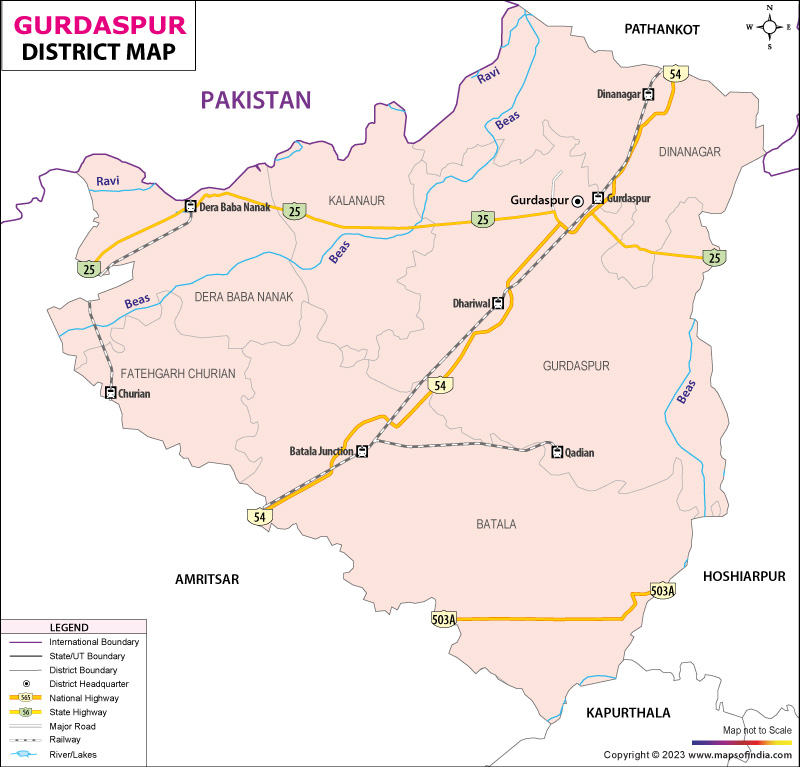
| *Gurdaspur District Map highlights the National Highways, Major Roads, District Headquarter, etc in Gurdaspur . |
About
Fields stretch across Gurdaspur, folding gently between villages where life moves at an older rhythm. Nestled within Punjab’s Majha region, it traces a path shaped by centuries rather than borders. Water defines much here - not just in boundaries formed by the Ravi and Beas, but in how damp earth supports more than farming alone. Talk turns to mountains sooner or later, which is why some call it the doorway to the Himalayas without pausing to explain. Slopes begin their climb nearby, rising from farmland into foothills marked by harder stone and shifting air. Westward stretches a forgotten edge - Narowal on the Pakistani side - a limit drawn by accords, recollections, yet constant crossings. The past stays close, present not merely in stone markers but within daily acts along divides where earlier times press together, blur.
History & Culture
Starting far back, Gurdaspur's past flows closely alongside Punjab’s restless journey through time. Not just a bystander, it absorbed waves of courage few regions could match. Spiritual depth took root early, growing quietly amid upheaval. Power changed hands often, each shift leaving subtle marks. From empires to uprisings, its story mirrors transformations felt across northern India. Moments of quiet devotion stand next to fierce resistance. Altogether, these layers form a narrative central to understanding wider changes on the subcontinent.
Long before modern borders took shape, people lived here. Evidence tucked within old writings points to life during the Indus times. Ruins dug up recently back those claims. At the time of the great epics, ties likely linked this land to Trigarta’s realm. Armies led by Alexander moved through these plains long after. The rule shifted hands many times across ages. First came the Mauryan grip, then waves of Kushan influence followed. Later still, power flowed under Delhi’s sultans. Through each turn, the soil held memories of movement and rule. This unassuming structure now rests quietly, holding stories far louder than its modest appearance suggests.
One chapter of Sikh military legacy unfolds in Gurdaspur, where courage marked the soil. At Gurdas Nangal, resistance burned brightest when Banda Singh Bahadur faced down imperial forces in 1715 - his defiance eternally carved into memory. Years later, borders trembled again in 1947. Gurdaspur holds deep roots in Sikh tradition and belief. There, messages of unity and compassion took root through daily practice. Just nearby begins the Kartarpur Corridor, newly built yet heavy with meaning. Linking across borders, it reaches toward Gurdwara Darbar Sahib Kartarpur in Pakistan. This passage stirs reflection, drawing seekers from distant lands. Spiritual gravity anchors the land, long before modern routes appeared.
Vibrant echoes of the Majhi Punjabi dialect shape Gurdaspur’s identity, seen by many as the most authentic version of the tongue. Fiercely held folk customs come alive through pulsing Bhangra steps and flowing Giddha dances, both bursting with rhythm. Energy pours into every celebration, especially during Baisakhi - tying joy directly to the harvest season.
Economy
Farming shaped Gurdaspur’s livelihoods long before anything else, fed by rich earth that sustained generations. Still, time brought change - slow at first - with new kinds of work taking hold alongside crops. One shift after another layered industry onto tradition, pulling income sources beyond harvests alone. Today, different fields matter just as much - the workshops, services, small factories woven now into daily life.
Fertile land shapes much of life in Gurdaspur, where growing food defines daily work for many. Outside of crop cultivation, production activities depend largely on agriculture-linked processing units - take rice de-husking facilities, major sugar refineries, or grain grinding operations. Scattered across the area are smaller workshops crafting farm equipment, basic manual instruments, and weaving fabric too, sustaining local initiative through hands-on enterprise.
Government Sector -
In the district, government work forms a core part of economic life, offering long-term job stability to many. Because Gurdaspur sits near a national boundary, military units, law enforcement teams, and support staff are widely stationed here - this boosts hiring across public offices. Office complexes managing civil affairs, court buildings handling legal cases, along with agencies focused on farming, irrigation, and village growth programs - all together provide livelihoods for thousands. Ongoing funding flows into publicly operated classrooms, universities at the regional level, and clinics serving general health needs; such backing keeps positions open year after year for teachers, managers, and doctors. Stability in these roles stems directly from sustained budget allocations shaping daily opportunity.
Public Sector -
Not just limited to policy-making, the Public Sector steps in where daily operations matter most across Gurdaspur. Through bodies like PSPCL and the public works department, electricity flows, and roads get built - work that keeps life moving. Instead of private firms, it is often these state-run units delivering steady paychecks alongside basic utilities. Banking access comes through institutions such as the State Bank of India and Punjab National Bank, with their branches stretching even into isolated rural corners. Farmers rely on them for credit; young people find stable positions behind counters and desks. While transport might seem minor, buses run by PUNBUS and PRTC tie distant areas together - not only linking places but offering livelihoods too. Behind much of what functions quietly stands this layer of service, unseen yet central.
Service Sector -
Now shaping much of Gurdaspur’s economy, the services sector grows fast across towns such as Batala and Gurdaspur city. Fueled by higher spending among wealthier rural households, retail spaces multiply at a steady pace. Driven mainly by faith-based travel, hospitality and tourism see sharp gains in activity. Pilgrimages to Dera Baba Nanak have risen sharply since the Kartarpur Corridor opened, pushing quick upgrades in lodging options - hotels, guesthouses, ride providers, guided tours, and eateries follow close behind. Alongside, clinics run by private hands, digital connectivity firms, and freelance-style work platforms offer fresh job paths. These attract young graduates stepping back from family farms into newer kinds of daily labour.
Tourism
Gurdaspur pulls visitors with varied interests - spiritual seekers find meaning here, while those drawn to heritage explore its layered past; natural beauty also lures many who wander beyond cities. Each year, people arrive from distant places, guided by faith or curiosity, filling roads and pathways with quiet movement. From here, the Kartarpur Corridor begins its stretch across borders. Each morning, people appear near the observation site, drawn without force. Their eyes fix on a distant roofline beyond the frontier - where Guru Nanak spent his final days. What they see is more than structure; it is presence. A stone stage sits quietly amid the fields near Kalanaur - this is Takht-i-Akbari. Though modest in structure, its significance emerges through time rather than ornament. Following Humayun's abrupt passing, the empire needed swift continuity; thus, a young Akbar stood there, barely fifteen, receiving imperial authority under uncertain skies. Construction does not shout here - the power lies in what happened, not how it looks. Visitors drawn to moments that shift dynasties often find themselves standing on ground thick with consequence.
Natural Attractions and Destinations -
Home to vast stretches of still water and reedy banks, Keshopur Chhamb stands among Punjab’s biggest freshwater havens. Winter brings waves of winged visitors - Siberian cranes glide in, pintails settle by the thousands, alongside others marked vulnerable on global lists. Bird lovers find it unmatched, not just for sightings but for quiet immersion.
Demographics
Back in 2011, Gurdaspur recorded a literacy level of 81.10%, rising from 73.80% ten years earlier. While men showed 85.90% literacy that year, women reached 75.70%. Earlier figures from 2001 stood at 79.80% for males, whereas females were at 67.10%. A count of 1,668,339 people could read and write - among them, 928,264 were men, and the rest were women, numbered 740,075. Females number around 895 for every thousand males. With people spread across each square kilometre, density reaches 649.
Among those living in Gurdaspur, patterns emerge when examining age, family size, and settlement distribution. Though change moves quickly, many households hold close to customs passed through generations. Among India's northern regions, this area stands out for having more than 2.2 million inhabitants packed into its landscape - numbers amplified by long-standing farming traditions and rich soil.
Most people speak Punjabi, especially the soft-toned Majhi version - this form is often seen as the core, traditional way the language began. In cities, many understand Hindi too, mainly because it shows up in schools and markets.
Administration
Deep within northern India, Gurdaspur operates through layers of careful administrative design. Its framework unfolds step by step, shaped by necessity rather than chance. Governance flows downward with precision because of the tiered oversight mechanisms in place. Law enforcement reaches communities quickly due to strategic coordination across districts. Public services move without major delays, even though terrain and proximity to borders add complexity. Structure defines function here - each level depends on the one before it. Efficiency emerges not from technology alone but from consistent human effort behind the scenes.
Split into smaller units for smoother management, the area organizes its work through multiple tehsils. Kalanaur holds quiet significance, while Dinanagar operates with a steady routine. Fatehgarh Churian completes the set, each guided separately by appointed officials.
| Facts of Gurdaspur District | |
|---|---|
| State | Punjab |
| District | Gurdaspur |
| District HQ | Gurdaspur |
| Population (2011) | 2,299,026 |
| Growth | 0.00% |
| Sex Ratio | 895 |
| Literacy | 79.95 |
| Area (km2) | 2610 |
| Density (/km2) | 649 |
| Tehsils | Gurdaspur, Dera Baba Nanak, Batala |
| Lok Sabha Constituencies | Gurdaspur, Hoshiarpur |
| Assembly Constituencies | Sujanpur, Bhoa (SC), Pathankot, Gurdaspur, Dina Nagar (SC), Qadian, Batala, Sri Hargobindpur (SC), Fatehgarh Churian, Dera Baba Nanak |
| Languages | Punjabi including Majhi, Hindi |
| Rivers | Beas, Ravi |
| Lat-Long | 31.940509,75.250454 |
| Travel Destinations | Takht - I � Akbari, Mahakaleshwar Temple, Barath Sahib, Baradari The Summer Resort, Pandori Dham Temple, Dera Baba Nanak, Gurudwara Chola Sahib, Achal Sahib, Achaleshwar Temple, Gurudwara Sri Kandh Sahib, Shrine Of Brave Haqiqat Rai, Dhianpur Shrine, Shrine Of Dhianpur Sri Baba Lal Dyal Ji, Mosque Aqsa, Sri Namdev Durbar, Jhulna Mahal, Gurudwara Ghallughara Sahib, Mukeshwar Temple, Arjun�S Chulha, Sehdev�S Cave etc. |
| Government Colleges/Universities | Govt. College (Gurdaspur), Govt. College (Kala Afghana), Guru Nanak College, Baba Aya Singh Riarki (Girls) College, Bebe Nanaki Khalsa College, Hindu Kanya Mahavidayala, Pandit Mohan Lal S.D. College, Sikh National College etc. |
FAQs
Q1: How many Villages are there in Gurdaspur?
Gurdaspur Tehsil has a total of 375 villages.
Q2: What is the Population of the District?
According to the 2011 India census, Gurdaspur had a population of 2,299,026. Out of which 1,212,995 are males and 1,086,031 females.
Q3: What is the District Famous for?
Gurdaspur is famous for its Punjabi tradition and deep historical roots. One of the most famous sites is Dera Baba, Nanak. It is the town of Guru Nanak Dev Ji. The District is known as “Gateway to Jammu- Kashmir “ as it connects Punjab with the Northern states.
Last Updated on : May 08, 2026
