|
||||||||||
 | ||||||||||
|





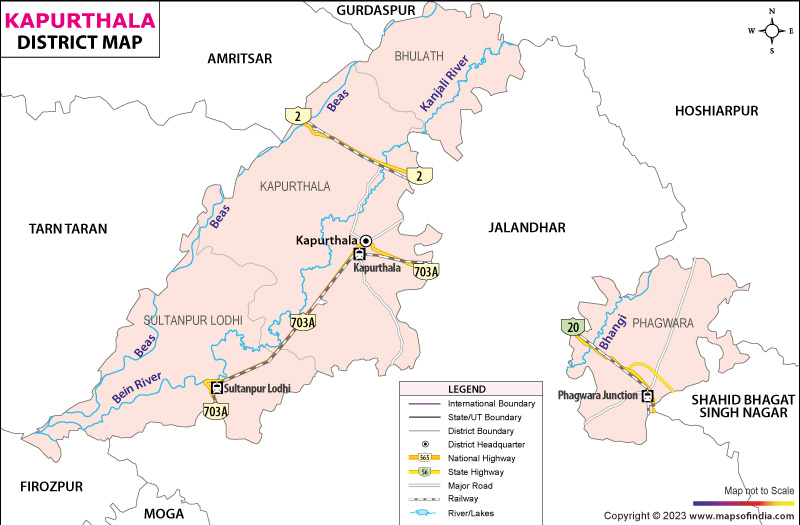
| *Kapurthala District Map highlights the National Highways, Major Roads, District Headquarter, etc in Kapurthala. |
About
Walking through Kapurthala, the air shifts - different somehow compared to elsewhere in Punjab. Called the "Paris of Punjab" across regions, this label sticks because it fits, not because someone wanted attention. A legacy lives here, shaped by rulers who admired balance in design, bold beauty, and buildings that echo old European dreams. Eastward lies Jalandhar, close enough to touch. North brings Amritsar and Gurdaspur into view, while Ferozepur holds the southern edge.
What stands out about Kapurthala is how it splits into two unconnected chunks - one holds Kapurthala and Sultanpur Lodhi, while Phagwara sits cut off, boxed in by Jalandhar and Hoshiarpur. Covering around 1,633 square kilometres, this small region links Punjab’s religious traditions with its growing industries. Though separated on the map, both sections shape a shared identity shaped more by culture than boundaries drawn on paper.
History & Culture
Out of the 11th century rises Kapurthala, born through Rana Kapur, descendant of Jaisalmer's Rajput line. Not until 1773 did its present form emerge, shaped by conquest - Baba Jassa Singh Ahluwalia claiming the land, making it the seat of the princely realm. Once head of the Ahluwalia Misl, he stood unchallenged among Sikh warriors, known less for titles than sharp strategy and shielding belief. His legacy lingers where stone meets memory, quiet but fixed.
Backed by sharp diplomatic moves, the kingdom kept its independence until it slipped beneath Britain's wing during the 1800s. Peace settled in, opening doors for Kapurthala’s brightest stretch, shaped largely by Maharaja Jagatjit Singh across six decades of rule. Art bloomed here, learning advanced steadily, culture thrived - his vision pulled European designers into the fold. Buildings rose under their hands, structures that now rise quietly against the skyline, echoes of royal times long past.
Deep within Kapurthala lives a culture shaped by soil, soul, and centuries. Sultanpur Lodhi rests here - a place touched deeply by spiritual presence. Guru Nanak Dev Ji, originator of Sikh teachings, lived more than fourteen years in this quiet town. Enlightenment came during a moment by the Kali Bein stream, water flowing nearby. From that instant emerged words that shifted understanding - “No Hindu, no Muslim.”.
People come together when the drums roll, sharing meals through langar without rank or status.
Economy
Farms stretch beside factories here, yet both fit naturally into daily life. Public plants hum along without drowning out small shops and family plots.
Government Sector -
Most jobs here come from offices run by the government. Since Kapurthala runs key services for the Doaba area, its court system, city councils, and regional agencies hire many graduates. Stability starts where paperwork does.
Public Sector -
What stands out most in Kapurthala’s economy? The Rail Coach Factory takes that spot. Set up back in 1986 under the Ministry of Railways, it sprawls across vast grounds. This government-run plant ranks among the biggest such facilities on Earth. Over the years, output here has climbed steadily. Tens of thousands of coaches now roll from its lines. Among them are swift LHB models. Even newer types like Vande Bharat emerge from these workshops. Size alone doesn’t tell the full story - technology does too. Out here, RCF changed everything - jobs popped up fast, putting engineers, techs, and workers on payroll. That ripple pulled in hundreds of smaller shops, backyard factories, supplier hubs, all stitching into one busy web across towns.
Services Sector -
Now pushing further into modern times, Kapurthala sees its service industries grow fast. Not far behind, Phagwara powers ahead as a busy centre where shops, property deals, and bulk selling shape daily business life. Thousands come each year to study at places such as Lovely Professional University. Because of this, shops, banks, and transport networks have grown fast around it. Housing needs jumped - landlords found new chances. Eating spots opened nearly everywhere. Jobs followed, mostly for young people working in service jobs. The town shifted slowly, shaped by student crowds walking its streets.
Tourism
Jagatjit Palace -
Built much like Versailles and Fontainebleau, this grand building used to be where the Maharaja lived. Now it serves as the Sainik School Kapurthala. Its stunning ceilings burst with colour, while pillars made of rare blue stone rise from the floor. Clocks shaped by French Renaissance hands tick quietly nearby. Fountains carved from white marble dip below ground level. All of it rises suddenly amid quiet farmland in Punjab.
The Moorish Mosque -
Hidden among northern India's skyline, this mosque was built by the Maharaja for his loyal Muslim community. Not far from tradition, its design mirrors the famed Grand Mosque in Marrakesh. Crafted by French designer M. Marcel, elegance flows through detailed stucco patterns along walls and arches. Step inside, where a wide courtyard opens beneath open sky. Few structures like it exist in the region. More than stone and plaster, it speaks of harmony across beliefs. Its presence lingers - quiet, firm, enduring.
Gurdwara Ber Sahib Sultanpur Lodhi -
After washing in the flowing waters of Kali Bein, he found peace right there. That very tree remains alive now, weighed down by clusters of small, sweet berries. Its shade still shelters visitors who walk miles just to stand near its roots. People arrive every day from distant lands, drawn without force or reason. The white marble around it gleams under open sky, untouched and calm. Few places carry such a steady hush.
Elysee Palace -
Standing since 1962, this quiet palace wears an Indo-French face like a faded postcard.. Once home to Kapurthala's royal family, its halls now teach through old echoes of luxury. Step inside, and you find not just rooms, but routines frozen in silk and shadow.
Panch Mandir Five Temples -
Standing apart from typical temples, this cluster rose under Sardar Fateh Singh Ahluwalia's rule. Around one core chamber, five separate shrines align in balance - each visible at once when seen from the middle. From that spot, eyes meet all five gods without shifting stance.
Kanjli Wetland -
Bird lovers find joy at Kanjli Wetland, formed when a sacred barrier was built on the Bein River. Home to winter travellers from the sky, native animals also roam here quietly. Weekend visitors often arrive from nearby towns, drawn by calm waters and camera moments. This place holds global importance now, marked officially among wetlands worth protecting. Boating slips through stillness while feathers rise above reeds without hurry. Photographers wait patiently where land meets flow, capturing what moves slowly into view. People come not just for sport but to stand beside something older than plans. Ripples carry silence better here, broken only by wings brushing air. Its status grew over time, shaped by care more than design. Few spots blend rest, life, and motion quite like this stretch of earth and flood.
Demographics
With 8,15,168 people counted in the 2011 Census, the district shapes a notable share of the state’s population makeup. Males make up 4,26,311 of that number, while females account for 3,88,857. Though smaller in count, women form a vital part of the local social structure. Economic activity here influences surrounding areas, thanks partly to administrative functions based in the region. Spread across 1,631 square kilometres, this region hosts roughly 499 individuals per square kilometre. Nearly every thousand men are matched with 912 women, showing the current gender balance. When it comes to reading and writing skills, just under four out of five residents can claim basic literacy. Among children, the pattern shifts - only 871 girls exist for each group of a thousand boys. Religion-wise, more than half follow Sikhism, making up 55.66 per cent of believers. In daily talk, voices most often carry Punjabi through homes and streets. Most people here live in villages, though more than one-third reside in towns. Nearly three out of every hundred residents in Punjab call Kapurthala home. Homes across the area number around 146 thousand. A significant share of life unfolds beyond city limits.
Back in Kapurthala, people tend to read well, share strong cultural ties, yet still move with the times. Census records lay out the basics - figures shaping the area - in clear detail. Eight hundred fifteen thousand one hundred sixty-eight individuals call Kapurthala home. Life moves more slowly there, shaped by soil and seasons.
Most people here grow up speaking Punjabi - it shapes daily life, trade, and family talk. In busy towns such as Phagwara, many switch easily into Hindi when needed. Students often move away for studies, while others keep strong links overseas, so English shows up regularly in schools, offices, and companies. The mix stays steady - home ground remains Punjabi, but wider spaces open to other tongues.
Administration
One way Kapurthala stays organized? Through clear administrative layers meant to deliver services across both divided areas. At the top sits the District Magistrate - also called Deputy Commissioner - who guides how city zones mesh with countryside regions. Balance matters here, especially when managing two very different landscapes under one roof.
Tehsils: Splitting things up helps with money matters, plus keeping order. Four main chunks make up the area's layout. Each part runs on its own, more or less. These sections go by another name, too - Tehsils. Not one stretches beyond the others much
Jalan Palace sits at the heart of things, running daily operations. From there, key decisions flow out across the region.
Phagwara: The high-growth industrial and educational powerhouse.
Sultanpur Lodhi: The sacred, spiritual and historical sub-division.
Besides rolling fields, Bholath holds strong ties to Punjabis living abroad. Its quiet farms stretch wide under open skies, shaped by seasons and distant kin.
Villages
| Facts of Kapurthala District | |
|---|---|
| State | Punjab |
| District | Kapurthala |
| District HQ | Kapurthala |
| Population (2011) | 815168 |
| Growth | 0.00% |
| Sex Ratio | 912 |
| Literacy | 79.07 |
| Area (km2) | 1633 |
| Density (/km2) | 501 |
| Tehsils | Bhulath, Kapurthala, Phagwara, Sultanpur Lodhi |
| Lok Sabha Constituencies | Khadoor Sahib, Hoshiarpur (SC) |
| Assembly Constituencies | Bholath, Kapurthala, Sultanpur Lodhi, Phagwara (SC) |
| Languages | Punjabi Including Doabi, Hindi |
| Rivers | Beas, Sutlej |
| Lat-Long | 31.372399,75.304985 |
| Travel Destinations | Moorish Mosque, Shalimar Gardens, Panch Mandir, State Gurdwara, Gurdwara Ber Sahib, The War Memorial, Mausoleum of Peer Yau-udin Sahib, Radha Krishan Temple, Dharni Dhar Temple, Gurudwara Chhevin Padshahi, St Mary's Cathedral Church, Shaheed-E-Azam Sardar Bhagat Singh Museum, Tulsi Mandir, Sodal Mandir, Wonderland Theme Park etc. |
| Government Colleges/Universities | NJSA Govt. College, Govt. College, Guru Gobind Singh College of Education, MGN College of Education for Woman, Hindu Kanya College, SD College for Woman, Guru Nanak Khalsa College etc. |
FAQs
Q1: How many villages are there in Kapurthala?
Some 626 villages sit within Kapurthala district, spread out evenly among four parts - Bhulath comes first, then Kapurthala town itself, followed by Phagwara, with Sultanpur Lodhi closing the list.
Q2: What is the Population of the District?
As of the 2011 Census, the total Population of Kapurthala is 815,168.
Q3: What is the Kapurthala District Known For?
Among Indian towns, Kapurthala stands out with buildings that echo old European charm - its palace and mosque pull echoes of France and the Mediterranean into the Punjab soil. What many overlook is how steel wheels come together just beyond the city at a factory crafting nearly every rail coach in the country. Spirit stirs here too; centuries ago, along quiet riverbanks, Guru Nanak found clarity beneath open skies near what is now Sultanpur Lodhi.
Last Updated on : May 08, 2026
