|
||||||||||
 | ||||||||||
|





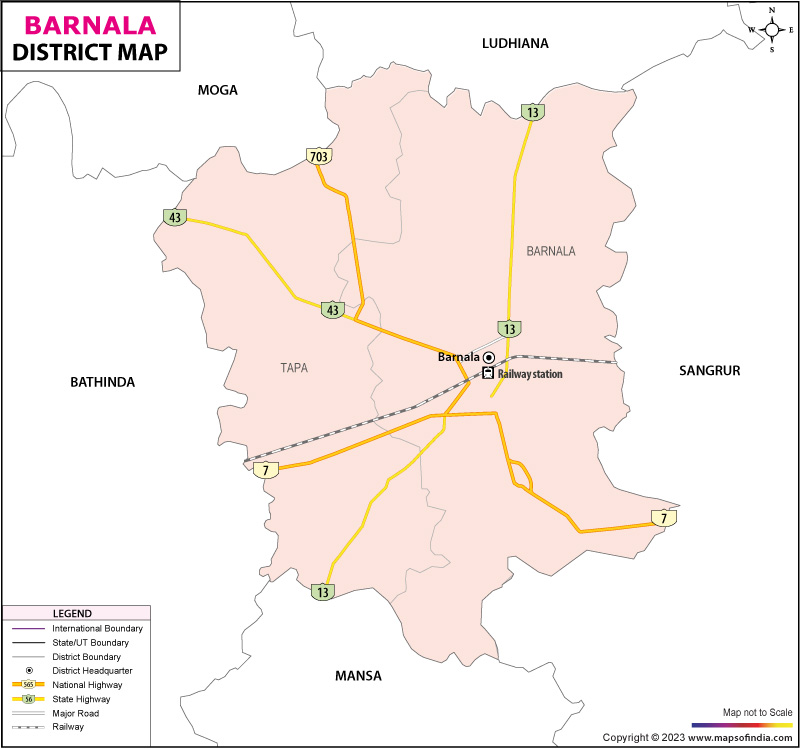
| *Barnala District Map highlights the National Highways, Major Roads, District Headquarter, etc in Barnala . |
About
Born from fields where stories run deep, Barnala pulses quietly beneath Punjab's broader landscape. Though formed only in 2006, its roots stretch well beyond official records suggest. Located within Malwa, the area hums with a blend of old rhythms and new motion. Small in scale, yet strong in presence, it measures worth through layers of heritage rather than sheer size. What it lacks in expanse it makes up for in quiet strength - shaped by endurance, shaped by voice.
Barnala pulses with a rhythm shaped by golden wheat plains alongside rising factory smoke. Tractors move steadily off production lines at Standard Combines while fabric weaves tightly in Trident Group mills. Not machines define it - instead, faces do: laughter echoing through village lanes during Lohri fires. Gatherings hum with folk tunes passed down dusty roads and shared meals under open skies. Strength grows quietly there - in hands clasped at weddings, voices raised together, nights lit by stories older than memory.
Barnala blends old roots with new rhythms. Where Bhangra drums meet factory sounds, life moves to its own tempo. Each narrow path through the countryside carries echoes of long-held customs. Not large in size, yet rich in meaning, it reflects what lies at Punjab’s core. Its quiet presence speaks volumes about regional identity.
Economy
Beyond farming, jobs in administration help sustain daily life across Barnala. Public offices anchor stability, while factories slowly reshape opportunity. Though small in scale, manufacturing adds new paths alongside traditional work. Government roles remain central, yet enterprise begins to stretch beyond old boundaries. Institutions serve as pillars, even as private ventures test fresh ground. Growth unfolds without
fanfare, steady rather than sudden.
Government Sector
Thousands rely on jobs within Barnala's public services for steady work. Stability comes through roles shaped by local administration needs.
Many people work in district administrative buildings, educational institutions serve students at different levels. Offices managing regions hire staff to handle daily operations. Learning centers from primary through higher education require employees for teaching roles. Some individuals support functions behind the scenes across these public facilities.
Public clinics, member-owned credit groups, and countryside improvement efforts support well-being while expanding access. Though often overlooked, these institutions form a quiet backbone for daily life outside cities.
Farmers gain access to new methods through aid programs, yet still preserve age-old ways of earning a living. Support systems bridge old traditions with updated techniques by offering guidance where needed most.
Backbone-like support comes from state efforts in village well-being, linking remote areas to progress through steady service delivery. Though often unseen, these systems keep distant communities within reach of essential aid.
Public Sector
Public buildings in Barnala serve roads, schools, yet also support health care and housing programs. Electricity reaches homes because of infrastructure maintained through consistent operational efforts. While primarily serving Punjab, the organization influences broader regional supply patterns. Energy delivery remains a core function under ongoing public oversight.
Farmers plus small enterprises gain access to funding through credit unions and rural banking networks. Health programs help reach underserved communities.
Equity in resource distribution emerges through public efforts that connect city and countryside alike. While cities grow, remote areas benefit from structured support systems designed to balance opportunity.
Private Sector
Barnala's economy moves fastest because of businesses that operate beyond national borders. These companies set the pace, shaping how work grows in the region.
Worldwide shipments mark the reach of Trident Group, a major force across textile and paper industries. Thousands find work within its expanding operations. Global demand meets steady supply through its diverse manufacturing footprint.
Punjab's farming sector leans heavily on Standard Combines. This key player builds equipment vital to local crop production. Machines roll out consistently, meeting demands across rural landscapes. Their presence shapes how fields are worked each season. With deep roots in agriculture, the company influences efficiency in harvest cycles. Handicraft production sustains income for many households.
Across Barnala, retail outlets signal shifting economic patterns. Transport firms emerge alongside changing mobility needs. Private education centers appear where traditional systems once dominated. Each reflects gradual transformation - visible, tangible, rooted in daily life.
Tourism
Barnala might not top travel brochures, yet its streets hum with quiet history. Old temples stand beside dusty lanes where stories linger in plain sight. Instead of crowds, there is space to wander without hurry. Though overlooked by many, faded murals whisper tales of older times. You find rhythm here, not in grand sights but in moments between them. Gurudwara Tap Asthan Bibi – a revered Sikh shrine.Festivals light up Handiaya, while traditions breathe through Tapa. Towns pulse with color when crowds gather each season. Music spills into streets where stories pass from old to young. Markets hum with rhythm only regular folks create. Each corner holds a voice that refuses silence.Rural Punjab experience – traditional villages, farmlands, and Punjabi hospitality.
Demographics
Back in 2011, the headcount came out to 596,294 during the national tally.Some folks read and write - about 68 percent.a figure comparable to the entire population of the Solomon Islands or Wyoming in the United States.With that count, it ranked last among Punjab's districts by number of people. That places it at position 527 nationwide when measured against India’s 640 total districts Each square kilometre hosts around 419 individuals.Between 2001 and 2011, its numbers rose by 13.16%.For every thousand men, there were 876 women present.Literacy stood at 68.9 percent across the area. People belonging to Scheduled Castes accounted for 32.24% of all residents. At the time of the 2011 census, 95.14% of the population spoke Punjabi and 4.30% Hindi as their first language. That number beats plenty of countryside spots nearby.
Punjabi holds official status here. Yet people often speak Hindi too. English shows up regularly in daily life. Different tongues mix depending on the setting.
Lots of Sikhs and Hindus live here, though there are also some Muslims alongside Christians. A few follow Islam, while others practice Christianity. Most people identify as Sikh, yet a fair number are Hindu too. Smaller groups include Muslim neighbors plus those who are Christian by faith.
Administration
Barnala handles cities and countryside through one coordinated setup, so rules apply everywhere evenly. Despite having few people, it needs strong oversight to weigh factory expansion against village well-being. Located in Barnala town, the Deputy Commissioner’s office directs key government functions. From this hub, oversight flows into public safety, income gathering, besides planning for growth. Assisting the DC are Additional Deputy Commissioners along with Sub-Divisional Magistrates. Professionals drawn from education, health sectors join these teams. Revenue and judicial officials operate within each, managing everyday administration. On another level, rural progress falls under three blocks - Barnala, Sehna, besides Mehal Kalan. These manage welfare initiatives, development projects, along with village-level self-governance bodies.
From time to time, real power shows up quietly in Barnala - not in offices, but where people gather under trees to talk about drains, wells, and quarrels between neighbors. These meetings take shape as Gram Panchayats, small bodies that handle daily concerns without waiting for distant orders. Because choices emerge locally, repairs to pipes or land conflicts move faster than paperwork might suggest. When national plans arrive - like jobs on farms, house grants, or help with seeds - it is these councils that decide who gets what, how, and when. Power stays close to home; voices matter more when they come face-to-face. Barnala relies on several police outposts and administrative clusters to uphold order. Cooperation between officers and neighborhood groups helps reduce illegal activity. Factories in industrial belts receive focused oversight due to their size and operational risks.
Justice at the grassroots comes through civil courts alongside criminal ones within the district system. Moving toward digital records happens now, with online tools slowly replacing paper trails. Efficiency grows when processes shift into electronic formats across these local courts. Transparency becomes possible once information flows without delays or hidden steps. Now comes clearer access - roads upgraded, water systems fixed, classrooms rebuilt. Growth in factories follows, not without checks: rules upheld, rewards offered where fit. Progress moves on two legs, one built of concrete, the other shaped by oversight.
| Official Name | Barnala |
| Location | Punjab |
| Area | 1482 sq. km |
| Population | 596,294 (2011 census) |
| Language | Hindi, Punjabi |
FAQs
Q1: How many Villages are there inBarnala district?
Barnala has about 133 villages.
Q2: How many people live in Barnala district?
Back in 2011, the count came out to 596,294 people. Though older now, that number still marks a clear point in time when everyone was tallied up across households.
Q3: What is Barnala famous for?
Built on textile looms and paper mills, Barnala hums with the rhythm of the Trident Group. Machines for fields rise through Standard Combines, shaping daily work. Punjabi traditions fill streets, homes, voices - deeply rooted, always present. Built where factories meet old customs, Barnala stands quiet but strong. Though few call it home, its role in shaping Punjab runs deep. Curious about how its workshops operate, what festivals feel like there, or which places draw visitors? Just say the word. Write in paragraphs using headings
Conclusion
Barnala might have few people, yet its role feels large. Industry hums here, old customs run deep, while governance keeps pace - each part holding up the whole. The reach of companies like Trident stretches far, even as village festivals keep rhythms alive on dusty ground. Progress moves forward, though tradition never steps back. This place breathes differently. Not merely lines on a map, it pulses with how Punjabis rebuild, imagine, stick together.
Last Updated on : July 17, 2026
