|
||||||||||
 | ||||||||||
|





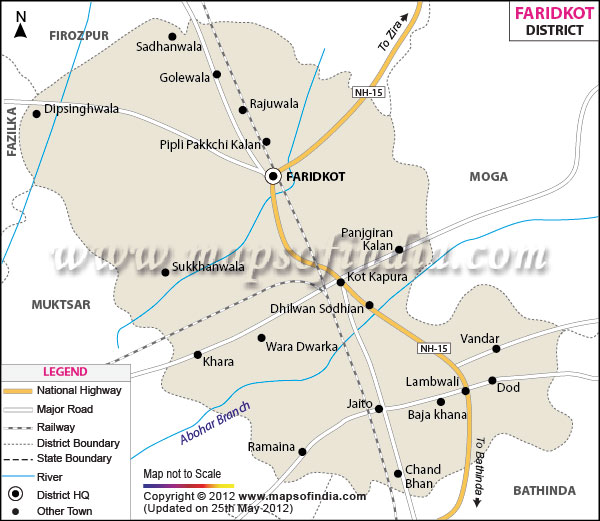
| *Faridkot District Map highlights the National Highways, Major Roads, District Headquarter, etc in Faridkot . |
About
Faridkot is among the heritage districts of the Indian state of Punjab. The administrative headquarters city is Faridkot and other cities like Kotkapura and Jaitu are also some important urban centre of the district which is responsible for the social and economic activity in that district. The district is a significant link in southern Punjab with the district of Bathinda, Moga, Muktsar and Ferozepur. The Map of Faridkot district is generally used by many students, researchers and travellers for understanding its geographical location and administrative divisions.
The area of the district is approximately 1458 sq. km. and lies in the plains of Punjab, a fertile tract. The fields are green and vast with farming as the dominant feature, the abundant shows of fields of wheat, paddy, cotton and others. It is also important for the Faridkot district map to be useful so that it can also be used to highlight the canal network and rural settlement that is used for the agrarian economy in Faridkot.
The name Faridkot is given because this town is influenced by Baba Farid's spiritual teachings who has influenced large portions of Punjab. Local legend says the town came about because centuries ago a saint visited the area. Later the district grew under the rule of the princely state known as Faridkot and was of significant importance during the colonial era and early after Independence of India. On the Faridkot district map, those viewing the map can determine the importance of the district in relation to roads and railway lines to southern Punjab.
History & Culture
Faridkot's history is associated with the Faridkot princely state; it is thus relevant to note that a description of its history will be present here.It becomes relevant to mention that the history of Faridkot district was connected with the establishment of princely state of Faridkot in the district. Local chieftains in the various prefecture areas ruled over the respective areas before the formation of the princely kingdom, according to history. The region was successively influenced by the different powers such as Mughals and then the Sikh misls in the medieval period. A Faridkot district map would come in handy for the historians to follow the expansion of the princely state and the neighbouring political areas.
The rulers of Faridkot were of great importance in developing the area. Among the prominent rulers who did a favor to the education, healthcare and infrastructure sector is Maharaja Harinder Singh Brar. Faridkot remained the princely state under direct colonial rule of the British during their rule. Since Independence India in 1947, the state has taken a part with the Indian Union, later transferred to Punjab. During the studies on reorganisation of Punjab and formation of modern administrative districts the Faridkot district map is used frequently.
Finally, the culture of Faridkot district is that of Malwa region of Punjab. The language spoken most of the time in the District is Punjabi and the religion followed is of Sikhism with Hinduism and Buddhists community contributing to the District's culture and a Muslim community also making a significant contribution to the culture of the District. During festivals and celebrations folk songs and bhangra performances along with gidda dances are common. With Faridkot district map, for many cultural researchers it is used to identify rural settlements in which the traditional folk customs are still alive.
The district holds big celebrations at various festivals of the Punjabi community. The local communities celebrate most of the major occasions that presently markl the season, such as Vaisakhi festival, Lohri festival, Gurpurabs as well as Diwali. Special events or festivals like either Diwali or Holi see Gurudwaras turning into a gathering place for spiritual and social activities. The Faridkot district map is also frequently checked by tourists passing through the district on to the places of spiritual and cultural interest on these festive days.
Faridkot also has a good literary and educational heritage. The district has given birth to scholars, teachers and writers, who have written in the Punjabi literature and education. Traditional Punjabi cuisines, such as makki di roti, sarson da saag, lassi and other dairy products provide an integral part of the life of the locals. The Faridkot district map is also useful for tourists who want to visit the villages which preserve the traditional lifestyle of the Punjabis.
Economy
Agriculture and associated agriculture are the main sources of income in Faridkot district. The fertile soil, facilities for irrigation and the use of new agricultural practices have rendered the district an important agricultural area in Punjab. The predominant crops grown in district are wheat & paddy, and cotton, maize, vegetables are grown in certain parts of the district. The farmers are mostly canal cultivated and tube well users as is evident on the Faridkot district map and the district's rural infrastructure.
Govt sector contributes to the district's economy to an important degree. A significant job roles are available in Government offices, education institutions, hospitals and administrative offices. Agriculture, rural development and social welfare-related public welfare measures have helped to improve living standards.
Other economic levers can be achieved via educational and medical institutions in the public sector, which play a significant part in the district's economy. Guru Gobind Singh Medical College and Hospital, Faridkot is among the most vital educational and healthcare institutes in the area. Students, doctors, and patients from around the country, in particularly from Punjab and adjacent districts visit it. Activity in public infrastructure has also bolstered economic activity through road, transport, and irrigation activities.
The size of services sector has grown overtime over past few decades. Many now work in the banking/finance sector, in retail sales or transportation, or in education and health care. Kotkapura is an emerging commercial hub with dynamic grain markets and trading centres. The Faridkot map district shows the connectivity of the roads facilitated the trading movement between the rural and urban areas.
Tourism
In the area of Faridkot, there are several historical, religious and architectural hot-spots, which are visited all year round. Raj Mahal, the Royal Palace of the previous rulers of Faridkot is one of the most significant site. The palace complex illustrates a combination of the traditional style of the Punjab with the influence of the colonial style. The map of Faridkot is a popular option for visitors seeking to find the location of the palace and any other heritage sites in the locale.
Tilla Baba Farid Gurudwara is one of the revered religious centres of the district. The shrine is dedicated to Baba Farid and is a place of worship for people from all over Punjab and northern India. During the annual fairs/religious functions in the shrine a spiritually vibrant ambiance prevails. The Faridkot district map is a popular tourist use map while visiting the gurudwara or other religious places of the region.
Sheesh Mahal is another monument of importance because of its gorgeous design and decorative mirrors. It is a reflection of the taste of the royal family, and is still a symbol of Faridkot's culture. This Faridkot district map is traditionally utilized by lovers of heritage who want to venture into the Royal Bungalows of the district.
There are also a few National Parks, small markets and educational institutions in this District that host the social life of Punjab. Slowly tourism industry has been developed and many people have become the source of tourism in the rural areas with the intention of experience the real life of the villages, farming tradition and local food in the villages. The Faridkot district map serves as an aid to help tourists find their way on rural roads and go to the villages in which they are interested in visiting their cultural heritage.
Demographics
The total population in Faridkot district is around 617,508 (as per the Census of India, 2011). There is a balance mix of the rural and urban populace in the district but with good chunk of villages population. High population density of the district is about 424 persons per sq km implying farming plan of development in the area.
On an average, Faridkot has literacy rate of around 69.55 per cent. It has improved steadily over the years as the increase of the number of Government Schools, Colleges and professional Institutions in the district have made educational awareness to grow. While male literacy is still higher than female literacy – there is the narrowing of the gap as a result of educative programmes.
The main medium used for administration, education, life activities is also Punjabi and it is the main language spoken across the district. Hindi and English comprehension are also appreciated, especially in educational institutions and urban centers. Sikhism is the major faith of the district with Hinduism and small minority groups following.
Administration
District Faridkot comes under the administration of Punjab Government. Deputy Commissioner is the executive officer having high responsibilities of dealing with the law, and administration and development works. Different government departments have offices in both district and sub-divisional levels for taking up public welfare or infrastructure plans.
There are three main tehsils in this district namely, Faridkot, Kotkapura and Jaitu. The responsibility of these tehsils is to take care of local administration, maintain land records and deal with revenue matters. Both urban and rural government are run by respective municipal and gram panchayats.
In most villages, the farmers constitute the main source of livelihood and in the district Faridkot there are more than 170 villages. The administration of the village is in the hands of the Gram Panchayats which are elected which cater for village development, sanitation and welfare activities. In spite of all these developments, the infrastructure in rural areas has greatly increased in the past few decades, including in rural regions such as irrigation and schools.
The District also has its representation both in Punjab Legislative Assembly and in the Parliament of India. Most importantly, interagency working in governance and provision of services in the district is between administrators, police, judicial and development systems.
| Facts of Faridkot District | |
|---|---|
| State | Punjab |
| District | Faridkot |
| District HQ | Faridkot |
| Population (2011) | 617508 |
| Growth | 0.00% |
| Sex Ratio | 890 |
| Literacy | 69.55 |
| Area (km2) | 1472 |
| Density (/km2) | 424 |
| Tehsils | Faridkot, Jaitu |
| Lok Sabha Constituencies | Faridkot |
| Assembly Constituencies | Faridkot, Kotkapura, Jaitu (SC) |
| Languages | Punjabi, Hindi |
| Rivers | ----- |
| Lat-Long | 30.595366,74.829054 |
| Travel Destinations | Qilla Mubarak, Raj Mahal, Darbar Ganj, Gurdwara Tilla (Chilla) Baba Farid, Gurdwara Godari Sahib, Gurdwara Guru Ki Dhab, Gurdwara Tibbi Sahib, Gurdwara Godavarisar Patshahi, Rajsthan and Sirhind Canals, Fairy Cottage, Check Tower etc. |
| Government Colleges/Universities | Baba Farid University of Health Sciences, Govt. Brijindra College, Govt. College, of Edu, Govt. College (Kotkpura), University College of Nursing, Malwa College of Nursing, Guru Gobind Singh Medical College etc. |
FAQs
Q1: What is the total number of villages in Faridkot district?
Faridkot district has more than 170 villages according to Census 2011 records and administrative data.
Q2: What is the population of Faridkot district?
The population of Faridkot district is approximately 617,508 as per the Census of India 2011.
Q3: What is Faridkot district famous for?
Faridkot district is famous for its royal heritage, agricultural prosperity, religious sites associated with Baba Farid and important institutions such as Guru Gobind Singh Medical College and Hospital.
Last Updated on : May 08, 2026
