




Introduction
Firozpur lies in Punjab where wide green fields meet quiet stretches of riverbank. Along the Sutlej River it lies, near a frontier shaped by decades of shifting borders. History moves slowly here, present in stone markers and silent parades at border crossings. Men once gave their lives during the push for freedom; today, monuments stand instead of names. Sounds rise from villages during harvests, voices blending into old tunes passed across generations. Food appears on clay stoves - simple meals made rich by tradition rather than spice. Outside town, rows of golden grain shift under wind, marking time without clocks.
This land feeds more than bodies, shaping identity through soil, sun, and shared past. Here unfolds a quiet strength, woven into market lanes humming with daily exchange.
History does not stand apart here; it breathes inside moments ordinary and overlooked. What remains is neither spectacle nor myth, but presence felt slowly, gathered across generations.
History
Contrary to all other districts in Punjab which have a rich history, Firozpur has a little history attached to it. Firozpur aka Ferozepur, is devoid of ancient buildings, and no buildings in the district are mentioned in the early records. The Sarai Nanga site is often linked to the Raja Salvahan. There are other sites that legends link to him that are a few miles away to the east of Mukatsar. However, none of the present towns find their mention from the earlier period than Akbar’s reign. This was because the entire western side of the district was within the last four centuries overrun by the river Sutlej. Any signs of antiquity or records that may have existed would have been eroded by the river in the course of this time.
Geographers argue that the Kot-Kapura Plateau would have formed the northern margin of the Great Rajputana Desert in the past. This region was more susceptible to having been invaded by immigrants because it was closer to the river which now runs near the Mukatsar and Faridkot towns. This made the area more habitable than other regions in the south (present-day Bikaner territory). The earliest known rulers in this district were the Pulwama Rajputs and Janer was the then capital of the region. General Cunningham in his archeological survey reports mentions this district and its capital. When the first Muhammadan conquest of India happened, the colony of Bhakti Rajputs came up from Jaisalmer under the leadership of Rai Hel. They settled to the south of what is known today as Mukatsar. The great tribes of Manj Rajputs, Naipals, and Dogra are also the branches of the Bhakti Rajputs. The colony was able to overthrow the local Punwar chief and establish their rule in the region.
During the Vedic time, it was inhabited by the Aryan tribes and later came under the reign of modern and the Gupta empire. There are many stories about the establishment of the district. One such story claims that Firozpur was founded by Ferozeshah Tughluq in the 14th century. Another version of the story argues that it was founded by a Bhatti chief named Feroz Khan. The former story is widely popular among people because Feroz Shah Tughlaq was known for building new cities and renaming old ones after himself. Ferozepur was of great significance during British rule in India. It was one of the most strategic positions in the northwest of India and was a major military center for the Britishers. In 1838 the district served as the base from which the British troops moved to Kabul during the first Anglo-Afghan War.
During the first Anglo-Sikh war in 1845, the British commanders were negligent at Firozpur, the result of which The Khalsa crossed the Sutlej river without any opposition. It is said that this negligence by the British commanders was the main cause of the battle of Mudki. Firozpur has also played a determining role in India's freedom struggle. It was during World War II that Ferozepur gained International attention. The cartridges used in the war were made in Ferozepur. The city was so important that Hitler’s propaganda minister Joseph Goebbels mentioned this city in his autobiography. It is said that Hitler wished to destroy this because of the benefits it had for the Allied war effort.
Culture
Just like all other cities in Punjab Firozpur is also a city that has a rich culture that reflects the traditions and customs in the region. There are many folk dancers which are practiced in the region. Bhangra is one of the most popular folk dances that is widely performed by farmers during the harvest season. Even though it began originally as a dance of celebration during the harvest season the folk dance is now performed in almost every celebration that takes place in the region. Apart from dance, the people in Ferozepur are also fond of folklore with songs and ballads often composed and sung in local dialects like Malwai and Pwadhi. There are many popular music styles in the region which are known worldwide. Some of these music styles are Lohris, Kafis, Dohas, Baits, Sehra, Hamds, and Jungni. Romantic songs like Dhola, Boliyan, and Mayhiah are also some of the most celebrated songs that are cherished by the people in Ferozepur.
There are many seasonal festivals which are celebrated with pomp and show in Ferozepur. These are Baisakhi, Lohri, Basant Panchmi, and Teez. Apart from these seasonal festivals, there are many other religious festivals where people participate in kirtans and carry out processions at Gurudwaras. Firozpur is famous for the plays and dramas which are performed on different occasions by the artists in the region. Many plays have now been known to the world and have been adopted in different versions.
Language
In Firozpur, language carries the mark of farming heritage alongside borderland influences. Punjabi dominates daily interaction, spoken by most residents as their first language. Found commonly in the Malwai form, it differs subtly from versions heard farther east within Punjab.
Where governance and schooling are concerned, Punjabi holds formal status, embedded deeply into systems. This institutional backing ensures continuity across generations, maintaining its prominence naturally. From fields to offices, the sound of Malwai remains unchanged in rhythm and usage. Starting from classrooms to government offices, one finds Hindi used alongside Punjabi, building dual-language skills early on. Through such exposure, youth gradually gain comfort in both tongues.
Because Firozpur lies near the border, Urdu holds deep roots there. Once prominent in writings and traditions, its presence grew strong under British rule and before 1947. Though fewer people speak it now, traces remain - seen in verses, carvings, on old walls. Despite fading from daily talk, echoes survive quietly. On another note, English serves roles in schools, offices, and official work. Rural zones show little use of it, yet cities see more, especially among younger, university-trained groups. Usage shifts slowly, shaped by access, exposure, changing times.
Here lies a blend shaped by time: Punjabi speaks the soul of daily life, while Hindi opens wider conversation. Though Urdu echoes an older past, its presence is subtle yet clear. Modern links emerge through English, tied to present-day movement beyond borders. Layered speech patterns mirror where old customs meet shifting realities on this stretch of land.
Geography
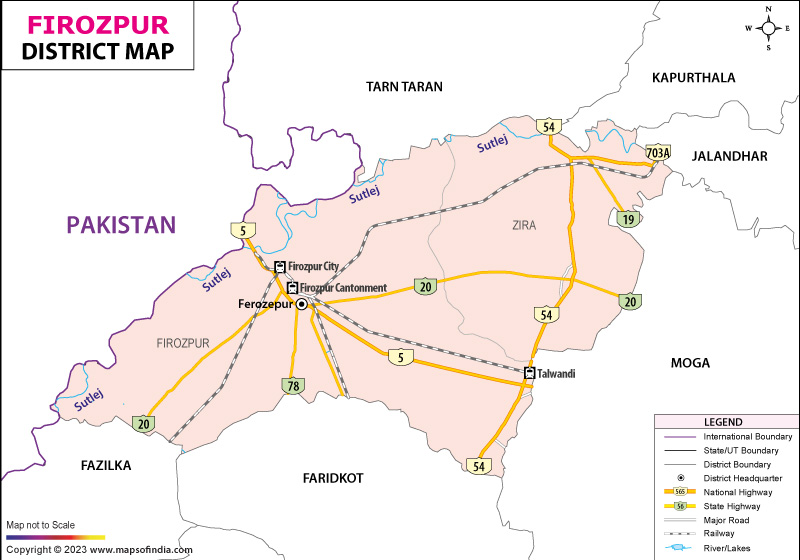
Below the western edge of Punjab rests Firozpur, a town and administrative region molded by the flow of the Sutlej River along with closeness to the boundary shared with Pakistan. At roughly 182 meters above mean sea level sits this territory, positioned near national limits - this location supports farming while also holding military significance. Spreading across the area are deep layers of silt left behind by ancient floods, enriched continuously through river-fed channels that enable consistent crop growth. Cultivation thrives in earth loaded with nutrients ideal for producing grains like wheat, paddy, fiber including cotton, together with sugar-rich cane stalks; despite this advantage, excess watering has led to pooling beneath fields alongside salt buildup within soils.
Firozpur carries distinct cultural weight due to its placement near international lines. Military infrastructure resides here, including sites like the Saragarhi Memorial and the National Martyrs Memorial - markers tied closely to safeguarding borders. Not merely agricultural or strategic, it holds weight due to rich biological diversity found in these nearby habitats. Fertile expanses define much of its terrain, yet seasonal water flows and drier conditions shape how land functions across years. Sitting at a boundary often draws focus to security matters - still, nature plays a quiet but steady role here too. Where farming thrives alongside shifting river patterns, geography becomes more than soil and borders - it reflects layers of resource use, ecology, and position.
| Facts of Firozpur District | |
|---|---|
| State | Punjab |
| District | Firozpur |
| District HQ | Firozpur |
| Population (2011) | 2029074 |
| Growth | 0.00% |
| Sex Ratio | 893 |
| Literacy | 68.92 |
| Area (km2) | 5334 |
| Density (/km2) | 380 |
| Tehsils | Firozpur, Zira |
| Lok Sabha Constituencies | Firozepur, Khadoor Sahib, |
| Assembly Constituencies | Zira, Ferozepur City, Firozepur Rural (SC), Guru Har Sahai, Jalalabad, Fazilka, Abohar, Balluana (SC) |
| Languages | Punjabi including Malwai, Urdu, Hindi |
| Rivers | Sutlej |
| Lat-Long | 30.93963,74.62115 |
| Travel Destinations | National Martyrs Memorial, Saragarhi Memorial, Barki Memorial, Anglo Sikh War Memorial, Pothi Mala, Hari ke Bird Sanctuary, Jain Mandir, Gurudawara Zamini Sahib, Boparai Rifle Range etc. |
| Government Colleges/Universities | R.S.D College, D.A.V College for Women, Dev Samaj College for Women, Dev Samaj College of Education for Women, DIET College, Shaheed Bhagat Singh College of Engg.& Tech, Govt. Polytechnic College etc. |
FAQs
Q1: What are the major tourist attractions in Firozpur?
There are many interesting places to visit in Firozpur including the National Martyrs Memorial, Saragarhi Memorial, Barki Memorial, Anglo Sikh War Memorial, Pothi Mala, Hari ke Bird Sanctuary, Jain Mandir, Gurudawara Zamini Sahib, and the Boparai Rifle Range.
Q2: Which are the most important festivals in Firozpur?
Baisakhi, Lohri, Basant Panchmi, and Teez are the most celebrated festivals in Firozpur.
Q3: What is the geographical importance of the region?
Firozpur sits by the Sutlej River, close to where India meets Pakistan. Its position has shaped its role through time - not only in commerce but also in military matters. Through centuries, riverside placement mattered just as much as proximity to frontiers. Defense needs often matched the rhythm of trading routes passing through. Geography, rather than choice, set its course early on.
Last Updated on : May 08, 2026
