|
||||||||||
| ||||||||||
|





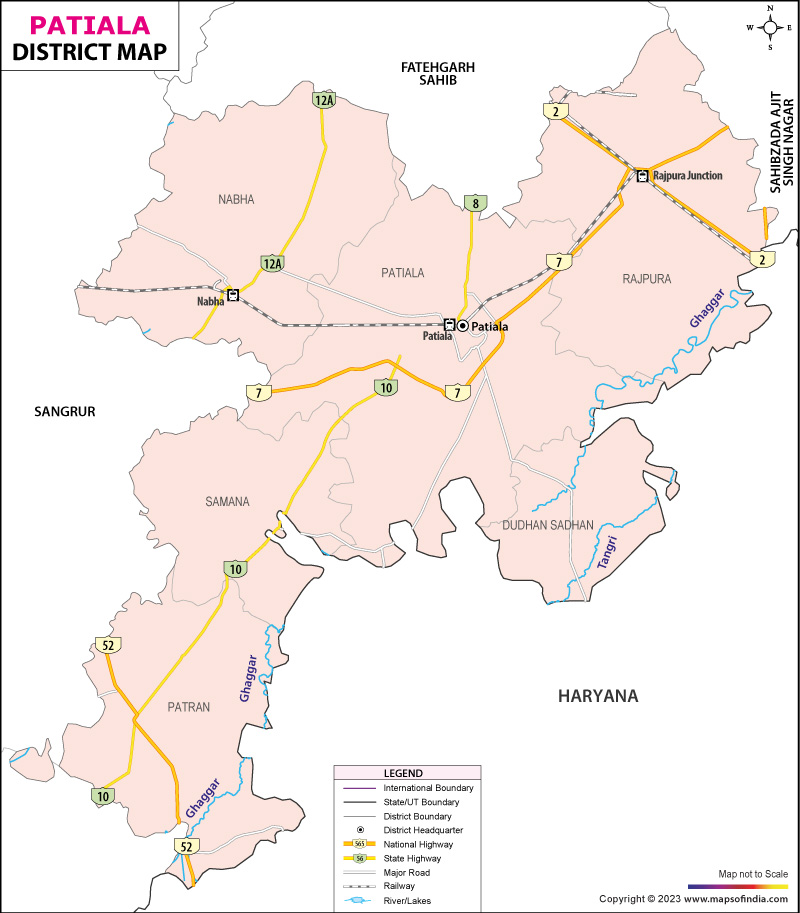
| *Patiala District Map highlights the National Highways, Major Roads, District Headquarter, etc in Patiala . |
About
Patiala district lies in southeast Punjab, standing among the region's key historical and cultural centers. Its reputation rests on regal history, striking buildings, classical soundscapes, learning centers, along with deep-rooted Punjabi customs - elements shaping Punjab’s identity in distinct ways. Elegance from earlier monarchy blends here with momentum of city development, forming an atmosphere where old echoes meet new rhythms without losing balance.
Punjab's rich flatlands host the district, nestled amid productive terrain. Wheat grows here, alongside rice, while sugarcane stretches through village fields - maize and greens appear just as often. Water flows reliably thanks to structured canals, feeding land that yields steadily under open skies. Roads link settlements tightly, enabling movement not only of crops but goods, services too. Education takes shape through universities and colleges rising slowly over decades. Hospitals stand near market areas, where daily exchange occurs without fanfare. Administration finds footing quietly, woven into routine structures beneath visible economic patterns.
History & Culture
The history of Patiala is old but major changes began to be seen during the 18th century. The power structure began to change among the Sikh rulers. Rural life dominated the lives of people before urbanisation began in the region. In 1763, its first structure rose under Baba Ala Singh, who shaped both the city and lineage. From that point onward, strength gathered slowly beneath his rule. One of northern India’s more resilient princely domains formed through steady effort. Growth unfolded beyond politics - culture deepened, trade expanded, presence widened. By later decades, stature had settled firmly into place.
In the 1700s and 1800s, authority in Patiala carried weight across local affairs. Growth came gradually; ties were held with nearby states along with colonial officials. While unrest affected certain areas, order took root here - structures arose, governance systems formed, defense units stood ready. These efforts defined the region’s character over time. Yet it was stability, more than power alone, that marked its distinction.
The legacy of the monarchy lingers within urban design and local customs. Qila Mubarak stands among regal edifices - residences, green spaces, entryways - that echo historical prominence. Blending Mughal symmetry, Rajput detailing, and Sikh craftsmanship defined Patiala’s built environment. Sections of the historic district unfold moments from an age marked by royal parades, artistic assemblies, court rituals.
Known later for artistic growth, Patiala drew attention through musical evolution. From this city rose the respected tradition called Patiala Gharana, admired nationally within Indian classical circles. Expression marked vocal delivery, while precision defined performance standards among its singers. Royal support shaped much of the music scene, where art flourished under imperial encouragement. Court events regularly featured creative presentations as embedded practice.
Beyond royalty, the area's character grows from village ways. In rural spots, old habits guide daily routines. Songs passed down through years echo at harvest time. Weddings follow customs held close for generations. Gatherings of neighbors keep shared stories alive. During festivities, Bhangra steps meet Giddha rhythms on open grounds. These dances mix sound, motion, and connection without effort. What people wear tells its own tale - Patiala salwar among them - a quiet nod to heritage. Culture lives not in displays but in moments repeated year after year.
Celebrations take place with energy everywhere in the area. Marking a key moment in Sikh tradition along with seasonal change, Vaisakhi stands out among yearly events. During cold months, people gather near fires on Lohri, drawn by warmth and shared customs. Gurpurabs echo through gurdwaras where hymns rise steadily into early hours. Held widely regardless of background, Holi, Diwali, Eid, and Christmas highlight variety within daily life here.
The cuisine of the district is another attraction for the tourists. Butter chicken is a celebrated food item of the district which is famous not just here but all over India. Stuffed parathas share space with chole on many morning menus. Lassi serves as a common drink, often found at busy street corners. Sweets follow old recipes, passed across generations without much change. Energy fills market lanes where small eateries draw steady crowds. Hospitality shows clearly, though never stated outright. The atmosphere thrives where wood-fired ovens stay lit through long hours.
Despite its quiet presence, the area held significance through India’s struggle for self-rule and the shift toward elected systems post-independence. While the former princely entity became part of sovereign India, echoes of monarchy still surface - not in power, but in how people recall history, shape buildings, and uphold customs.
Economy
Patiala district draws its livelihood from fields, classrooms, markets, visitors, factories, and service work. Even now, growing crops holds steady as a pillar of income, particularly where village life depends heavily on tilled land. Punjab's flat lands near Patiala support crop growth thanks to managed water supply alongside updated cultivation practices. Mainly wheat followed by rice occupies most fields throughout the area; however, farmers plant maize, sugarcane, mustard, greens, and animal feed too. Rural families gain extra earnings through milk production and bird raising on small farms.
Among those employed, a notable share finds work within structures like district governance, schools, law enforcement, clinics, city councils, along with programs focused on community support. Stability in job availability has grown alongside Patiala’s role in regional oversight - its function shaping long-term positions across sectors. Among those shaping the local economy are public entities like banks, transit systems, schools, hospitals, plus athletic organizations. Among its economic activities, the area hosts modest enterprises focused on textiles, farm tools, hand-made items, sport-related gear, or food production methods. Items like stitched garments, Punjabi-style shoes, and thread-decorated cloth reach buyers not only locally but across neighboring regions too.
Among economic factors, visitor interest in palaces, sacred Sikh temples, landscaped parks, and aged structures plays a role. In city zones like Adalat Bazaar and Leela Bhawan, commerce continues through clusters of storefronts, eating spots, and long-standing trades.
Still, agriculture holds ground even as city life expands across Patiala. Education weaves through daily routines while markets hum alongside tradition. Growth unfolds slowly, shaped by learning, trade, and inherited customs. Progress does not rush yet remains steady under these combined influences.
Tourism
Patiala district stands out because of palaces built long ago, places where people pray, green spaces open to visitors, buildings that hold history, alongside spots tied deeply to local traditions. Among these, a fortress called Qila Mubarak draws attention due to its age and connection with rulers who once lived there. Built using styles seen under Mughal rule combined later with designs from Sikh builders, it still holds a strong presence across the skyline today.
Over time, despite changes around it, this place has stayed central to how locals see their past.
Among the key sites stands Sheesh Mahal, notable for intricate mirrors, artwork, landscaped grounds, along with preserved artifacts. During the rule of regional monarchs, construction took place, revealing tastes shaped by culture and court traditions.
In the district, visits tied to faith matter much. Devotees come steadily through every season to Gurdwara Dukh Niwaran Sahib. Spiritual depth marks this site; its roots trace back to moments in Sikh heritage along with practices aimed at relief. Among the sites that enhance the area's draw is Baradari Gardens, set near the historic Moti Bagh Palace. Colonial architecture appears throughout, lending a distinct character to the surroundings. What pulls many travelers here goes beyond landmarks.
Demographics
Patiala district, as recorded in the 2011 Census, holds approximately 1.9 million individuals. While parts of the region see fast-paced city development, others remain rooted in farming life across vast countryside areas. Among spoken languages, Punjabi holds the widest usage; meanwhile, Hindi along with English sees regular application across government offices, schools, and commercial activities. While Sikhism forms the primary religious presence in the area, Hindu and Muslim populations add layers to its societal makeup.
Among Indian cities, Patiala shows a literacy level near 76%. This figure emerges alongside growth in learning institutions - colleges, universities, and primary centers spread through the area. A pattern forms where knowledge access expands with infrastructure. Not far behind stands public engagement in education, shaping outcomes over time. Learning spreads gradually, supported by long-standing academic setups. One notices steady investment in teaching facilities here. Growth does not rush; it follows quiet effort. Numbers rise because systems endure.
Administration
Patiala district organizes its governance through multiple subdivisions and blocks. From the urban core, administration flows across the region. The city of Patiala hosts central offices, guiding public services. Oversight begins here before reaching outward. District functions operate under a structured layout anchored in this hub.
Patiala stands among the principal tehsils, followed by Nabha where administrative functions are centralized. Rajpura appears next, its location contributing to regional connectivity. Samana holds significance due to agricultural output across surrounding villages. Dudhan Sadhan completes the list, situated at a distance from urban centers.
Across the region lie hundreds of settlements, nestled within rich farmland and areas blending urban with rural traits. Governance at ground level emerges through village councils alongside town administrations, shaping progress in farming zones. From these structures come efforts that maintain cleanliness, support medical access, build roads, and guide growth. Key contributions arise where elected community bodies meet planning agencies, operating together yet independently.
Among key concerns stands education, followed by structured city design. Urban planning connects closely to how regions grow. Support reaches farming communities through targeted measures. Preserved sites reflect cultural value over time. Healthcare systems adapt alongside population needs. Transport networks expand where movement demands increase.
| Facts of Patiala District | |
|---|---|
| State | Punjab |
| District | Patiala |
| District HQ | Patiala |
| Population (2011) | 1895686 |
| Growth | 0.00% |
| Sex Ratio | 891 |
| Literacy | 75.28 |
| Area (km2) | 3222 |
| Density (/km2) | 596 |
| Tehsils | Nabha, Patiala, Patran, Rajpura, Samana |
| Lok Sabha Constituencies | Patiala |
| Assembly Constituencies | Nabha (SC), Patiala Rural, Rajpura, Ghanaur, Sanour, Patiala Rural, Samana, Shutrana (SC) |
| Languages | Punjabi including Pwadhi, Hindi |
| Rivers | Ghaggar |
| Lat-Long | 30.311246,76.318874 |
| Travel Destinations | Qila Mubarak Complex, Qila Androon, Rang Mahal, Sheesh Mahal, Ran-Baas, Darbar Hall, Jalau Khana, Sard Khana, Lassi Khana, Shahi Samadhan, Moti Bagh Palace, Sheesh Mahal, Lachman Jhoola, Bir Moti Bagh, Rajindera Kothi, Baradari Gardens, Ijlas-e KhasGurudwara Dukhniwaran Sahib, Kali Temple, Qila Bahadurgarh, Panj Bali Gurdwara, Maiji Di Sarai etc. |
| Government Colleges/Universities | Punjabi University, Rajiv Gandhi National University of Law, Government Medical College and Rajindra Hospital, Government Mohindra College, Government Bikram College of Commerce, Multani Mal Modi College, Government College Of Physical Education, Government College Of Education, Govt. College for Women, Govt. Ayurvedic College, Govt. College (Dera Bassi), Govt. Ripudaman College etc. |
FAQs
Q1: How many villages are there in the district?
There are 934 villages in the region.
Q2: What is the population of the region?
According to the 2011 census, the population of the district is 1895686.
Q3: What is the district famous for?
Patiala is famous for its rich heritage which goes back to history. Qila Mubarak, Patiala Gharana music tradition, and the Punjabi culture is highly celebrated.
Last Updated on : May 08, 2026
