|
||||||||||
 | ||||||||||
|





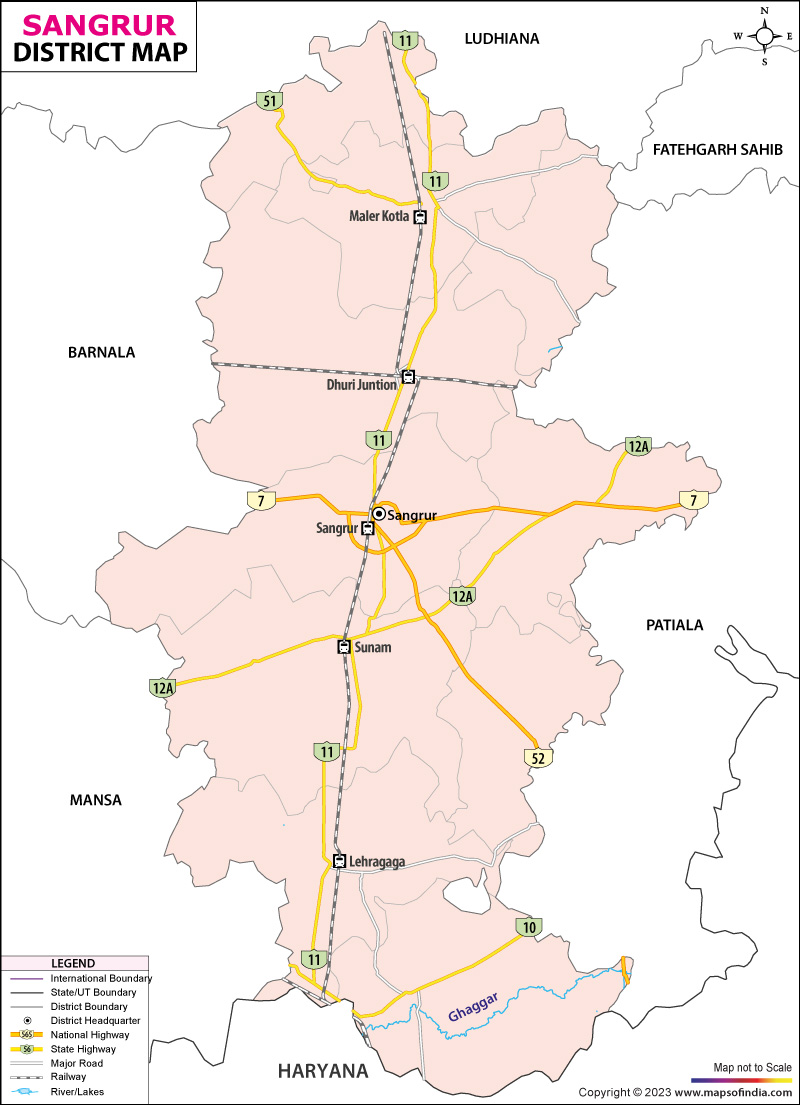
| *Sangrur District Map highlights the National Highways, Major Roads, District Headquarter, etc in Sangrur. |
About
Farming runs deep here, shaping how people live in Sangrur, a place tucked into south Punjab's heart. Fields stretch wide under open skies, feeding both families and local customs passed down through seasons. Life moves slowly in villages where elders speak stories older than roads. Yet busier towns now rise near old farmland, bringing schools that hum during morning hours. New routes link distant spots once cut off by silence and dust. Markets grow without fanfare, standing beside fields where wheat sways like it always has. Administrative offices appear quietly at crossroads once marked only by trees. History lives not in books but in harvest songs sung after long days. Change slips in - steady, unannounced - not replacing, just joining what already stands.
Old royal echoes mix with new city rhythms in Sangrur, where the district office stands. Roads laid out long ago meet bustling bazaars, schools rise beside heritage archways, government structures anchor daily life. Not loud like bigger Punjabi hubs, yet never still - commerce hums, farming fuels small enterprise, celebrations gather crowds now and then. Power moves quietly here too, rooted in seasonal rhythm and community ties. Back then, the area belonged to the royal domain of Jind until the nation gained freedom. Some buildings and open areas from those days remain scattered across the region, shaping how Sangrur looks today. As years passed, what was once farmland ruled by royalty turned gradually into a busy district linked by roads, trains, and growing trade.
History & Culture
Out here among the fields, Sangrur's past grows from the same soil as the rest of Malwa in Punjab - farming roots, small kingdoms once stood, and deep threads of Sikh heritage woven through. Long before roads cut into the land and towns took shape, clusters of villages dotted wide stretches of rich earth. Life moved with the seasons; people worked the ground, kept animals, traded what they made, while daily rhythms spun around village gatherings. Culture lived close, not in books or speeches, but in shared routines under open skies.
Sangrur’s political importance grew when it tied itself closely to the kingdom of Jind. As the 1800s rolled on, those who ruled Jind started shaping how Sangrur would grow. With careful thought behind each layout, roads took form alongside gates, green spaces sprouted near offices, while trading spots emerged between them. Unlike some places close by that stayed loose and scattered, this town looked put together. Even now, if you walk through certain areas, traces of old royal design linger in walls, streets, and corners built long ago.
Back then, under British control, Sangrur stayed tied to royal-style governance even as slow shifts crept into daily life. Trains began running, paths got paved, schools opened their doors - each change settling in quietly. Farming picked up pace across the land thanks to better water flow and new methods taking root. Trade started humming alongside these upgrades, weaving itself into older ways of living.
Back then, just like elsewhere in Punjab, Sangrur felt the heavy weight of 1947's division. People left homes behind because new boundaries split villages apart. Across those shifting lines families traveled, not knowing what waited next. Life changed fast - neighbors gone, towns repopulated overnight. Yet, little by little, routines returned even when memories didn’t. Years passed before things settled into something steady again.
Out here in Sangrur, old Punjabi ways shape how people live day to day. Farming doesn’t just feed folks - it colors music, meals, and how neighbors treat one another. Stories passed mouth to ear keep history alive, mostly out in the countryside. Season by season, village get-togethers mark time like clocks made of soil and sun. These moments hold on tight to what used to be, long before machines took over.
Out here, music shapes how people see themselves. When weddings happen, you’ll spot dancers jumping into Bhangra and Giddha under open skies. Festivals tied to crops bring crowds together through rhythm and motion. Stories about love or leaving home echo in old Punjabi tunes sung for generations. Not far off, the beat of the dhol pounds through village squares at joyful moments. These sounds aren’t just noise - they carry meaning when folks gather.
Economy
Farming holds steady as the main way people earn a living across much of Sangrur, particularly out in the countryside where daily routines follow the seasons. While crops feed families and markets alike, shops, schools, and tiny factories also keep money moving through the district's veins. Fertile land stretches across the area, fed by wide networks of water channels that make growing wheat and rice possible on a big scale - these two dominate what farmers harvest here.
Most people look for work in offices run by local leaders, where they manage towns or teach in classrooms spread across cities. These roles often include nursing centers, training halls for young adults, peacekeeping teams in neighborhoods, support networks for families, plus education hubs at many levels. Holding such a role usually brings steady income and respect among neighbors. Many see these positions as reliable paths that offer long-term security along with community recognition.
Most of the district's economic strength comes from public banks, schools, hospitals, water management teams, and transit systems. Besides these, farm aid efforts along with construction work shape how villages grow. Out here, the service industry keeps growing in Sangrur and its neighboring towns. Not just shops but also moving goods by road plays a big role in creating jobs. On top of that, places teaching extra classes hire many locals. Medical clinics and hospitals bring steady work too. Food joints and guest houses pop up more each year. Even messaging and phone networks add to hiring. Young people come from villages nearby to study at colleges around here. That flow helps stores and vendors stay busy.
Farm tools made by local workshops help boost the economy, while machines for cleaning and packing crops do too. When crops come in, marketplaces bustle just like grain trading yards, showing how deeply farming runs here. What stands out is how cloth makers and small plants that produce building supplies add steady value all year round.
Tourism
Besides the bigger names in Punjab’s travel scene, Sangrur flies under the radar - yet old temples, sacred sites, and local traditions quietly tell its story. History lives here, not in grand announcements, but in corners shaped by time.
Walking through Sangrur’s older neighborhoods reveals wide avenues laid out long ago, shaped by decisions made under the Jind dynasty. Where you’ll find arched entrances standing beside leafy lanes, remnants of a layout drawn up during royal times appear without warning. Structures built when princes governed linger in brick and stone, their forms unchanged by newer trends. Scattered across certain districts, buildings echo how officials designed towns back in the 1800s, quiet echoes of an earlier system.
Pilgrimage matters a lot here. Places of worship like gurdwaras and temples in Sangrur draw crowds from nearby areas, particularly when celebrating holy days such as Gurpurabs or big spiritual events. Festivals tied to village shrines still hold deep meaning for people. While time passes, these traditions stay rooted in daily life.
Outdoors spaces like parks fill with people when harvest time arrives. Seasonal events pop up across small towns bringing color and noise. During festival weeks, guests find themselves caught in lively circles of song and drumming. Traditional dishes appear on long tables under fabric shades. When weddings begin in nearby villages, visitors stay longer than planned. Rural life unfolds through tastes and rhythms strangers do not expect. Harvest fields stretch beyond roads where buses slow down.
Demographics
According to the 2011 census, 1655169 people live in Sangrur district. Punjabi fills the streets here, heard more than any other tongue. Alongside it, Hindi finds its place in schools, offices, government work - English too slips into meetings and forms. Most people follow Sikh teachings, their gurdwaras standing at the heart of towns. Still, temples rise where Hindus gather, mosques mark spaces for Muslims, each adding shape to daily life. Most people in Sangrur can read and write - about two out of three. Learning has slowly climbed, city and countryside alike. Classrooms fill up more now than before. Education centers opened doors once shut. Programs backed by officials nudged numbers upward. Years passed, results showed. Growth did not rush, yet it came.
Administration
Among the fields and villages, Sangrur district spreads out in patches of order - split into parts that help keep things running. Right at its heart sits Sangrur city, where papers are signed, meetings held, roads planned. Each block answers to it, like spokes pointing inward. The town breathes slowly but stays awake most nights.
Inside Sangrur district, towns like Sunam and Malerkotla once held central roles, while Dhuri, Moonak, and others shared similar status. Over years, boundary shifts reshaped authority lines following fresh district creations. Lehragaga kept relevance despite these moves. Andana appeared on records early, yet its rank shifted gradually. Power centers rotated without loud announcements. Changes came quietly through policy updates far away.
One may find hundreds of villages dotting flat farmlands alongside areas slowly growing into towns. While local councils handle village matters, city-style administrations manage urban zones - both shaping daily life through health services, waste systems, roads, and support networks. Farming gets help first, while water for crops follows close behind. Schools matter just as much as clinics when setting goals. Out in the countryside, progress shapes daily life.
| Facts of Sangrur District | |
|---|---|
| State | Punjab |
| District | Sangrur |
| District HQ | Sangrur |
| Population (2011) | 1655169 |
| Growth | 0.00% |
| Sex Ratio | 885 |
| Literacy | 67.99 |
| Area (km2) | 3625 |
| Density (/km2) | 449 |
| Tehsils | Dhuri, Lehra, Malerkotla, Moonak, Sangrur, Sunam |
| Lok Sabha Constituencies | Sangrur, Fatehgarh Sahib |
| Assembly Constituencies | Lehra, Dirba (SC), Sunam, Malerkotla, Amargarh, Dhuri, Sangrur |
| Languages | Punjabi, Hindi, English |
| Rivers | ----- |
| Lat-Long | 30.396569,75.815849 |
| Travel Destinations | Sheesh Mahal, Marble Baradari, Sita Sar, Banasar Garden, Gurudwara Nanakiana Sahib, Gurudwara Janam Asthan, Gurudwara Patshahi IX, Gurudwra Wadda Ghalughara Sahib, Suraj Kund, Samadh Bhai Mool Chand etc. |
| Government Colleges/Universities | Government Ranbir College, Akal Degree College, Colonel college of education, Desh Bhagat Polytechnic College, Akal Degree College (For Women), Colonel Degree college for women etc. |
FAQs
Q1: How many villages are there in the district?
There are 423 villages in Sangrur district.
Q2: How many people live here?
The population of the district is 1655169 according to the 2011 census.
Q3: What is the district famous for?
Sangrur district is known for the rich agricultural economy, the Punjabi rural culture which has strong links to farming and community life. Because it was a princely state, the heritage remains from the period continue to excite people who visit the district.
Last Updated on : May 08, 2026
