
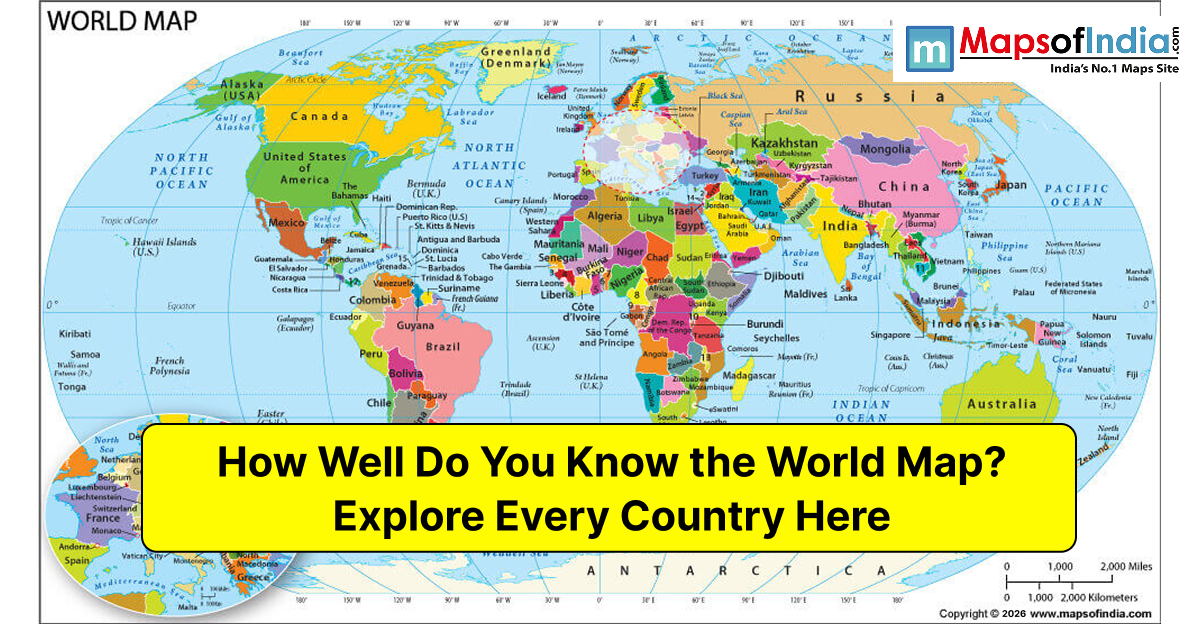
Without using a world map, see how many countries that you can name. Many countries are easy to find, like India, the United States, China, Australia and the United Kingdom, but for many other countries, it takes a little more effort to locate. Can you correctly mark up the map of Kyrgyzstan, Belize, Eswatini or Vanuatu? While these countries may not often be on the tip of everyone’s tongue during casual conversation, each has a distinctive location in the world, past history, and culture. However, the world map provides a chance to explore these often-overlooked countries and a bigger picture of the diversity the world offers.
A world map isn’t simply a place locator; it’s a powerful resource for learning about the world. This provides a wider perspective of our world and helps us to recognize the links between countries, continents, oceans and natural features. In the end, even if you’re just interested in the globe itself, inquisitively looking around a globe of the world can be a great way to learn more and locate new destinations to check out for both students and visitors.
Why the World Map Is More Interesting Than You Think
A world map, at a quick glance, might appear kind of like you’re just looking at a bunch of borders and countries. Each line and each region has a story, though. Maps show how civilizations formed around rivers, how mountains influenced civilizations and how oceans linked civilizations together in trade and exploration.
They also teach us the size of our world! For instance, Russia is nurtures crossed two continents, Indonesia comprises a huge number of islands, and Africa is a lot bigger than it shows on most of the traditional map projections. The closer you look at a world map, the more you find interesting.
Meet the Seven Continents
The world consists of 7 different continents that have different geography, cultures, and landmarks.
- Asia – It is the largest and most populous continent, which includes countries like India, China, Japan, Indonesia and South Korea.
- Africa – It has an incredible level of cultural diversity, wildlife, conservation, natural resources, and rapidly developing economies.
- Europe – A continent that is both historical and known for its architecture, cultural traditions and influential countries.
- North America – Canada, the United States, Mexico and various Caribbean countries; varying landscapes, climates.
- South America –It is home to the Amazon Rainforest and the Andes Mountains and also has colourful countries like the nations of Brazil, Argentina and Peru.
- Australia and Oceania – Comprises the nations of Australia and New Zealand, as well as many Pacific island states that span a wide area of ocean.
- Antarctica – It is the coldest continent, and it’s the place of scientific studies and environmental studies.
In all, these continents represent almost 200 countries, all with their own history, culture and geography.
More Than Just Countries and Borders
A person would normally consider a world map and map countries. Maps are also used for depicting or observing the physical features that influence life on Earth. Regions are characterized by the presence of large mountain ranges and can have important river systems, deserts and oceans.
The Himalayas comprise a natural barrier in the Asian continent, and the Sahara is a natural barrier over a large part of North Africa. The Amazon Rainforest has one of the most diverse ecosystems on Earth, and the Pacific Ocean serves as a gateway between thousands of miles of nations. Geographical features are equally significant as political borders in comprehending the world.
Some Countries Might Surprise You
Exploring a country map can be very fun, especially when you find out about countries that you’re not familiar with. The countries with extensive news coverage and travel guides tend to be the larger ones, but there are hidden treasures of stories and culture in many smaller countries.
In the case of the Pacific Ocean, countries are dispersed all over it, and it can be difficult to spot them on a map. There are some microstates in Europe that are smaller than many cities in the world. In the meantime, other African and Central Asian States, situated in land-locked regions, face particular challenges and opportunities.
Seeing these lesser-known regions will help you appreciate the world and promote learning from beyond the most popular, talked-about regions.
Why Geography Still Matters
Memorizing places may not seem like something that’s needed in the age of smartphones and GPS when it can be looked up with just a few taps on a digital screen. But geographical knowledge is of very high value.
A knowledge of the world map aids in the comprehension of international information, trade, climatic conditions, population movement and cultural ties. It enables us to see why some areas might have certain problems in the world, how countries have come and gone, and how geography still affects world events.
Geography also enhances travel experiences. Having an understanding of the geography of the world provides context to a place that is helpful when you’re planning a new trip.
How Interactive Maps Make Exploration Easier
With the advent of technology, it’s now easier than ever to explore the world. Interactive maps enable users to zoom in on countries, locate major cities, the geographical features and look at geographical regions in more detail.
Users don’t have to only read a picture but can travel from continent to continent, make comparisons between countries, and learn more about the world’s geography. Making learning more fun and easy to understand for all ages.
Interactive maps are a great way to explore the world from the comfort of your computer, whether you are conducting research about a place, working on a school project or just curious.
See the World One Country at a Time
Geographical knowledge does not need to be learnt in one go. The best method of developing knowledge is to study one country at a time. Choose a continent, find out the names of the countries, capitals and present some main landmarks of this continent, and slowly move to understanding other regions.
Over the years, you will start seeing patterns, knowing where they are located geographically and the amazing diversity around the world! Each nation has its own distinct appeal, and each location offers a new sliver of our understanding.
Final Thoughts
The world map is more than just a geographical map; it’s a way of exploring people, places and landscapes that make our world so unique. There are fascinating narratives to be found in every nook of the world, from the largest countries to the smallest islands.
How much do you know about the world map, then? You can learn about countries, about continents, about new regions; there’s always something that you don’t know. Start with a world map, and head out to discover countries as you go.