|
||||||||||
| ||||||||||
|





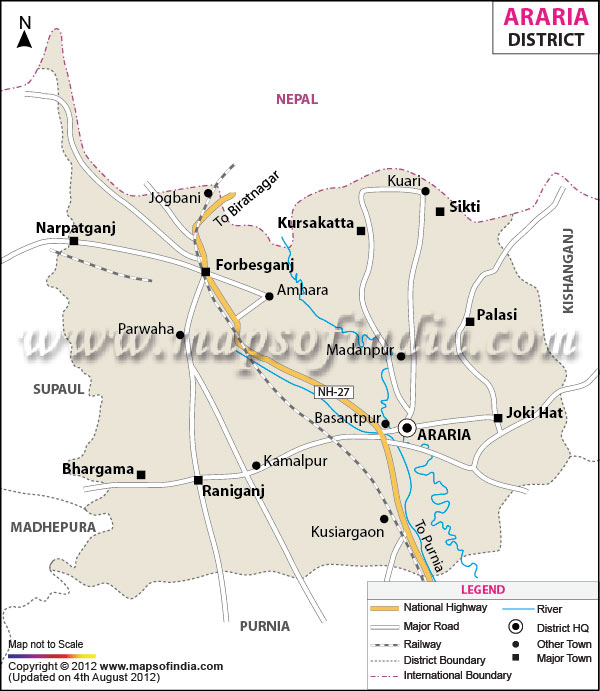
| *Araria District Map highlights the National Highways, Major Roads, District Headquarter, etc. |
About
In northeast Bihar, tucked near Nepal, lies Araria - a place rarely spotlighted though central to Seemanchal’s character. Fertile soil runs beneath its surface; rivers swell each monsoon, shaping life in unpredictable ways. People here speak multiple languages, grow rice and vegetables, and rely on rainfall more than infrastructure. Surrounded by Kishanganj, Purnia, Supaul, and an international boundary, its location adds layers - economic, social, political. Headlines mention floods, poverty, migration - but miss what stays constant: effort without spectacle. After water recedes, farmers return, seeds go back into mud, markets reopen by dawn. Tradition holds firm, not through ceremony alone but routine rebuilt daily. Survival takes form quietly - in repaired homes, shared labor, children walking miles for school. Not every story fits progress metrics, yet movement happens regardless.
On February 14, 1990, Araria emerged as a separate district when it was separated from Purnia, enabling sharper focus on regional administration and growth. Though established later than many neighbors, its core functions are anchored in the town of Araria, where governance takes shape day by day. Commerce flows strongly through Forbesganj, which pulses with trade activity distinct from bureaucratic rhythms elsewhere. Nestled within Bihar's stretch of the Terai region, the land draws strength from river-fed sediments washed down from mountain slopes far north. Because of this, fields here yield generously - yet such abundance arrives hand-in-hand with risk. When waters rise in channels branching off the Kosi, they sweep across villages without warning, washing away both harvests and homes.
Fields of rice roll across Araria, setting its economic pulse along with corn plots, jute rows, and temporary harvests of vegetables. Life here moves to seasons, not schedules - rural roots run deep through clustered villages that define much of the region. Work often draws people away, prompting regular travel toward urban centers where jobs wait. Even so, classrooms grow more present now, reaching corners once untouched by schools. Movement shapes progress; concrete paths link distant farms to wider trade routes while fresh opportunities seep into everyday routines. Change arrives quietly - not all at once - but piece by piece.
History and Culture
Long before becoming a district, Araria formed part of a dynamic landscape in northeastern Bihar. Shaped by changing empires, it lay within reach of Mughal governors and later felt the weight of British land systems. The ground here carried life long before official maps drew boundaries around it. Once linked closely with Purnia, this stretch belonged to border areas where customs from Mithila blended with influences coming down from Bengal or across from Nepal. Power shifted often; rulers came and went, leaving traces beneath modern names. Agriculture flourished due to fertile soil, which in turn drew attention from governing forces beyond the hills. Political significance grew quietly alongside harvests, fed both by geography and movement between regions. Only decades ago did Araria gain formal status, yet its roots extend far deeper than administrative records suggest.
In the medieval centuries, shifting power among local dynasties paved the way for Mughal control, eventually folding large parts of Bihar into imperial administration. As British authority took hold, the landscape transformed economically - centered on tax extraction, farming levies, and systems built around indigo cultivation. Land relations changed deeply under colonial policies, especially via zamindari structures that redefined rural class lines in places such as Araria across decades. While uprisings remained limited compared to neighboring zones, resistance quietly grew through farmer awareness, reform movements, and wider political shifts shaping Bihar’s identity.
Araria's path since independence began with a focus on countryside progress - shaped by efforts to manage flooding, rely on farming, while navigating demands for fair political voice. Being grouped into Seemanchal pulls it toward talks not only about safety along borders but also how minorities fit in, together with upgrades to roads, power, and services.
Deep within its roots, Araria carries many cultural strands woven together. Rather than one overarching norm, life here unfolds through overlapping traditions living side by side. What stands out is the strong presence of Surjapuri ways shaping daily interaction. This influence sets the region apart from central parts of Bihar in subtle yet clear ways. Alongside Hindi and Urdu, people regularly speak Surjapuri, showing how movement and time have mixed things differently here. Traces of Maithili and Bengali appear too - especially near edges where exchange has long taken place.
Under moonlight or dawn, festivals pulse through Araria’s days like quiet heartbeats. During Chhath Puja, people appear by water - ponds, rivers, temporary steps - offering prayers to the rising sun, their voices soft but steady. Even when money runs thin, something deeper pulls them forward. When Eid arrives, streets hum with shared meals, prayer echoes from mosques, doorways glow with light. Color spills into alleys during Holi; lamps flicker on rooftops at Diwali. Drums roll for Durga Puja, silence marks Muharram, villages gather for seasonal fairs. Through each turn of the year, belief slips into motion, shaping how people meet, move, live.
Economy
Farming shapes Araria’s economy at its core, supporting most residents’ daily lives through cultivation. Because of rich alluvial soil, growing crops comes easily - yet frequent flooding and weak transport networks limit progress. Life in this region turns on planting cycles, family labor patterns, sometimes even marriage timelines shaped by harvests. What happens in fields influences much more than income; it sets rhythms for entire communities.
Most farming centers on rice, shaped by seasonal rains and fertile, moist ground. Maize now plays a larger role as income grows from its sale; at the same time, wheat, legumes, sugar cane, and fiber crops add value locally. In northeast Bihar, jute links communities to broader markets through long-standing trade ties. Growing vegetables and tending orchards boost family earnings - meanwhile, milk production, animal care, fish ponds, and raising birds offer further stability.
Most of Araria’s residents rely on jobs linked to state-run services because growth has followed a path shaped by public investment. Schools, clinics, local councils, law enforcement, and administrative hubs offer steady work, supporting household stability across generations. Welfare initiatives like MGNREGA, housing assistance under PM Awas Yojana, and food security networks reach far into daily survival strategies - especially among those with few alternatives.
Despite its narrow industrial base, the public sector supports cooperatives alongside schools and water management agencies. Infrastructure like railways and roads has grown over time - yet progress shows clear gaps across regions. Public works programs operate together with farming credit networks under state oversight. Flood defenses exist but spread irregularly where need runs high.
Heavy rains wreck fields along with highways, while low reading skills limit job options. Still, progress could grow from smarter farming methods. Because the area sits close to Nepal, selling goods across borders might increase. Poor funding for factories slows growth, yet fixing water systems would help villages thrive. Opportunities exist where education meets local business ideas.
Tourism
Pictures of temples blend with fields stretching into Nepal, shaping how people see travel here. Though guidebooks rarely mention it, daily rituals draw quiet interest from visitors passing through. Life along the edge of a country colors much of what happens in these towns. Instead of grand monuments, routines rooted in faith give meaning to place. Remote does not mean empty; rather, different rhythms define its appeal. For anyone curious about Bihar beyond cities, patterns emerge in ordinary moments.
A town with quiet momentum, Forbesganj plays a central role among the region's urban hubs. Under British rule, its value grew through governance and commerce - this legacy still shapes daily business life today. While travelers rarely seek it by name, glimpses of Araria’s economic shifts emerge here. What matters most lies beneath the surface: steady activity, local exchange, quiet transformation.
Pilgrimages thrive around neighborhood sites - temples, shrines, prayer grounds - not grand destinations yet central to daily faith. Though distant travelers rarely visit, rituals at Kali temples or riverside platforms during Chhath pull consistent local devotion. Gatherings for Eid, seasonal festivals, sacred groves serve as anchors, not for economies, but belonging. Meaning builds quietly where routine and reverence overlap.
Close to the Nepal border, the land takes on added geographical significance. Where people live near boundaries, traditions and speech frequently cross lines drawn on maps. Instead of dramatic displays, what stands out are country paths, fields used for farming, and ecosystems unique to the Terai region. Observation here becomes a quiet way to understand the place.
Festivals throughout the year along with routine village markets quietly serve as spots where culture shows itself naturally. While moving among stalls, people see handmade goods, taste everyday meals, watch seeds change hands, notice how communities interact - without staging. What draws others to Araria grows from real life unfolding, never from museum setups.
Demographics
More than 2.8 million people lived in Araria district as of the 2011 census - numbers surely larger now, given steady increases over time. Most residents live in villages, making rural areas the core of daily life here. Towns such as Araria and Forbesganj are growing slowly, even if city-like development still plays only a minor role across the region.
Though still below half, literacy rates have begun rising across the region. Boys are more likely than girls to read and write, a pattern seen often in similar areas. Over recent years, school availability has grown, helped by state-led programs. Improvement comes slowly, yet signs point to change.
Spoken forms in Araria shift widely across communities. Though Hindi runs government work, Urdu shapes daily life in powerful ways. One regional voice stands out - Surjapuri - not alone, since Maithili and Bengali also leave their mark. Such layered speech patterns form a core part of local identity.
Though faiths differ, daily life in Araria blends Muslim and Hindu traditions through common spaces and routines. Where one might expect separation, joint celebrations quietly take root. Markets hum with shared rhythms, shaped by both groups over time. Custom, more than creed, guides many interactions here. Even when beliefs stay distinct, culture bends toward overlap.
Administration
Most of its people live in villages spread across a wide area, shaped by administrative divisions. Two main subdivisions carry out regional oversight - Araria and Forbesganj stand as key hubs. Below them operate several blocks: Jokihat leads here, followed by Raniganj, then Narpatganj, each handling grassroots tasks. Palasi connects remote areas, while Sikti, Kursakanta, and Bhargama serve scattered settlements. At the base, elected village councils take charge through panchayats. These groups handle everyday needs instead of waiting for city-led directions. Road repairs come up often, just like distributing aid or tracking progress on social programs. Beyond its vast stretch lie over seven hundred settlements, each shaping Araria’s farming backbone and community life in quiet ways. While water threats persist, efforts tilt toward sheltering farmland, lifting village living standards, treating illness where it spreads, and opening paths to learning.
| Facts of Araria District | |
|---|---|
| Official Name | Araria |
| Location | Bihar |
| Area (km2) | 1830 |
| Population | 2811569 |
| Language | Hindi, Urdu |
FAQs
Q1: How many villages are there in the district?
Araria district has more than 700 villages, spread across multiple blocks and panchayats.
Q2: What is the population of the district?
According to Census 2011, it had a population of about 2.8 million, and it has continued to grow since then.
Q3: What is this district famous for?
Araria is famous for its fertile agricultural land, borderland culture near Nepal, multilingual communities, and its strong rural traditions shaped by the Seemanchal region.
Last Updated on : June 24, 2026
