






About
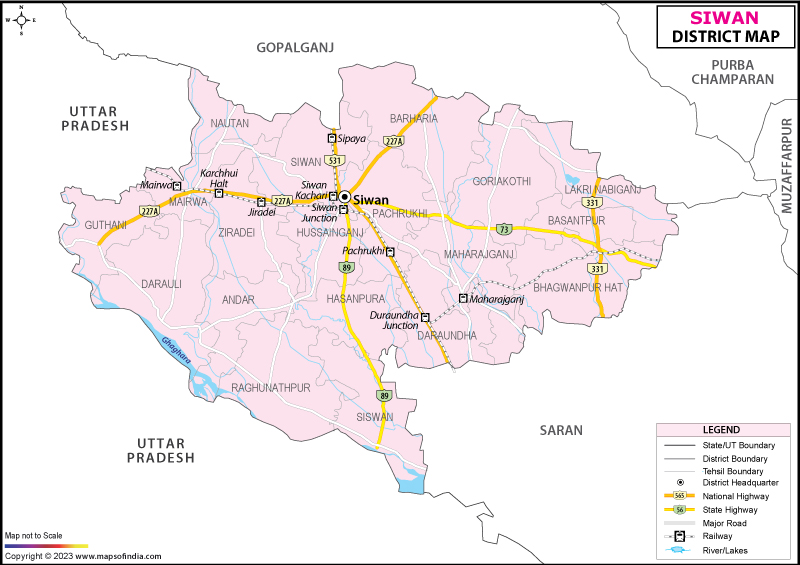
Siwan district is a key administrative and cultural area that is located in the north-western part of the Indian state of Bihar. It is named after the town named Siwan which also acts as the administrative center of the district as well as trade, learning and administration center. The origin of the name Siwan is thought to have been seewanna or the boundary and therefore it was known as Siwan, a place which was close to boundary of neighbouring regions.
Similar to the borders of Uttar Pradesh, Siwan district is strategically located with respect to connectivity and cultural interchange. The amazing cultivability of the Alluvial plains formed through the rivers such as the Ghaghara also particularly help in enhancing agricultural productivity by a good admirable scale. The district is also unexpectedly seen to be very well interconnected amongst the networks of road/railway networks, therefore it is truly connecting itself with other big cities such as Patna, Gorakhpur, and Varanasi thus enhancing transport time and comfort. Comprehensively too the Siwan district map can also help associate the rich history, agricultural prowess, and diversity of culture of the region.
History and Culture
The Siwan district is highly historical and imbued with Indian civilisation of ancient and medieval times. This area originally belonged to the ancient kingdom of Kosala and then it became a subject of the domination of such great empires as the Mauryas and the Guptas. Its historical value and cultural preservation are strengthened by the fact that it is relatively close to some of the most important historical centres such as Vaishali and Pataliputra.
The medieval era saw the reign of the different dynasties such as the Delhi Sultanate, the Mughal Empire in Siwan. These periods saw the region evolve into a local government centre and trading hub. During the British colonialism, Siwan was a province of this greater Bengal Presidency and eventually the Bihar Province. The district played an active role in the freedom movement in India and most of the local leaders attended protests and other nationalistic campaigns.
In terms of culture, the district of Siwan replicates the traditional Bihar ethos. The celebrations of Chhath Puja, Diwali, Holi, Eid and Muharram are advised and attended with a lot of zeal and togetherness. Chhath Puja is especially significant, as it entails rituals carried out on riverbanks and water bodies, as they signify the veneration of the Sun God.
Another aspect of the district is its cultural heritage of Bhojpuri. Social life uses folk songs, dances and oral traditions, which are especially important in the case of weddings and festivals. The Bhojpuri language stands out as an effective means of expression and identification. Such cultural landmarks and heritage sites that offer historical and cultural richness of the district are frequently pointed out on the Siwan district map.
Men wear traditional outfits like dhoti-kurta and women wear sarees which are popular mostly in the rural places. Siwani cuisine is a simple yet a tasty one which includes such dishes as litti-chokha, dal, rice and couples of sattu type dishes. Sweets like peda and khaja are popular also.
The cultural heritage in the district is that of a peaceful coexistence of various religious and social groups. This diversity is one of the characteristics of identity of Siwan such a unity in diversity.
Economy
Siwan district is mainly agrarian with agriculture being the backbone in terms of livelihoods. Nevertheless, it also has other sectors which contribute to its economic framework, like government employment, public services and service industry.
Most of the individuals work in the administrative service, education, healthcare, and law enforcement in the government section. Government schools, colleges, and hospitals are well-paying positions that are necessary to the socio-economic growth of the district. Such institutions are also significant in enhancing literacy and health.
The public sector encompasses different state-sponsored plans and development programmes that are planned to uplift rural people. The efforts in terms of irrigation, road development, housing and job creation have helped in the betterment of the living standards. The Siwan district map is a map that is usually utilized in planning and execution of these developmental projects, which presents effective distribution of resources.
There is a gradual growth in the services sector of Siwan. There is increased banking facilities, retail outlets, transport and communication facilities, specifically in towns and semi urban models. The backbone of this sector is small-scale enterprises and local markets.
The predominant economic activity is agriculture whereby crops like paddy, wheat, maize, sugarcane as well as pulses are grown extensively. The soil is fertile and the climate favourable to facilitate cropping seasons several times. Still, as irrigation facilities do improve, monsoon rainfall remains an important component to irrigation.
The rural economy also includes livestock farming, dairy production and poultry. This type of activities gives additional revenue to farmers and it aids in livelihoods.
The other economic factor is migration. A substantial population of the Siwan migrates to such cities as Delhi, Mumbai and Kolkata plus to other countries and in particular the Gulf countries in entirety in search of better job prospects. The remittances that is received is very important in sustaining families and contributing to the economy at home. The Siwan district map shows the rural-urban distribution, where there is more economic activity.
The emerging modern sectors with a transition towards diversification suggest that the overall economy of the district presupposes a mix of traditional farming methods and the modern ones.Also, the Siwan district map can be very helpful for this purpose.
Tourism
Siwan district may not be a major tourist attraction site, but it does possess the different historical, religious and cultural attractions that form the tourist attraction sites.
Darauli Ghat, which lies on the Ghaghara River, is one of the more famous attractions. It is a peaceful tourist attraction to pilgrims and tourists especially during religious festivals. Its beauty of the landscape and the religious atmosphere turns it into a recreational and worship place.
Yet another tourist attraction is village of Zeeradei where Dr Rajendra Prasad was born. Visitors come here to pay their homage and to learn about the life of the first President of India. The memorial and the surrounding areas epitomize the simplicity and values that he believed in.
The district also is diverse in terms of religion as there are a lot of temples, mosques and local shrines. They are not merely a place of worship but a social place. The Siwan district map aids tourists to locate such places as well as navigate them effectively.
Historical sites too are not to be forgotten in addition to the rural landforms of Siwan which is a unique experience. The visitors can observe traditional ways of farming, the local markets and village life that imparts knowledge on the cultural composition of the area to the visitors.
Local fairs and festivals take part in the district contributing to tourism. It is an entire cultural experience through the presentation of folk music, dance, crafts and traditional food through these events. These are normally marked in colour and included in the Siwan district map hence tourists can better enjoy cultural celebrations.
Siwan district map could help it become a smaller-scale tourist destination in the state of Bihar with improved infrastructure and marketing.
Demographics
Siwan district has a very high heterogeneous population. According to the census of India 2011, the population of the district is approximately 3.3 million people hence it is one of the most populated districts of Bihar.
The literacy of the Siwan district is estimated to be 68% that implies a slow change of the literacy level through the years. The improved levels of literacy have been linked to educational schemes and more awareness despite the gap in the levels of male and female literacy.
Bhojpuri, Hindi and Urdu are the major languages spoken in the district. The most commonly spoken language is the Bhojpuri language that they use in their everyday practices and the official language is Hindi, which is the administrative language. There are other communities where Urdu is popular.
The country is predominantly rural with majority of the people changing their location to villages. The Siwan district map provides a clear picture of population distribution in different regions with emphasis made to the urban centres and rural settlements.
The district is a diverse population of religion. Religions are predominantly Hinduism and Islam and people of different communities live in peace together. This co-axiality develops social power of the district.
Overpopulation and density introduces such issues as resource poverty, employment and infrastructure. This notwithstanding, developments have been on-going which aim to correct the issues.
Administration
Siwan district is structured; with regard to its administration, the district has been structured in a way that ensures that there is good governance and developments. To improve management it is further classified into sub-divisions, blocks and villages.
It is decentralised with three large subdivisions and managed by the district which are called Siwan Sadar, Maharajganj, etc. These sub-divisions are again categorised into community development blocks that undertakes local government and implementation of government schemes.
Siwan, Mairwa, Guthani, Darauli and so many others are some of the tehsils or blocks of the district. These administrative units are in charge of land registers, collection of taxes and settlement of local disputes.
Siwan district consists of more than 1,500 villages and these villages are further divided into gram Panchayats. These local governments make up an important component of the grassroots democracy; they serve with the community needs and execute the development programmes.
The Siwan district map is a very helpful administrative tool, which will help the authorities to organize the infrastructure, resources and the provision of services to the people in the best possible way. It can also be used in the planning of roads, schools, health care and disaster management plans.
Municipal bodies run cities; these bodies supervise such civic amenities as sanitation, water systems and city planning. This kind of institutions is critical towards the standard of living within towns.
FAQs
Q1: What is the total number of villages in Siwan district?
Siwan district has more than 1,500 villages governed by local panchayats.
Q2: What is the population of the district?
The population of Siwan district is approximately 3.3 million as per the 2011 Census.
Q3: What is this district famous for?
Siwan district is famous for its agricultural productivity, Bhojpuri culture, and as the birthplace of Dr Rajendra Prasad.
Last Updated on : June 24, 2026
