|
||||||||||
| ||||||||||
|





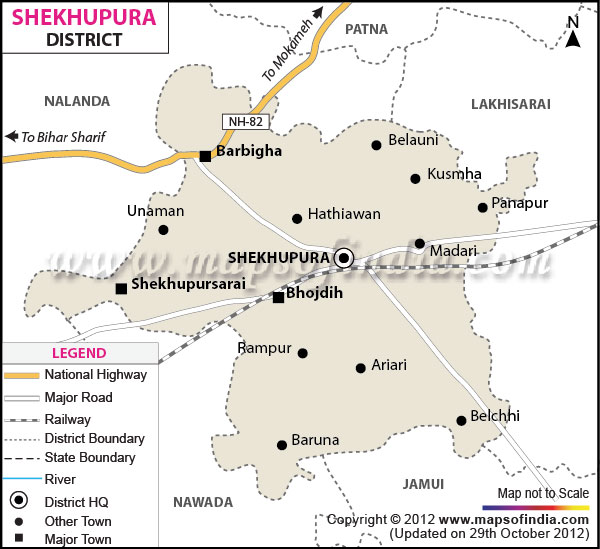
| *Sheikhpura District Map highlights the National Highways, Major Roads, District Headquarter, etc. |
About
Formed on 31 July 1994, Sheikhpura district emerged when it separated from Munger in Bihar's eastern region. Though covering just around 689 square kilometers, its role extends beyond mere area measurements. Administratively, culturally, and historically, the district carries weight disproportionate to its scale. Among hills and temples, Girihinda Parvat rises near quiet trails. Vishnudham Samas stand apart, visited often by those seeking calm. Dal Kuan draws people through steady seasons, fed by long-held traditions. History rests lightly in these places, shaped by time rather than noise. Born here once was Shri Krishna Sinha, leader at a turning point. His presence lingers in ways unseen but felt across the region. Meaning builds slowly where land and memory meet.
History and Culture
Old stories link Sheikhpura district to legends, old buildings, because of power shifts across centuries. Deep in time, traces appear within the Mahabharata, an epic central to Indian heritage. From customary beliefs emerges a connection between Girihinda hill then Hidimba, partner of warrior Bhima among the five Pandavas. During years living far from home, Bhima stayed near this place so it seems, following what has been passed down; afterward, the rise of land took her name instead.
From times past, when medieval powers shaped the land, control of Sheikhpura passed to Sher Shah Suri, an Afghan sovereign whose constructions remain visible even now. Among these, Dal Kuan stands prominent - a water well built under imperial oversight. Though simple in function, it reflects advanced planning typical of that age. Its presence signals how central this area was within broader territorial designs. Function met form here, where necessity guided design without sacrificing visual balance. Because of where it lies, between routes long traveled, authority figures valued the site across centuries. Traces linger - broken walls, places of worship, domed enclosures - evidence of layers settled into earth and memory.
In Sheikhpura, culture unfolds as a blend shaped by many heritages. Though rooted in ritual, celebrations like Chhath Puja, Diwali, Holi, Eid, and Durga Puja unfold as shared moments across communities. Because they gather neighbors, these occasions strengthen quiet understandings between families. From doorsteps to fields, Bhojpuri melodies rise alongside Maithili writings and spoken tales. While elders recite stories once told centuries ago, younger voices shape them anew. Over time, fresh forms join familiar rhythms without replacing what came before.
In the story of modern India, Sheikhpura stands apart because of its link to Shri Krishna Sinha - one among few who led Bihar at its start. Hailing from this town, his path crossed often with Mahatma Gandhi and others during efforts to break colonial rule. From protest marches to council chambers, his presence marked shifts in how power moved across Bihar. Even now, residents see echoes of that past when they speak of fairness or community duty. Not by slogan but habit, ideas like modesty and equity shape daily life here. How long such influence lasts depends on those who remember him not just as leader - but neighbor.
Beyond history and governance, Sheikhpura draws depth from varied beliefs. Alongside mosques stand temples honoring Vishnu, Shiva, and others - each place shaping shared sacred space. Places such as Vishnudham Samas temple, Girihinda Parvat draw those on pilgrimage paths. Cultural moments unfold at seasonal gatherings where customs pass quietly between people. Rooted in farming ways, community rhythm follows crop cycles. Rituals mark sowing, reaping - the land dictating when to pause, honor, resume.
From time to time, stories of old shape how people see Sheikhpura today. Though often overlooked, its buildings tell of eras long past. Because independence movements once stirred here, political memory lingers in quiet corners. While temples echo myth, streets carry rhythms older than records. Wherever one looks, layers remain visible - neither hidden nor explained. Since change comes slowly, tradition walks beside daily life.
Economy
Most of the people depend on cultivation. Farming is one of the major activities which shapes the lives of people here. The rich soil of the region helps in the cultivation of staples like wheat, rice, corn, legumes and seed olives. In recent times, cultivation of tomatoes, mangoes, cucumbers has also occupied an important position in the field of crops grown here.
Employment arises within the district through administrative functions, schools, and medical centers. Where rural growth initiatives exist, so too does economic stability, shaped by water access programs and power expansion projects. Economic continuity often follows from structured public interventions aimed at infrastructure improvement across villages. Influence flows quietly where state-backed efforts meet community needs, especially in farming areas dependent on consistent utilities.
Across the region, cooperative ventures form part of the public sector’s structure. Small manufacturing units appear scattered, playing a role in local economics. In certain areas, handwoven fabric production exists alongside home-based craft work. These activities show limited advancement when measured against neighboring zones. Development lags despite their presence.
Expansion within the service industry continues at a modest pace. Retail, transportation, and educational activities show measurable progress. In Sheikhpura town, new enterprises have appeared over recent years. Coaching institutions now operate alongside medical facilities. These additions respond directly to community demands. Growth emerges not through announcements but quiet establishment.
Even with minimal industry and weak infrastructure, Sheikhpura maintains economic strength through farming; state programs also help improve village life. Resilience emerges where development lags, backed by land-based livelihoods. Progress moves slowly, yet support systems create subtle shifts in daily conditions. Rural focus shapes outcomes more than urban models do here. Stability grows not from expansion but from adaptation within constraints.
Tourism
Among the draws of Sheikhpura, faith-based destinations hold steady importance. Not far behind stand remnants of earlier times, quietly present across the landscape. Nature appears here through pockets of green and flowing waterways. Each aspect unfolds without fanfare, yet remains deeply woven into daily life. What emerges is a quiet rhythm shaped by belief, memory, and terrain.
Perched above the valley, Girihinda Parvat holds ties to Hidimba of Mahabharata lore. Pilgrims arrive in numbers when festival times come. Linked by ancient tales, the summit draws those observing tradition. Though quiet most days, it pulses with presence at sacred intervals. From afar, its slopes appear still; up close, traces of ritual mark stone and path alike.
A sacred space honoring Lord Vishnu stands quietly within Bihar's landscape. Pilgrims arrive here from distant corners of the region, drawn by deep-rooted tradition. Reverence shapes each visit, forming bonds beyond mere travel. This site, known as Vishnudham Samas Temple, holds presence without spectacle. Devotion unfolds gradually, marked not by noise but persistence.
Around Dal Kuan stands a structure raised under Sher Shah Suri’s rule - its form shaped by methods of that era. Though time has passed, the design still speaks of careful planning long ago.
Among quiet lanes and old walls sits Sheikhpura Town, holding both governance duties and traces of tradition. Its streets host places where people trade goods, pray in Hindu temples, or gather inside Islamic prayer halls - each space marking difference without conflict. What stands out is how routine life carries history within it, not apart from it. Structures rise not for show but because they were needed long ago and remain so now. Daily movement around them feels natural, unforced by design trends or modern pressure.
Though growing slowly, tourism in Sheikhpura holds promise through heritage sites, natural landscapes, followed by places of worship. Unexpected shifts may come from quiet trails instead of crowded centers. Progress appears where old traditions meet untouched environments. Potential unfolds not through speed, rather persistence across cultural markers. Development emerges behind the scenes, guided more by location than loud announcements.
Demographics
With around 636,342 residents recorded in 2011, Sheikhpura district shows a population density nearing 923 individuals per square kilometer. Though the literacy level measures 65.17%, marginally under the state's mean, progress appears evident over time because of focused learning programs. Despite regional benchmarks, gains have emerged slowly where education efforts took root. Improvement, while modest, follows consistent investment in schools and outreach.
Hindi appears most often across the region, next comes Urdu, Bhojpuri, followed by Maithili - each present within daily communication. Administration proceeds through Hindi; classrooms follow the same path. Most residents live outside city limits, their lives shaped by farming cycles. Work in fields defines much of economic activity here. Different religious groups form part of everyday life, Hindus alongside Muslims among them. Peace marks interaction between neighborhoods of varying belief systems.
Administration
Beginning with administration, Sheikhpura splits into six areas known as blocks or tehsils - Sheikhpura, Barbigha, Ariari, Ghatkusumbha, Chewara, along with Shekhopur Sarai. Within these zones exist a total of 261 villages, each managed under local self-governance systems called Panchayati Raj. Oversight for rule enforcement, civil management, and progress initiatives flows through the central office located in Sheikhpura town.
From the top down, programs move through structured channels so benefits arrive at remote villages. Efficiency emerges when district collectors work alongside village councils, guided by clear roles. Rural progress gains support through focused spending on schools, clinics, roads. Oversight flows steadily where communication links remain active between tiers of authority.
| Facts of Sheikhpura District | |
|---|---|
| Official Name | Sheikhpura |
| Location | Bihar |
| Area (km2) | 689 |
| Population | 111089 |
| Language | Hindi, Urdu, Magadhi |
FAQs
Q1: How many villages are there in the district?
There are 310 villages in Sheikhpura district.
Q2: What is the population of the district?
According to the 2011 socio-economic caste census(SECC), the district has a population of 636342.
Q3: What is this district famous for?
Sheikhpura is famous for the Vishnu Dham temple in Samas and the Girihinda mountains. The famous shiv parvati temple on this mountain attracts devotees from all around the world. The district also specializes in producing high quality red onions.
Last Updated on : June 24, 2026
