






About
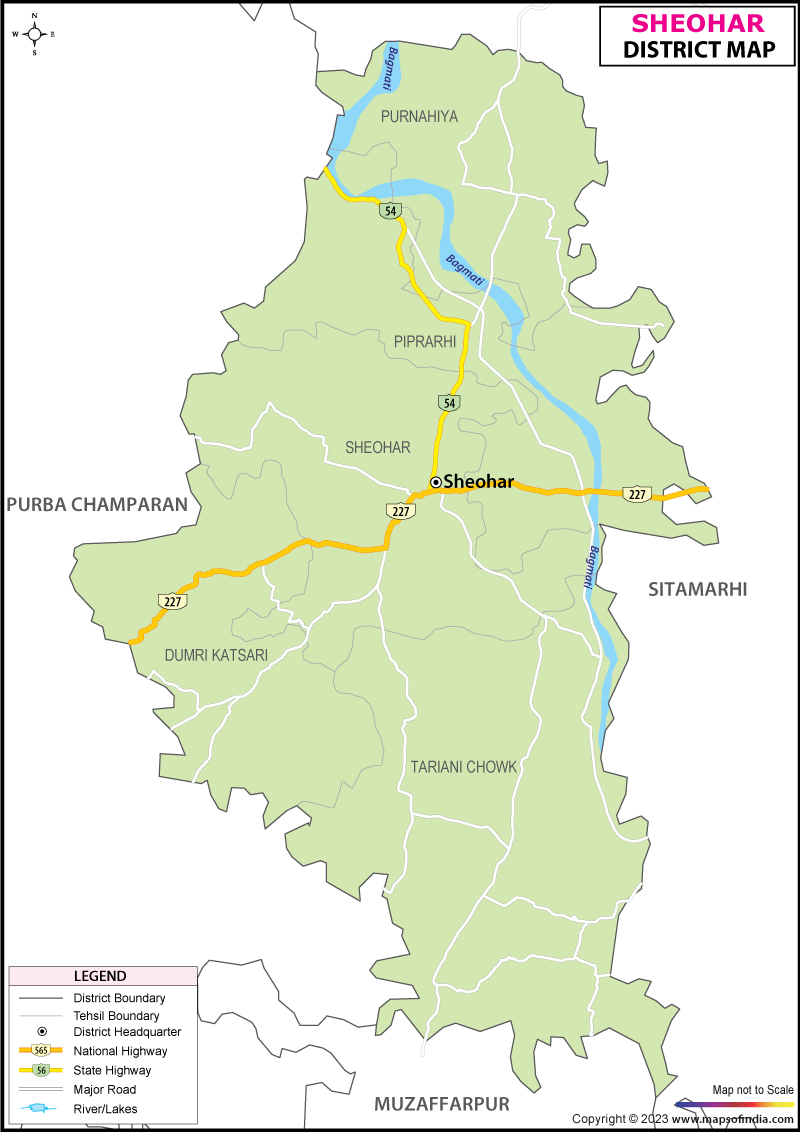
The Sheohar district is one of the smallest, yet historically and culturally significant administrative districts in the Indian state of Bihar. It is located in the north central portion of the state which is classified as Tirhut division and has the North border with Nepal. The small district is noteworthy by its strategic position, agrarian nature and rich culture. The expression Sheohar district map is widely used in geographical and administrative spoke in order to get the idea of tight layout of the district, the physical boundaries of it and the way settlements are arranged in it.
The district is mostly rural with agriculture being the foundation of its economy and social life. The close proximity of the district to its neighbours e.g. Sitamarhi, Muzaffarpur and East Champaran are also revealed in the Sheohar district map which facilitates connectivity of regions and linkages of trade. Sheohar has had a steady development in such areas as rural development, governance, and education and as such, it has been a district of both opportunity and adversity. Over the past years, heightened interest in connectivity, digital governance, and rural welfare schemes have embarked on redefining the developmental process of a district.
History and Culture
The historical beginnings of Sheohar district are profoundly covered in the ancient and medieval traditions of Mithila region. Traditionally, the region was a part of the cultural landscape of the ancient kingdom of Videha that had an intellectual and spiritual background. The Sheohar district map canl assist in placing the district within this larger Mithila region which has long been recognised as having scholarly traditions, especially in the fields of philosophy, literature and the study of religions. The region also gained long-term cultural significance with figures like King Janaka and the epicism of the Ramayana also attached themselves to Ancient Mithila.
It was conquered by various rulers (Delhi Sultanate and the Mughal Empire) in the medieval period. The administrative practices, land revenue system and culture exchange were affected by these regimes. The administrative traditions, architecture, and the system of governance of the Persian were influences to the region. Sheohar was part of larger executive units under the British, and experienced the socio-economic change brought by the policies of the British authorities, such as an agricultural transformation, taxation and rural administration (CED). The Sheohar district map can give us an idea of how the system of administration and the division of the country changed during this period and how the alterations of the system of administration and the division of the country imprinted themselves on the map of the country.
It was also a very small but significant contribution of India to the freedom struggle in the country by the district. Similar to most regions of Bihar it saw involvement in movements like the Non-Cooperation Movement, Civil Disobedience Movement and even the Quit India Movement. Villagers and other local leaders were also involved in nationalist affairs, and in many cases were repressed yet they responded by being resilient and united. These attempts though less known continue to play an essential role in what the district community remembers about themselves and others.
In cultural terms, Sheohar is a resounding echo, of Mithila traditions. The festivals such as, Chhath Puja, holi, diwali and durga puja are celebrated with a lot of zeal and with a harmonized unity. Of particular interest is Chhath Puja, which pays homage to the Sun God, and involves some elaborate rites which are conducted at sunrise and at sunset close to rivers and ponds. The folk songs known as Chhath geet are a few of the folk songs that consist of these rituals.
Economy
The economy of Sheohar district is majorly agricultural based with majority of the population being involved in the process of agriculture and related activities. The fertile alluvial soil that depends on the river systems support the growth of crops like paddy, wheat, maize, pulses and oil seeds. The Sheohar district map shows the agricultural picture of the area and how the river basins and plains make the contribution to the farming pattern. But due to constant flooding of the lands especially because of the Bagmati River, areas are affected causing crops to be destroyed, people displaced and economic stability ruined.
Within the government sphere, jobs are mostly focused on the areas of administrative services, education, healthcare, and local governance. Government offices, schools, anganwadi centres and primary health centres provide stable sources of employment and are also very crucial in the running of the district. Sheohar district map is useful in determining the distribution of these facilities so that even those in remote villages get services.
Sheohar is characterized by a relatively underdeveloped public sector, as compared to more industrialised districts of Bihar or India. No large industries are present and economic activity is highly decentralised. Government efforts to rural development, infrastructural development, irrigation, and poverty reduction, have however led to a gradual economic development. The Sheohar district map, then, is commonly used in planning and delivering such initiatives, and in making sure there is an efficient distribution of resources and target development is delivered.
The services industry has been continuously growing. The work force of this sector is made up of small business, stores, transport services, and local trade. The crucial economic centres are the so-called haats held by the farmers and traders who exchange goods weekly. Migration is also the driving force in the economy of the district as many citizens are in search of employment opportunities in metropolitan cities or other states. The inflow of remittances made by migrant workers can benefit families and boost local consumption and investment. The growing focus on skill training and self-employment programs is slowly creating new opportunities in the economies of diversification.
Tourism
Sheohar district though being not a well-known large tourist destination, has a number of areas of religious, cultural and natural tourism, which reflects the traditional nature of this district. The Sheohar district map may be a valuable resource, especially to visitors who may want to explore these less known attractions.
Deokuli Dham is a shrine to Lord Shiva and it is among the most eminent religious sites in the district. The temple has a huge number of worshippers and most people flock the temple during Mahashivratri festival. From neighboring districts pilgrims come to the shrine in order to pray and hold religious services. The Sheohar district map tends to identify such religious centres and so visitors can easily identify them and plan their trips.
Besides the Deokuli Dham, the district contains a large number of smaller temples and holy places which resemble the strong spiritual ethos of rural Bihar. These are the areas where the festivals take place that fairs, programmes on culture and local markets give vitality to the atmosphere. The Sheohar district map is useful in the spatial distribution of these sites and how they can be accessed by various areas of the district.
Sheohar has many natural attractions such as rivers, fields and rural landscape. The Bagmati River and surrounding are seen as a source of scenic beauty and also an avenue to experience the primordial life in the village. The visual appeal of the area is enhanced by seasonal changes with monsoon and harvest periods particularly.
Demographics
As per 2011 Census, sheohar has a population of about 656,916 which makes Sheohar one of the least populated districts of Bihar. The Sheohar district map helps us to understand how, in what way, this population is distributed over a number of blocks and villages and in what way this distribution is so rural a one. The number of people in the district is relatively large due to only a small territory.
The literacy rate of the district is approximately 53.78 per cent that is low as compared to the national average. Nevertheless, some progress is being achieved to raise the literacy standards through government programmes like Sarva Shiksha Abhiyan and other educative programmes. Sheohar district map: this map is most commonly used when planning the expansion of schools, in order to make good educational facilities much more accessible to the villages. The female literacy despite improving, remains in the shadow of the male literacy, which renders the promotion of female literacy a special necessity.
The main languages spoken in the district have mostly been Maithili and Hindi. Maithili is used extensively in every day communication and also in the practices of culture whereby the use of Hindi is not applicable in every aspect of life, though it is extensively used in the administrative and educational sectors. The population composition is mostly rural with good social identifications and old social order influencing the daily life.
Administration
Administratively, Sheohar district is sub-divided into five blocks namely Sheohar, Piprahi, Tariyani, Dumri Katsari and Purnahiya. The blocks are used as sub-district governance, development planning and implementation of government schemes. The Sheohar district map gives a good picture of these administrative divisions and helps in efficient governance and coordination.
This district consists of some 204 villages which are governed locally by panchayati Raj system panchayati Raj. These institutions at the village level are important in the grassroots democracy, resolving local problems, and functional development programme. The Sheohar district map is vital in administrative planning, disaster management and monitoring of developmental activities in these villages.
A District Magistrate heads the district administration who is assisted by a number of officials which are engaged in the matter of law and order, administration of revenue and development work. Disaster management due to the vulnerability of the district to floods is an essential part of administrative activities. One of the factors is continuous development of the infrastructure i.e. roads, schools, healthcare facilities and irrigation systems.
FAQs
Q1: How many villages are there in the district?
Sheohar district has approximately 204 villages, which form the foundation of its rural administrative and social structure.
Q2: What is the population of the district?
The population of Sheohar district is around 656,916 as per the 2011 Census.
Q3: What is this district famous for?
Sheohar district is famous for its agrarian economy, Mithila cultural heritage, traditional festivals such as Chhath Puja, and religious sites like Deokuli Dham temple.
Last Updated on : June 24, 2026
