






About
Samastipur district is both an administrative and an appreciable cultural region found in the east of the Indian state of Bihar in India. The district is named after its headquarters town, Samastipur which serves as the hub of administration, education and commerce. The word Samastipur is thought to have an origin in Sanskrit meaning samasti, meaning collective or entire and pur, meaning settlement, meaning therefore a home of united dwelling.
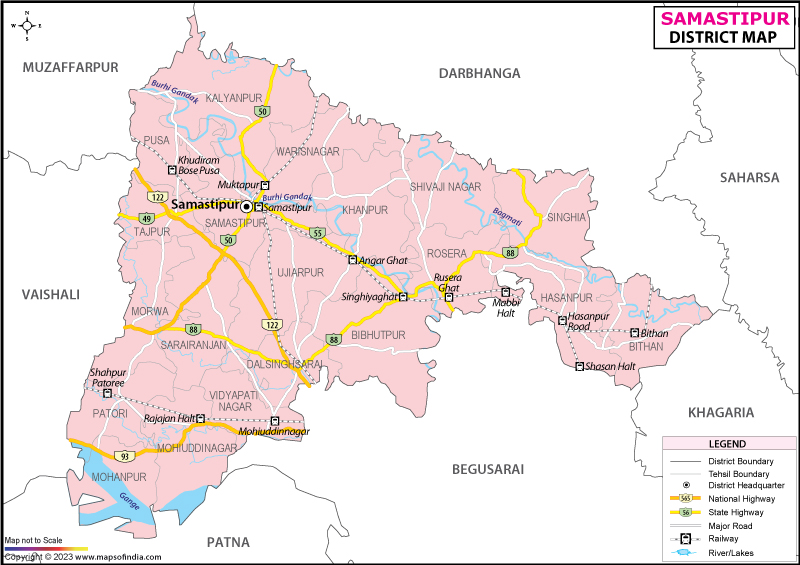
Geographically, the district is located in the fertile plains of alluvial plains of North Bihar, and lies within the culturally rich Mithila region. Some of the districts it shares borders with include Darbhanga, Begusarai, Vaishali and Saharsa making it a strategic area. The fertility of the land is further increased with the help of seasonal rivers and canals.
The significance of spatial comprehension within the district is commonly echoed by the name of the district map, common in the education, planning and government. The Samastipur district map assists in recognising its divisions, villages, routes of transport and river systems. The very convenient map in the administrative discussions is the Samastipur district map drawn to allot the floods prone areas as well as relief operations. Likewise, the samastipur district map is the key tool in designing infrastructure emulating greater road connectivity and rural development.
The district can be seen having the facilities used by national and state highways that connect the district with larger part of the various regions of Bihar and neighbouring states cities. Frequent use of the district map of Samastipur in the expanding area of logistics and connectivity planning can even help improving its place in the development of the region.
In general, Samastipur district is the composite of the flourishing agrarian culture, cultural richness, and administrative role. The frequent use of the Samastipur district map is testimony to the fact that it is easily used to comprehend the layout of the district and the future development of the district.
History and Culture
Samastipur district has a long history since ancient civilisation of Mithila has long been a seat of learning, philosophy and culture. The area itself was in the past epoch included in the Videha kingdom with great legends like Janaka who are closely related to the Hindu scriptures. The region was then subdued to the rule of great dynasties such as the Mauryas, the Guptas, amongst others who influenced its cultural and administrative development.
Later, Samastipur was under the influence of the Delhi Sultanate and later Mughal Empire during the medieval period. Such regimes ushered in new systems of administration, architecture, and culture which merged with the local cultures. The region was an agrarian centre under the Mughal rule, which sustained the economy of the empire by raising revenues.
Colonialism was one of the turning points in the development of the district. The British railroad was built in North Bihar and Samastipur became an important railway station. Not only did this upgrade trade and mobility, but it made the district more prominent. The district was also actively involved in the struggle of India and local leaders and citizens were part of movements like the Non-Cooperation Movement, the Civil Disobedience Movement and the Quit India Movement.
The Samastipur district culturally exhibits the festival spirit. This is largely determined by the Maithili language, and Hindi and Urdu. Chhath Puja, Durga Puja, Diwali, Holi and Saraswati Puja are all religiously celebrated with a spirit and enthusiasm. Historians and researchers primarily use the map of Samastipur district to track the patterns of settlement and spread of culture. The folk songs, like the songs of Samdaun and Jatsari are still being sung at the festivals and ceremonies.
Mithila painting is one of the traditional kinds of art practised in some parts of the district, particularly among the women, and also marked with complex designs and saturated colours. These paintings will have themes of religious issues, nature and social issues. The areas where such cultural practices are widespread can also be established using the map of Samastipur district.
Economy
The fertile soils and abundant water mostly make Samastipur district an agricultural economy. Major crops that are grown in the district are rice, wheat, maize, pulses and sugarcane. To a large percentage of the population, agriculture continues to be the biggest source of income.
Government Sector
The government sector is a crucial part of the economic framework of the district. Administrative buildings, schools, hospitals and police departments offer work. The government projects like rural employment schemes, housing and social welfare projects help to provide stability to the economy. The Samastipur district map is widely utilized by government officials in the allocation of resources and tracking development initiatives.
Public Sector
Samastipur has a public sector that comprises of railway services, institutions of co-operatives as well as state-sponsored firms. A big employer of thousands of people is The Samastipur Railway Division workshops, offices and other maintenance units. Associative banks and agricultural society promote farmers giving credit and resources. The Samastipur district map is important in the planning of the infrastructural facilities of the population and the connection of rural and urban regions.
Services Sector
Services are a booming sector in the district and this includes trade, retail, education, healthcare, and transport. This sector is established on local markets and small businesses. There is an expansion of private schools, coaching centres and health care facilities, which help in job creation. The map of Samastipur district assists in locating the commercial centres and regions where service sector can develop.
Allied activities like dairy farming, poultry and fisheries are becoming important in addition to agriculture. The activities reduce the dependence on a single source of income and improve the livelihoods of the rural areas. Efficiency in utilisation of land and water resources is guaranteed by the use of the Samastipur district map.
In general, the economy of the Samastipur district is slowly shifting towards less agrarian base to a more diversified system, with the help of the government program and the increasing number of services.
Tourism
Samastipur district is a destination with a small but a culturally rich tourism experience. It is not a big tourist destinations, but has a number of religious, historical, and natural sites.
The Budhi Gandak River enhances natural beauty of the district. Its banks also act as the places of cultural and religious practices especially during Chhath Puja. The picturesque environment renders it a relaxing tourist destination. Tourists can find it easy referring to these locations on the riverbanks by the use of the map of Samastipur district.
Local fairs and festivals also welcome tourists and provide them with some insight into the traditions and lifestyle of the district. Rural fairs and religious meetings give a chance to get in touch with the local culture. The Samastipur district map, will aid in scheduling trips to these events as well as knowing their location distribution.
Despite the fact that the infrastructure of the tourism sector is at its young stages of development, the district has the opportunity to develop the rural and cultural tourist industry. Its attraction can be increased with one or other by means of enhanced connectivity and improved facilities. Retained use of the Samastipur district map in the tourism planning will be instrumental in unlocking this potential.
Demographics
One of the overpopulated districts in Bihar is Samastipur district. As per Census data, the population stands at 4.2 to 4.3 million people. The settlement patterns of rural settlements and the fertile land make the district very populated.
Literacy rate in Samastipur is approximately 61-63% with a high literacy rate among men in comparison with women. Attempts are however underway to enhance education particularly among the women and the rural population. Education, schools and colleges are playing a role of gradually improving.
The district has languages of Maithili, Hindi and Urdu. The native language Maithili is both dominant and a constituent of the region. In demographic research the “ Samastipur district map is commonly referred to in order to study the population distribution and linguistic diversity.
The people are predominantly rural and mostly they practice agriculture. Semi urban centres like Samastipur town are steadily increasing, which adds to the economic and social growth. The Samastipur district map aids in learning the distribution of settlements and urban growth.
Administration
The district of Samastipur has clear administrative division which focuses on effective administration. It is subdivided into like Samastipur, Dalsinghsarai and Rosera. These divisions are in charge of local governance and development.
The district further subdivides into blocks (tehsils), which are used to execute the government schemes and control the local matters. There are a number of panchayats and villages in each block.
It has over 1,200 villages in Samastipur district which indicates its rural nature. A plan of Samastipur district- The plan of Samastipur district is the inevitable administrative instrument employed as a plan, resource allocation and tracking remarks on the development programmes.
The district has numerous departments in the government; these include education, health, agriculture, and public works. Proper planning and mapping helps to coordinate these departments. The map of Samastipur district ensures that there is good governance and delivery of services.
Along with its simple administrative units, a decentralised system of governance is exhibited by Samastipur district or Panchayati Raj, guaranteeing the involvement of the local people in decision-making and development. At the village level, gram panchayats operate and blocks development offices organize programs on rural development, agriculture, education and health. The District Magistrate leads the district administration that is in charge of law and order, revenue management as well as enforcing government policies.
FAQs
Q1: What is the total number of villages in Samastipur district?
Samastipur district has more than 1,200 villages.
Q2: What is the population of Samastipur district?
The population of Samastipur district is approximately 4.2 to 4.3 million people.
Q3: What is Samastipur district famous for?
Samastipur district is famous for its agriculture, Mithila culture, Maithili language, traditional festivals like Chhath Puja, and its important railway junction.
Last Updated on : June 24, 2026
