






About
Saharsa district is the significant administrative and cultural area of the North-eastern part of the Indian state of Bihar. The district is named after the town of Saharsa, the headquarters of which is the major centre of government, trade and education. Geographical and socio-economic identity of the district is strongly determined by this river system, thus defining the opportunities and challenges of the area.
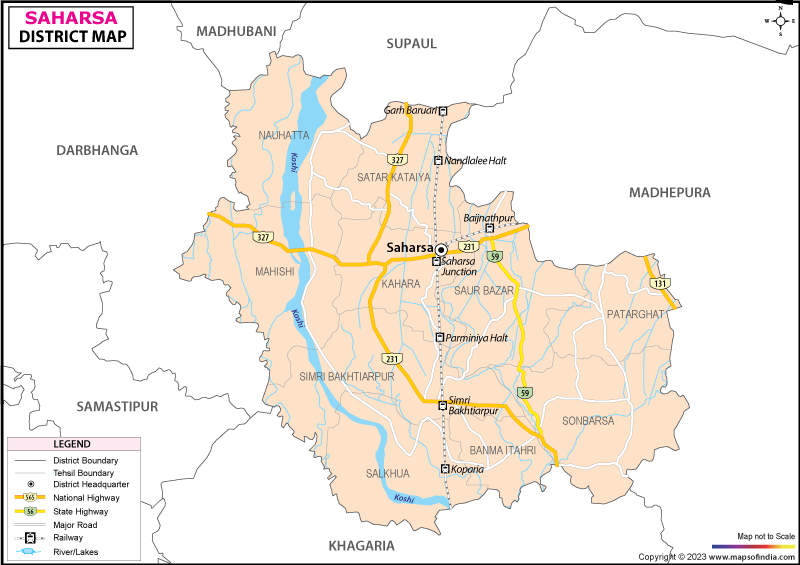
The importance of the district is not limited by its historical, as well as cultural background, but also the strategic position of the district on the fertile plains of North Bihar. The Saharsa district map marks where it borders with other neighbouring districts like Supaul, Madhepura and Darbhanga thus it is part of the Mithila region. The soil is mostly alluvial with deposits of rivers, and is the basis of the agricultural sector as the main livelihood.
The observed blend of urbanisation with the primitivity in the countryside typifies the district of Saharsa. Most people are in their villages, however, the town of Saharsa is slowly coming up to become a commercial centre. As depicted in the map of Saharsa district, a closer inspection shows that the district has numerous rivers, canals and wetlands which will provide a variety of ecological diversity in the district. Saharsa is growing as well, thus, we could speak about resilience and adaptability to the attempts to cope with the situation by means of the impediments, i.e., floods and infrastructural limitations.
History and Culture
The history of Saharsa district is more or less interconnected with the ancient province of Mithila that was a great centre of learning, spirituality and culture since the Vedic times. The territory is mentioned in ancient literature and it is thought to have belonged to the kingdom of King Janaka, the Father of Goddess Sita. Throughout the centuries, there has been the impact of different dynasties, such as the Mauryas and Guptas, who have added weight in shaping the region in terms of its administration and culture.
The medieval era was characterized by the rule of local chieftains in Saharsa and later the Mughal Empire. It was a significant administrative unit since it was at a strategic location. Saharsa got prominence under British colonialism and was a district with magnitude of the greater administrative system of Bihar especially its agricultural productivity. The results of the colonial Saharsa district map reveal its changing boundaries and administrative divisions.
Saharsa has strong cultural links with Mithila. Maithili is the language of the people of the district, and it is not merely a language, but also a repository of much literary and artistic value. Celebrations like Chhath Puja, Durga Puja, Holi, and Diwali are very animated celebrated. In particular, Chhath Puja is unbelievably significant, with the believers amassing on banks of rivers and water bodies to worship the Sun God. They are usually identified as the cultural sites on the Saharsa district map to be visited at the time of festivities.
The cultural expressions of Saharsa are also influenced by traditional art forms like Madhubani painting though it becomes more manifested in the neighbouring districts. The folk songs, dances and rituals have a crucial role in the day to day lives of the people. Both marriage ceremonies and other social events are characterized by traditions and a rich customs.
The culture of the district as well displays the aspect of resilience during natural adversities. The river Kosi has been involved in floods that have influenced the identity and the memory of the people. The Saharsa district map readily reminds of areas where floods have been known to occur and this has affected the settlement patterns and cultural practices. Regardless of these issues, Saharsa people have a good community spirit and continuity of culture.
Economy
Saharsa district has a basically agrarian based economy in which agriculture is the main source of livelihood to a major population. Crops like paddy, wheat, maize and pulses are grown on the fertile alluvial soil and water resources. The Kosi River is however highly prone to flooding and that is a major challenge to agricultural productivity. Planners and farmers would normally use the Saharsa district map to know the areas which are prone to floods and how to control agricultural operations.
Administration, education, health care and public works are the major sources of employment creation in the Government Sector. The town of Saharsa and other administrative centres are equipped with government offices where a good number of the educated population is employed. It is also through development programmes that emphasise flood control, rural development and enhancement of infrastructure that leads to employment.
The Public Sector has a minor but significant impact on the economy of the district. Financial inclusion and rural development are sponsored by public sector banks, cooperative societies and government-run institutions. The projects and initiatives guided by the Saharsa district map such as irrigation projects and flood control projects will play a pivotal role in reducing the negative impacts of natural disasters and increasing agricultural production.
Services Sector is slowly growing most especially within towns such as Saharsa town. The main component of this sector is made up of small businesses, retail shops, transportation and education institutions. The rising numbers of the private schools, coaching centres and healthcare facilities indicate the rising need of quality services. The Saharsa district map also highlights the Saharsa district accessibility by road and railways making it easy to trade and conduct business.
Besides agriculture, animal husbandry and fisheries are also a part of rural economy. The presence of dairy farming is one of the typical additional activities, which can generate additional income among farmers. The wetlands and water bodies in this district, as shown in the map of Saharsa district, sustain fish farming, which is also becoming a popular means of sustainable living.
On the whole, despite the structural issues in the economy of the Saharsa district, a transition of the economy to diversification and modernisation is taking place gradually. The policy and better infrastructure of the government are likely to contribute to the future economic part of the district.
Tourism
Saharsa district is not necessarily a large tourist attraction centre in Bihar, but it has a few culturally and religiously as well as natural sites of interest. The Saharsa district map enables tourists to find these attractions and to make good arrangements to visit them.
Even the river Kosi through which the river flows is a major tourism attraction. The river, which is associated with devastating floods, has beautiful sceneries and can provide nature lovers with a chance. Saharsa district map frequently shows the course of the river and its surrounding location where one can explore it.
The other place of interest is Chandika Sthan a holy spiritual recreation related to local beliefs and customs. Religious devotees go to this place to receive blessings and engage in religious rites. Such sites can be regarded as culturally significant by where they were placed on the map of the Saharsa district.
The district has wetlands, and rural landscapes that contribute to the tourism potential of the district. The locations offer an insight into the rurality of Bihar, intertwined with green fields, architectural old houses, and local culture. The Saharsa district map has the potential of leading travellers to these under-known and yet attractive places.
Even though the infrastructure in tourism sector is in its early stages, there is potential in growth in this sector because of the cultural heritage of the district and its beauty. Connectivity and publicity can make Saharsa a better place to visit culturally, as well as, eco tourism.
Demographics
Saharsa district is a diverse and a vibrant population because of the cultural richness of Mithila region. The most recent statistics show that the district has its population of approximately 1.9 million people. The Saharsa district map has been commonly utilized in demographic studies in the investigation of the trends of population distribution and settlement.
The literacy rate in Saharsa district is about 54-55 per cent relative to national average but there is gradual enhancement of the literacy rate throughout the years. Both the government and non-governmental organisations are striving to advance the levels and access to education particularly in the rural areas.
Maithili followed by Hindi is the language mostly spoken in the district. A section of the population is also Urdu speaking. The linguistic variety adds cultural diversity to the district which is given by the plurality of the linguistic diversity. The map of Saharsa district frequently makes allusions to linguistic and cultural districts of light on the appearance of various peoples.
The population is predominantly rural with a large proportion of the population engaged in agriculture and related activities. The towns, particularly the Saharsa town, are experiencing expansion due to immigration, and economic success. The Saharsa district map helps to observe the rural-urban gap and further develop the development program relying on it.
Administration
To achieve a good governance and service delivery, the district of Saharsa is subdivided into a sequence of administrative units. The district is a part of Kosi division headed by a District Magistrate.
It has a few tehsils (sub-divisions) including Saharsa and Simri Bakhtiarpur. These are the units of government that make the government policy and see that law and order are maintained. The Saharsa district map shows these subdivisions explicitly, which aids when planning of the administration.
The rural administration of the district is composed of many blocks and villages. These are community-based governmental bodies that are relevant in rural development and community participation. The Saharsa district map is a critical map; this is utilized in marking the limits of the villages and development proposals.
Some of the key roles of the district administration include development and construction of infrastructure, management of disasters and provision of public services. The administration highly relies on geographical data and Saharsa district map in order to prepare and respond suitably to floods due to the vulnerability.
FAQs
Q1: What is the total number of villages in Saharsa district?
Saharsa district has more than 600 villages, governed through a network of Panchayats.
Q2: What is the population of Saharsa district?
The population of Saharsa district is approximately 1.9 million according to recent estimates.
Q3: What is Saharsa district famous for?
Saharsa district is famous for its association with the Kosi River, its rich Mithila culture, and festivals like Chhath Puja.
Last Updated on : April 17, 2026
