






About
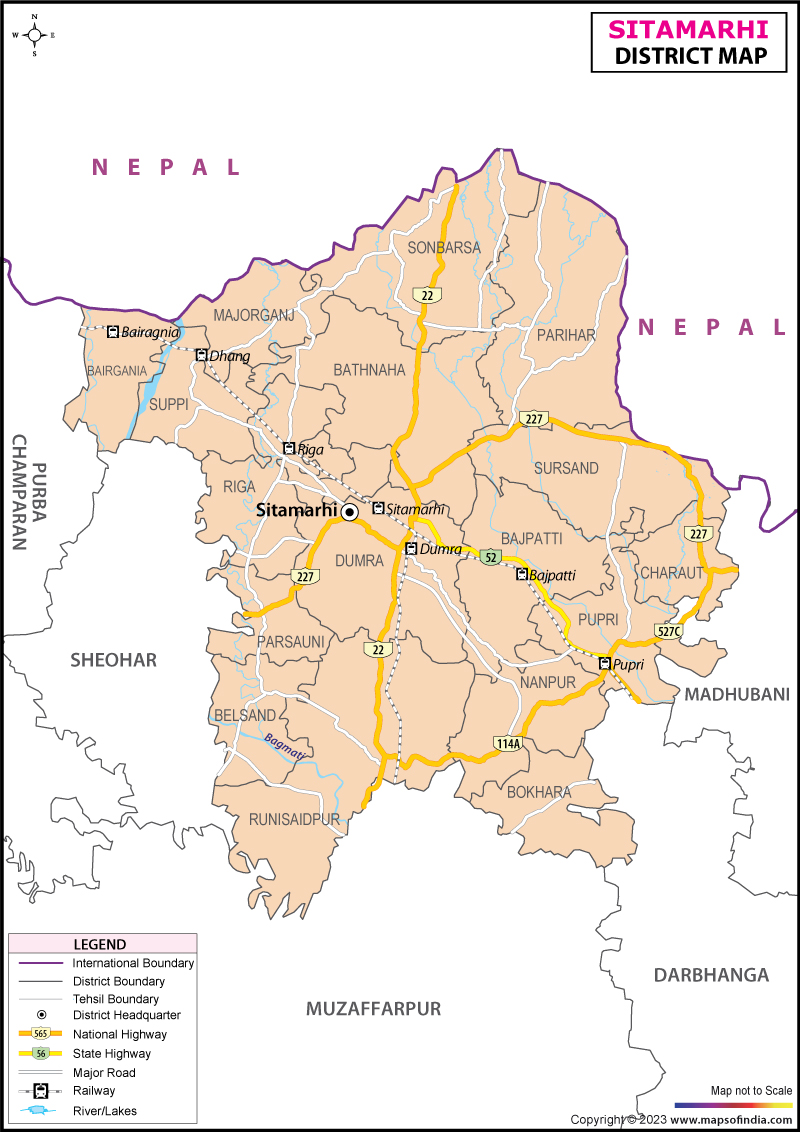
Sitamarhi district is an important pillar and administrator of a given culture in the north of Indian state of Bihar. It is called after the town of Sitamarhi, a place closely associated with religion as it is believed that goddess Sita, the wife of lord Rama in the epic Ramayana, was born in the town. The association gives the district spiritual identity and destination of pilgrimage. Of interest is the geographical importance of the district map of Sitamarhi, especially in terms of its positioning along the Indo-Nepal border which contributes to added cultural and economic exchange.
The Sitamarhi district lies in geographical possession of Mithila region and borders Nepal on the north. The Sitamarhi district map indicates that the area is predominantly of a flat topography with fertile alluvial basin that has been formed by various rivers including the Bagmati, Lakhandei and the group of the Adhwara among others. These rivers help to increase the fertility of soil, but on the other hand, it puts the district at risk of seasonal floods and therefore the impact caused by such rivers is immense to the people of the region.
Even the Sitamarhi district map can help to properly illustrate and demonstrate that the district has been smoothly linked to the major cities be it like Patna, Muzaffarpur and Darbhanga through road and rail networks. Sitamarhi is primarily a rural area but gradually gaining infrastructural development. This predisposes it to become a crucial component of the socio-economic and cultural environment of Bihar due to its idolization of religious importance, agro-productivity and trans-border connectivity.
History and Culture
The Sitamarhi district is rich in history and mythological contexts which have defined its identity up to date. Hindu mythology explains that such area is considered as the place where goddess Sita had been discovered by King Janaka. This religious spectacle is celebrated at the Janaki Temple in the town of Sitamarhi which is still the center of religious worship. Sitamarhi district map can assist to locate this temple i.e. one of the most important sites of the district.
The district was a part of ancient Mithila kingdom, the country which made significant contribution to the philosophical, educational and art spheres. Indian intellectual traditions were shaped by great scholars and thinkers which lived in Mithila. Sitamarhi passed on to the rule of a number of dynasties with the Mauryas and Guptas, and then the Delhi Sultanate, and finally Mughal Empire spanning a number of centuries. It subsequently became British India whereby administrative structures and infrastructure began to be formed.
Sitamarhi was also active during the Indian freedom movement. The local leaders and citizens joined great national movements like Non-Cooperation Movement and Quit India Movement. The map of Sitamarhi district has served in the historical record-writing process to locate sites that played a major role in the fight towards the independence.
Sitamarhi is culturally inclined towards the traditions of Mithila region. Maithili language is prevalent and the district enjoys artistic background with Madhubani paintings that are highly artistic with heavy designs and colour priorities. They tend to be religious art and such paintings constitute a significant aspect of local culture.
Sitamarhi celebrates festivals with taking fervour and piety. Ram Navami and Vivah Panchami are some of the festivities which hold a special importance considering this region and the fact that they are related directly to the life of Goddess Sita and Lord Rama as we can refer from the scriptures too. Chhath Puja, another vital festival in Bihar, is an event held with a lot of enthusiasm just like the Holi, Diwali and Eid. To control pilgrim routes and to organise the big gatherings, the Sitamarhi district map is often implemented in case of one of the most important festivals.
Economy
Sitamarhi district is mostly economically dependent on agriculture as it demonstrates the presence of good fertile plains and a properly conducive climatic conditions in the area. The Sitamarhi district map helps to indicate vast agricultural prowess, which include paddy, wheat, maize, pulses and oilseeds. Rivers also do guarantee irrigation, but they can easily flood, a challenge that is challenging to agricultural productivity.
During the government, the administration offices, government schools, government medical institutions, and law enforcement offer them employment opportunities. Programs introduced by the government to improve the rural areas, irrigation programs, housing and job creation have affected the district positively. The Sitamarhi district map is frequently utilized to plan and execute such plans, so the benefits can be extended to remote and flood prone localities.
Public sector encompasses cooperative institutions, agriculture support and distribution systems in the country which supply necessary commodities to the citizens. The institutions contribute to the macro stabilisation of the rural economy by providing financial support, seeds, fertilisers and market access. The Sitamarhi district map is important to determine the areas that need extra support and resources.
The number of services is slowly growing using trade, education, health and transportation as drivers. The commercial centre of the district is Sitamarhi town which has its own markets that cater to both the local and the Nepalese traders. There are several people who are employed in the retail businesses, small enterprises and the transport services. The Sitamarhi district map brings out significant trade paths and connectivity, which are crucial in economic development.
The other important feature of the district in terms of its economy is migration. The inhabitants migrate to the other states where they seek improved job opportunities. Remittances of these workers back home can be used as a source of household income and local development. They face challenges like low industrialisation, natural calamities but Sitamarhi district is going well along with its farming power and increasingly advancing service industry.
Tourism
The Sitamarhi district has a major tourist focus on its religious and cultural backgrounds. It has the most notable site, the Janaki Temple, which is thought to be the birthplace of Goddess Sita. It is a place of attraction to thousands of pilgrims annually particularly during festivals such as Ram Navami, and Vivah Panchami. This temple is clearly depicted with the help of the Sitamarhi district map that helps visitors locate this temple.
Haleshwar Sthan, a temple constructed in dedication of the lord Shiva is also a big attraction. Prior to the performance of this ploughing ritual, it is said that King Janaka had constructed this temple. There is a Sitamarhi district map detailing pilgrims as this site is a must visit site.
This is believed to be the location that witnesses the events of the journey of Rama and Sita and is a historically and religiously important area. Green will surround it and people may very well have a very tranquil experience there. Sitamarhi district map can be helpful even for a tour guide to pay a visit to such places.
The Nepal district of Janakpur is an adjacent site that the district has hence enhancing its tourism prospects as pilgrims will most likely visit the two sites in a pilgrimage tourism. A map of Sitamarhi district is highly valuable in strategizing these cross-border trips.
Although infrastructure in tourism is at a very poor dimension, efforts are underway to improve infrastructure, market heritage sites as well as making them more accessible. The cultural and religious heritage of the district is very strong, therefore has an unending flow of visitors all through out the year.
Demographics
Sitamarhi district is a densely populated heterogeneous area. It has a population of approximately 3.4 million (as per census of India 2011). Population density in villages and urban areas is one of the typical study sites of Sitamarhi district map.
The literacy of the district is about 52 percent compared with the national average but is getting better now because of pursuance of more educational programs. All sectors of the society are being enhanced in terms of literacy and education in schools, colleges and government programmes.
Sitamarhi district has major languages -Maithili, Hindi and Urdu. The most commonly and regularly spoken language along the region is Maithili; it acts as one of the displays of the glamorous cultural identity of the Mithila region. The Sitamarhi district map helps to follow the underlying linguistic trends and variations in different areas of the district.
Majority of the population resides in the rural areas and the main source of livelihood is farming. However, urbanisation is gradually increasing and particularly in the town of Sitamarhi and it is altering the demographic patterns.
Administration
Sitamarhi district is integrated to be effectively governed and developed in an administrative manner. The district of Sitamarhi has been clearly illustrated in the map, which reveals the subdivisions and blocks within the district that assist in good management.
The district is divided into three sub divisions and they are, Sitamarhi, Pupri and Belsand. These subdivisions are further subdivided into community development blocks which are the lowest units of rural development and rural administration.
The district is predominantly rural having over a thousand villages. An overview of the district map of Sitamarhi is critical in tackling the management of these villages, the development projects that were implemented and the government services delivered.
There is a presence of several administrative offices, police and local government structure that uphold law and order in the territory to ensure the policy implementation. One of the key tasks of disaster management is carried out by the administration particularly in the fact that the district is prone to floods.
FAQs
Q1: How many villages are there in the district?
Sitamarhi district has approximately 1,200 villages, highlighting its rural character and agricultural base.
Q2: What is the population of the district?
As per the 2011 Census, the population of Sitamarhi district is around 3.4 million.
Q3: What is this district famous for?
Sitamarhi district is famous as the believed birthplace of Goddess Sita and for its rich Mithila culture, religious heritage, and vibrant festivals.
Last Updated on : June 24, 2026
