

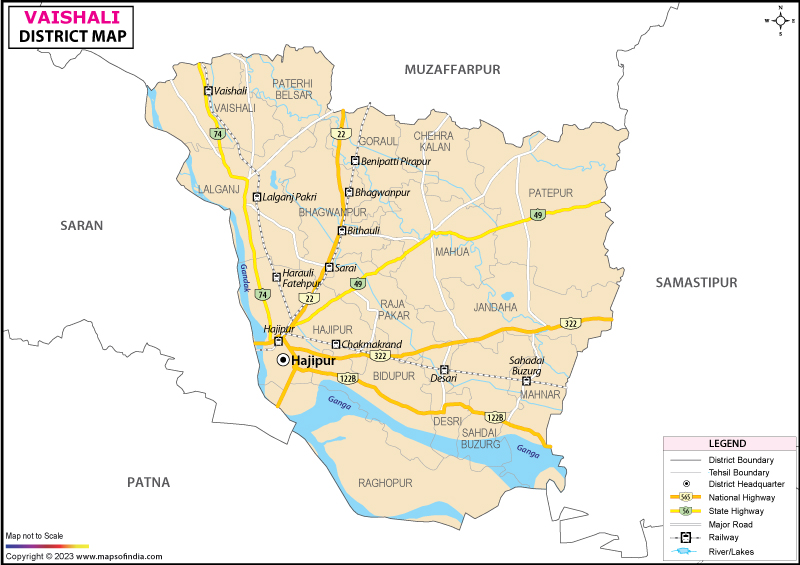





About
The Vaishali district of Bihar, a region of great geographical, cultural and historical importance, is found in the northern part of the region. The district is located close to the Ganga River and is cut across by smaller river systems making it fertile alluvial plains supporting an agrarian economy and high densities of rural settlements. Its strategic position has long been known for easy trade, communication and cultural exchange with neighboring areas and this has led to its significance over the ages at the Gangetic plains.
History and Culture
Vaishali, an ancient city is commonly considered to be among the earliest republics in the world, ruled by the clan of Licchavis. This is a form of political system based on decision making and assembly traditions which is a special development in the early Indian polity.
It is also an essential part of the religious history of the subcontinent. It has a close relationship with Gautama Buddha who visited the region several times and preached in this region. In this part of the region, he attained Mahaparinirvana and this gave it its profound spiritual appreciation in Buddhist culture. Also, it is thought that the Second Buddhist Council took place here which further consolidated its position in the Buddhist religion. It is also a significant site in Jain tradition because the site is associated with Mahavira, the 24th Tirthankara, who was born in the adjacent Kundagrama.
In the early historical era, the region was within a greater political setup of the Magadha kingdom and later it became an area where great empires like the Maurya Empire and the Gupta Empire established. These eras saw the growth of administrative policies, trade and cultural institutions.
During the medieval times, the area fell into the hands of a series of dynasties that were associated with the Delhi Sultanate and the Mughal Empire. These periods also established new administrative systems, architecture and interaction of cultures, especially the fusion of Indo-Islamic cultures.
Colonial policies had a strong influence on the agrarian arrangements and the rural society in the district, which was under British colonial rule and formed a part of the Bengal Presidency. The area was also a part of the wider nationalist movement, which allowed modern political awareness and social reform activities.
The district is a part of the Bhojpuri-Maithili cultural zone, which has a primary role in identity formation based on language. Local languages are carried in folk songs, oral traditions and seasonal festivals which are based on the agricultural cycles and the life of the community. These festivals, including Chhath Puja, have invaluable importance, which signifies a connection between nature and spirituality and the participation of people, especially on the banks of rivers.
Economy
Vaishali district mainly has an agrarian economy, as is common to the rural economy of the Gangetic plains of Bihar. The area has highly fertile alluvial soils deposited by the rivers like the Ganga River, and the Gandak River, which sustain high agricultural activity. Agriculture forms the foundation of livelihood as a significant part of the people and the principal crops include rice, wheat, maize and pulses. There are seasonal changes and reliance on the monsoon that affect agricultural productivity which is dealt with some assistance by irrigation facilities of canals, tube wells, and local water bodies.
Local markets and urban centres like Hajipur are centres of trade and commerce. The other major contributors to the informal economy are the weekly markets and fairs.
The manufacturing industry is not industrialized and small and cottage industries like food processing, agriculture related factories and handicraft are the sources of income. Inadequate infrastructure, capital and technological availability remain factors limiting industry.
The migration is also an interesting aspect of the economy of the district as numerous individuals are rapidly migrating to other states and cities to find better jobs. Migrant workers send remittances, which are added to the home funds and local economic activity.
Tourism
Vaishali district lies in the cultural scenery of Bihar, with tourism being highly entrenched in historical and religious backgrounds within the area. The district is mainly visited because of its early republican customs and the evolution of Buddhism and Jainism. Though it is not as commercially developed as other tourist centres, it has great potential for heritage and pilgrimage tourism.
The Ashoka Pillar Vaishali is one of the sites that stood tall remembering Emperor Ashoka and correspondingly recognizing the visit of Gautama Buddha. This column has been the representation of the expansion of Buddhism and Mauryan architectural success. The adjacent building is the Relic Stupa Vaishali, which is thought to contain the Holy relics of Buddha, and is therefore, a significant pilgrimage place among Buddhists worldwide.
The other important place of interest is the Abhishek Pushkarini which is a sacred tank related to the coronation ceremonies of the Licchavi kings. This place represents both political and cultural aspects of one of the oldest known republics in ancient India. The historical significance of the region, the Raja Vishal ka Garh which is an old fort-like building is thought to have been the assembly hall of the Licchavis as well.
The district is also significant in Jain tradition, and is linked with Mahavira, who was born in nearby Kundagrama. This relation draws Jain pilgrims and contributes to the multi-religious nature of tourism in the region.
Traditional practices and local festivals join communities and visitors together, as religious occasions and local fairs provide an understanding of the local culture. The countryside region, including its agricultural land and riversides offer a serene ambience to people who want to explore cultural and spiritual settings.
The tourism infrastructure in the district is still scanty despite its rich heritage. Other facilities like accommodation, transport and site management need to be developed more in order to maximize visitor experience. Nevertheless, continued campaigns to preserve historic sites and enhance connectivity make it a bit easier to get to heritage sites.
Demographics
The 2011 census of India shows over 3.4 million population in the district, thus the district is one of the most densely populated in the state. The majority of the population is based in the rural regions with a centre of administration, trade, and services being in the urban centres like Hajipur.
There is also high population density putting strain on the land resources (in an agrarian environment particularly, as landholdings are small and fragmented). Scheduled Castes make a very large percentage whereas Scheduled Tribes are relatively few in number. These social categories determine the settlement, occupation, and accessibility of resources. The religious affiliation is mainly Hindu, with a large minority of Muslims, and minorities of other religions which make up a pluralistic social fabric.
Bhojpuri fills the streets here, shaping how people talk every day. Though Hindi runs schools and offices, most folks mix it naturally into daily life. Because of this blend, routines carry both paperwork ease and local pride. Songs passed down through years echo these speech patterns loud and clear. Festivals burst with words that trace back to village tales and family memories.
A big percentage of the population is within the working age bracket which gives it an economic potential. Nevertheless, the few job prospects in the district and especially through relying on agricultural activities and low levels of industrial growth contribute to migration into the urban centers and other states. Migrant worker remittances have significance in terms of reinforcing household incomes and making the local economy viable.
Administration
Vaishali district is governed by an administrative structure that is based on the typical pattern of district administration of Bihar and the incorporation of decentralized local self-government institutions in conjunction with state administration. A District Magistrate (DM), also referred to as the Deputy Commissioner, heads the district; this person is in charge of law and order, enforcing government policies, and development programs. The Superintendent of Police (SP) also aids the administration and oversees security of the people as well as law enforcement in the district.
To ease administration, the district is further divided into subdivisions headed by a Sub-Divisional Officer (SDO). These divisions are then broken down into blocks, which serve as important units in terms of rural administration and development. Block Development Officers (BDOs) deal with the implementation of a range of government programs connected with agriculture, rural development, welfare programs and infrastructure at the grassroots level.
Decentralization at the village level is the Panchayati Raj system which ensures their governance allows people to be involved in decision making. Elected bodies such as Gram Panchayats are important to govern the local administration, the minor disputes and to carry out local projects. Such a system enhances democracy in governance and makes sure that local needs are still met in an effective manner.
City settlements in the district are provided by municipal councils and municipal corporations. The functions carried out by these institutions are to offer vital civic services such as water supply, sanitation, garbage collection and urban planning. Since elected officials collaborate with administrative officials, it guarantees effective administration.
Both state legislative assembly and national parliament represent the district, making sure that it is involved in the larger political processes. Different departments that form part of the government such as health, education, agriculture and social welfare among others, work at one or other level of administration to provide government services and ensure overall development.
| Facts of Vaishali District | |
|---|---|
| Official Name | Vaishali |
| Division | Tirhut |
| Area (km2) | 2,036 |
| Population | 3,495,021 |
FAQs
Q1: How many villages are there in the district?
1,569.
Q2: What is the population of the district?
3,495,021 (2011 census).
Q3: What is this district famous for?
World’s first republic, Birthplace of Lord Mahavira, Site of Lord Buddha’s last sermon, Ashoka Pillar, Raja Vishal ka Garh, Vishwa Shanti Stupa, Buddha Relic Stupa, Abhishek Pushkarini, Home of Amrapali, Hajipur Bananas, Sonepur Mela, Ramchaura Temple, Bawan Pokhar Temple, Vaishali Museum.
Last Updated on : June 24, 2026
