|
||||||||||
| ||||||||||
|





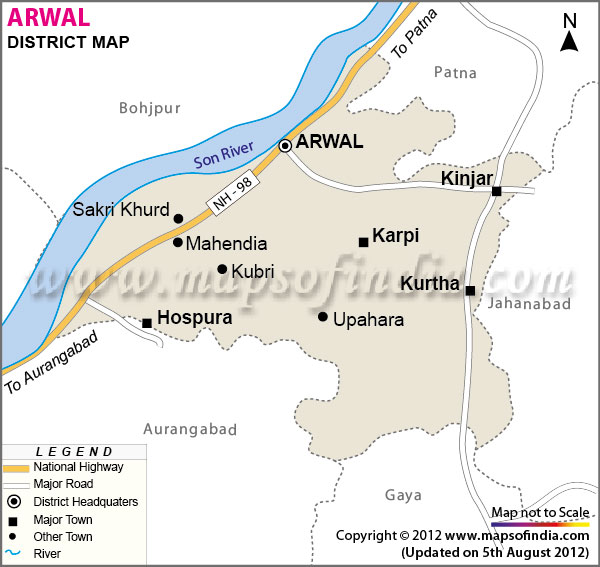
| *Arwal District Map highlights the National Highways, Major Roads, District Headquarter, etc. |
About
Built from farmland and quiet determination, Arwal stands small but steady in south-central Bihar. Not loud like Patna or Gaya nearby, it speaks through patterns - seasons turning in fields watered by rivers, lives shaped by soil and history. Created only in 2001 after splitting from Jehanabad, its borders are fresh on maps, though its people trace back long before that date. Caste currents run deep here, mixed with old farming rhythms and slow shifts in power.
While others rush ahead, this place holds memory close - not frozen, just rooted differently within the wider story of Magadh. Each harvest tells something: change does not need noise. The location shapes who thrives here - and how. Most live close to the soil, moving through days framed by hamlets, village markets, and rows of rice or wheat. Still, behind quiet fields lie echoes of protest - clashes over land, waves of organizing, demands for fairness etched into local memory.
Out here, away from the main town, the real shape of the distirct takes hold. Though administration runs through the district seat, daily rhythms beat strongest in rural pockets. Farming shapes routines - wheat, rice, lentils, greens - all fed by water drawn from the Son canals over decades. Life in these settlements ties closely to land, kin networks, and shifting hopes around schooling. Small-scale enterprise stirs quietly amid older patterns tied to hierarchy and tradition. Slow shifts ripple through how people live, work, learn. Modern influences nudge customs without sweeping them aside.
History and Culture
Deep roots tie Arwal to the broader story of Magadh, a core area in early Indian civilization. Only carved out as its own district in recent decades, the territory has existed within Magadh’s shifting political frame for ages. Close to old power hubs, it shares space with lands where empires like the Maurya and Gupta once took shape. Not a seat of the empire itself, still embedded in heritage, the place rests inside a belt thick with past influence. Long before modern borders, movement, rule, and belief shaped life here through centuries. Its identity grew quietly amid wider currents that defined an era.
Long after kingdoms shifted control, farming stayed at the heart of daily life across the countryside. Power once held by local lords gradually gave way to imperial oversight when Mughal frameworks took root. Later still, colonial demands reorganized rural economies around tax collection rather than subsistence needs. Control over fields often followed lines drawn by distant offices instead of village customs. Even once new national borders formed, old hierarchies lingered in fields and ledgers alike.
One reason the district stands out in recent history lies in its connection to movements demanding fairness and moments of unrest. National awareness grew after what happened in 1986, when officers opened fire on rural workers and organizers gathered together, resulting in several lives lost. That moment spotlighted deep problems like unequal treatment by birth status, lack of access to property, and force used by authorities across central Bihar. Despite the sorrow it carries, this episode shapes how people understand the district today. It reflects wider fights for respect and basic entitlements among groups long pushed aside.
Still alive today, old folk tunes linked to wedding rites, crop gathering times, or yearly celebrations hold fast to spoken tradition. Passed down quietly through years, women's melodies at nuptials and sacred acts keep long-held stories breathing. What people eat grows out of farming roots - dishes like rice, lentils, flatbread, fresh greens, roasted grain mix, baked dough with mashed sides, plus dairy form daily meals. Politics quietly threads through daily talk in Arwal. Whether it's land rights or schooling, people weave these themes into ordinary moments. Not just rooted in custom, the place thinks critically about power. Awareness grows not in speeches, but in tea stalls and fields.
Economy
Farming shapes Arwal’s economic core, forming the main source of income for nearly everyone who lives there. Thanks to rich soil fed by the Son River along with canals, people grow staples like rice, wheat, corn, lentils, and seeds with oil. Life in this region turns around harvest cycles, guided less by clocks than by weather, planting, and reaping. What happens in fields decides much about how households live, when they work, and what villages depend on throughout the year.
Water for crops in the area has long come through the Son canal network, allowing some regions to farm despite irregular rains. Still, seasonal rains heavily shape how much is grown each year. Small-scale growers frequently struggle with access to water, limited acreage, unequal supply sharing, high expenses on supplies. Though infrastructure exists, uneven benefits persist across different farms.
Public institutions stand alongside farming as a key part of Arwal’s economic base. Schools run by the state, local governance offices, clinics, law enforcement, and social aid networks offer jobs - particularly to young people who have completed their education. Programs like MGNREGA, projects aimed at improving village housing, along with financial support for crop production, play a vital role in helping families facing hardship. While agriculture dominates, these public efforts create stability through steady work.
Public services cover water channels for farms, shared lending groups, pathways between towns, plus aid programs backed by government funds. While factory growth remains low, spending on moving people and learning tools has slowly linked areas better over time.
A steady pace marks growth in the service industry. Beyond retail outlets, transportation firms boost household earnings more each year. Coaching outfits along with medical clinics add gradual value across neighborhoods.
Among smaller enterprises, rice milling stands alongside flour production, while brick firing supports livelihoods too. Dairy farming appears quietly across villages, just like craft making done by hand. Not far off, women organize into small collectives that shape income through sewing tasks. Their role grows slowly within town economies, especially where cooking turns raw goods into market items. Some start tiny ventures without fanfare, yet their presence shifts how households manage money.
Tourism
Though Arwal lacks recognition as a top tourist destination, its local heritage sites provide insight into Bihar's countryside traditions. Historical landmarks here reflect the area’s role in shaping regional politics. Visitors drawn to authentic experiences may find value exploring these quieter corners. Cultural remnants tell stories beyond mainstream narratives. Understanding this place means looking past typical travel routes.
Flowing through the region, the Son River shapes much of what happens on its shores. Where water meets land, farming thrives alongside quiet village life. Along these edges, fields stretch
into views that feel untouched by time. During festivals like Chhath and Dussehra, small community temples gain meaning through shared practice. Though overlooked beyond regional borders, such places shape identity in quiet ways. What matters most unfolds where daily life meets ritual - away from official recognition.
Located close to key areas such as Gaya and Jehanabad, the district sits within reach of sites tied deeply to Magadh's past. Its position offers access for those moving through central Bihar with an interest in older layers of regional history. What makes it stand out isn’t just scenery - it’s rooted in how deeply it ties to struggles for fairness. A place like this draws attention not through monuments, but through moments of change shaped over time. Those studying shifts in village-level power structures find here a setting rich with real examples. Meaning emerges slowly, revealed in conversations, local records, even silence between words spoken by elders.
Demographics
With around 700,000 residents, Arwal ranks among the least populated districts in Bihar based on the 2011 census. Rural life shapes much of its character because settlements are mainly clustered in village form. Despite progress in recent years, gaps remain between boys and girls in schooling outcomes across this region of Bihar. Still, compared to neighboring rural areas, reading and writing skills are somewhat stronger here. While more males can read and write, chances to attend school have slowly increased for everyone. Girls’ participation stays lower, yet the overall picture shows cautious movement forward.
Spoken here are Magahi, Hindi, Bhojpuri - each shaped by daily life. Though others appear now and then, Magahi holds its ground as a marker of who people are. Besides caste divisions, farming families also shape the area's makeup, adding layers to its social fabric. While some groups hold traditional roles, others bring different customs into daily life. Minority residents, although smaller in number, influence community patterns too. Together, these elements create a varied yet intricate network across the region.
Administration
Though small in size and people, Arwal district in Bihar built a system meant to deliver governance straight into rural hands. After splitting off from Jehanabad back in 2001, it began shaping how things are run on its own. Government work flows mainly through the town of Arwal, where offices, police, and planners gather. Over time, routines took root without fanfare - just steady steps toward local control. What emerged was less about grand design, more about daily function fitting the land’s quiet rhythm.
One way to look at the district is through its internal divisions - subdivisions and community development blocks - that handle tasks like local rule and managing land. Underneath the surface, a single core subdivision named Arwal holds together multiple operational units known as blocks. These blocks take charge of daily oversight, gathering revenues, rolling out social programs, along with pushing forward growth efforts across villages. Among them stand five key zones: Arwal, Karpi, Kurtha, Kaler, and Sonbhadra Banshi Suryapur - all playing similar roles to traditional tehsils. From record-keeping on farmland to helping farmers access support, each area acts locally while following broader state directives. Governance here flows through these hubs where policy meets practice in routine ways.
| Facts of Arwal District | |
|---|---|
| Official Name | Arwal |
| Location | Bihar |
| Area (km2) | 634.23 |
| Population | 700843 |
| Language | Hindi, Urdu |
FAQs
Q1: How many villages are there in the district?
Arwal district has several hundred villages distributed across its rural administrative blocks.
Q2: What is the population of the district?
According to Census 2011, Arwal’s population was around 700,000, making it one of Bihar’s smaller districts by population.
Q3: What is this district famous for?
Arwal is famous for its agricultural economy, Son River irrigation system, political history linked to social justice movements, and its place within Bihar’s culturally significant Magadh region.
Last Updated on : June 24, 2026
