|
||||||||||
| ||||||||||
|





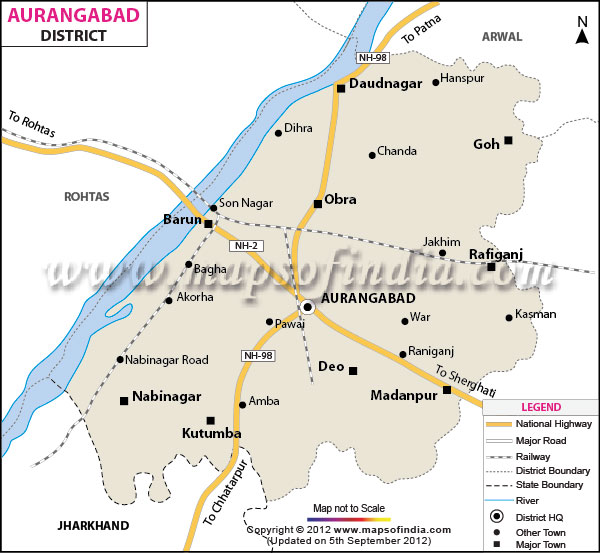
| *Aurangabad District Map highlights the National Highways, Major Roads, District Headquarter, etc. |
About
The Indian state of Bihar, a large administrative and historical state, is also a large territory that is a home to the Aurangabad district in the Indian state. It is called by the name of the town of Aurangabad in which its headquarters is situated and is the seat for major government, business and social and economic activity. The district lies in a good position between the plains of the central Bihar regions and the plateau regions of the boundaries Jharkhand and is geographically and culturally interesting. An analysis of the map of the Aurangabad district can help and assist in understanding the different topography, river streams, paths and settlement patterns which it comprises.
The district is sometimes called the Chittorgarh of Bihar because of its historical links with bravery and struggle especially in medieval and colonial times. As can be seen on the Aurangabad district map, the district is connected to neighbouring districts like Gaya, Rohtas, Arwal, and Palamu (Jharkhand) making it a transitional area between various cultural and ecological areas. Fertile land and availability of irrigation has caused agriculture to be the core of economic activity of the district.
Another aspect related to education and new infrastructure is its contribution to the work of service in the Aurangabad district. The Aurangabad district map also shows the distribution of the urban centres and rural settlements by showing the dominance of agrarian communities. Aurangabad is still a very important part of the regional development of Bihar with a mix of historical heritage, economic prospects and cultural diversity.
History and Culture
The history of the Aurangabad district is built on an ancient and medieval Indian tradition. It was once a component of Magadha Empire which was one of the most powerful states in ancient India. It went through the rule of the different dynasties, Mauryas, Guptas, and the next Mughal Empire, as well as the Delhi Sultanate. The strategic importance of the route as the interconnection point between the north and eastern India could be estimated with the help of the Aurangabad district map.
Prominence of the district during the Mughal period and its present name is said to have been affected by Emperor Aurangzeb. During the medieval period, local chieftains and zamindars were critical in making the socio-political environment. The Aurangabad district map shows regions that were centres of resistance in British colonial times and particularly the Revolt of 1857 when the local leadership had been active in the anti-colonial movements.
The Aurangabad, district is in Magadh traditions. It has a very enthusiastic religious practice and is very serious when it concerns major Hindu celebrations like Diwali, Holi, Durga Puja and Chhath Puja among others. Particularly in view of the festival of Chhath Puja has a very high esteem and it is a highly cultural festival because it is dedicated to the Sun God. It is carried out on the riverbanks and along the water bodies, which can also be seen on the Aurangabad district map.
There are also several folk traditions existing in the district, such as local songs, dances and the oral storytelling. The cultural influences of Bhojpuri and Magahi can be spotted in life. The Aurangabad district map can also be used to identify the rural cluster locations where traditional crafts and cultures still thrive. There is also a high degree of religious harmony as individuals of various groups live in harmony.
The district has architectural heritage of temples and historical buildings that show its rich history. The Aurangabad district map can also be used as a baseline to these locations of cultural interests as it would be easier to see how this heritage of the district evolved. Comprehensively, the history and culture of Aurangabad is characterized by continuity, diversity and resilience.
Economy
The economy of the Aurangabad district is mainly agrarian and the people of the district have their major source of income through agriculture, which is the major source of livelihood of a big part of the population. According to the district map of Aurangabad, there is much agricultural land located based on the irrigation of the land by rivers, canals and ground water supplies. Key crops produced in the district are rice, wheat, maize, pulses and oilseeds.
Within the Government Sector, the district administration is important to carry out the development schemes in terms of agriculture, rural development, education as well as healthcare. The region is densely covered with government offices, schools, and health centres to provide administration access even in remote regions and this is apparent in the Aurangabad district map.
The Public Sector plays a role by providing infrastructure, irrigation schemes and energy services. Having power plants and infrastructure in the surrounding places has had good impact on the economy of the district. The Aurangabad district map also brings attention to transportation networks like road and rail networks that enable transport and mobility.
Services Sector is slowly growing especially in the urban centers such as the town of Aurangabad and Daudnagar. Non-agricultural, i.e. branches of banking, retail, education and healthcare services are on the rise and they open up employment opportunities. Aurangabad district map shows that such services are concentrated in urban centres whereas in rural areas, rural areas are still developing in this area.
It also has small-scale industries like agro-processing units, brick kilns and local manufacturing which support the economy of the district. The movement of labor into other states to work is a common aspect and remittances constitute a significant aspect of domestic income. The map of the Aurangabad district assists to determine the areas, which have great economic activity and development opportunities.
On the whole, the Aurangabad district economy is in a phase of transition; it still has to diversify the old economy based on agriculture to embrace services and small industries.
Tourism
Aurangabad district presents a number of tourist sites which can be considered as the cultural, historical and natural heritage. The Aurangabad district map can be helpful in terms of identification of such destinations and traveling arrangements in the district.
Deo Sun Temple is also one of the greatest attractions in the town of Deo. This is an ancient temple to the Sun God and is amongst few such temples in India. It has thousands of followers and particularly on Chhath Puja. Deo is a big pilgrimage site which is marked on the Aurangabad district map.
The other major attraction is the Umga Temple that is devoted to Goddess Durga. It is located in a picturesque place with hills and is religious in nature as well as natural. The map of the Aurangabad district indicates the path to this temple thereby making it easily reachable by visitors.
It is also a neighbourhood to some of the great tourist attraction sites in other neighbouring regions like Bodh Gaya, in the Gaya district. The map of the Aurangabad district will show how close it is to such world renowned destinations contributing to its tourist ability.
Natural scenery, rivers and countryside are also an improvement of the district. The district of Aurangabad map can provide the clues to the regions and tourists have access to the undiscovered sites. Local fairs and festivals are also available in which visitors can learn more about the colorful local culture.
Demographics
Diversity in the Aurangabad district is a growing phenomenon. According to the current statistics, available there is the fact that the biggest portion of the population of the district is comprised of some 2.5 million people. The map of the Aurangabad district will assist in interpretation of distribution of population in both the urban areas and rural areas; majority of them reside in the villages.
The educational achievement in the district is around 70 per cent showing a gradual growth in the level of literacy over years. The increase in the number of literacy and awareness is as a result of proliferation of institutions of learning in the district evident in the district map of Aurangabad.
The languages spoken in the Aurangabad district are Hindi (the official language) and other regional languages, including Magahi and Bhojpuri. Cultural identity of the district is achieved by these languages. The locations where the concentration of the language communities can be monitored are also indicated in the map of the Aurangabad district.
People are very rural with agriculture as the primary activity. Nonetheless, there is gradual growth in urbanisation and especially in such towns as Aurangabad and Daudnagar. This trend is captured by the Aurangabad district map where the urban areas are expanding.
In total, the demographic situation in the Aurangabad district offers a combination of the traditional rural lifestyle and the new urbanized process of development.
Administration
In order to have an efficient governance, the administration of Aurangabad district takes several subdivisions and blocks to cater to the unique needs of the people. This district map of Aurangabad is necessary in the interpretation of these administrative groups, and their geographical extent.
The district has subdivisions like Aurangabad and Daudnagar. The subdivisions are further subdivided into community development blocks or tehsils which are made of Aurangabad, Daudnagar, Barun, Obra, Rafiganj, Madanpur, Kutumba, Deo, and Haspura. A map of the Aurangabad district will give a pictorial view of these administrative units.
Aurangabad district has over 1,700 villages which are headed by local panchayats. The Map of the county district of Aurangabad assists in bringing out the following villages and how they are connected with big roads and towns. Local government and village development Panchayati Raj bodies are vital in the local government.
A District Magistrate heads the district administration and is in charge of law and order, development programmes, and public services. The Aurangabad district map aids the administrative planning as it gives geographical details.
FAQs
Q1: What is the total number of villages in Aurangabad district?
Aurangabad district has more than 1,700 villages, distributed across its various blocks and administrative units.
Q2: What is the population of Aurangabad district?
The population of Aurangabad district is approximately 2.5 million, with a majority living in rural areas.
Q3: What is Aurangabad district famous for?
Aurangabad district is famous for the Deo Sun Temple, its historical significance, agricultural economy, and its cultural traditions, especially the celebration of Chhath Puja.
Last Updated on : June 24, 2026
