






About
Banka district is situated in the South of the Indian state of Bihar and it is the land of deep cultural heritage, natural beauty, and evolving socio-economic environment. The district is named after the town of Banka which is the administrative headquarters of the district. Banka is historically and of geographic significance since it is in the Anga region and borders Jharkhand making it provide a distinctive combination of plains and plateau characteristics.
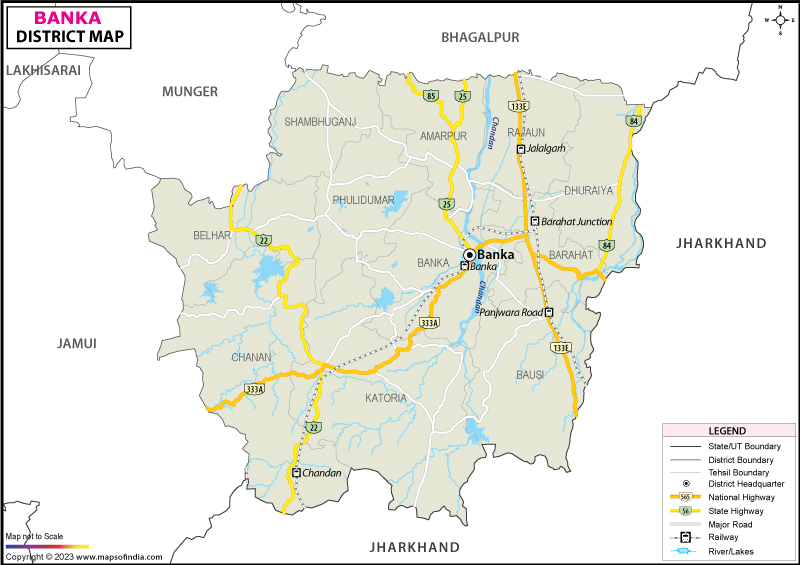
The importance of the Banka district map is that it portrays the strategic position between Bihar and Jharkhand and location has added to its culture, economic status and availability. It is not the Bihar Gangetic plains that are simply level, and have hilly forms and forest and meandering rivers, as illustrated in the map of the Banka district. Rivers such as Chandan and Orhni supply the district, which supports agriculture and rural populace.
The Banka district map also shows its administrative localities, routes and closeness with major cities like Bhagalpur and Deoghar. This geographical position is a part of its emerging role as a regional-trade and tourist destination. Altogether, the Banka district can be defined as a perfectly balanced combination of tradition and progress when the simplicity of the rural life is in the states of coexistence with the slow urbanisation.
History and Culture
Banka district has an extensive historical context dating back to ancient India, especially the Anga Mahajanapada, which was one of the sixteen major kingdoms of early historic period. The area has seen the emergence and disappearance of different dynasties such as the Mauryas, Guptas and the medieval rulers. It is situated close to some of the major cultural centres in the area such as Bhagalpur and this has had an impact on its historical progression.
The cultural identity of Banka is an amalgamation of tribal and non-tribal cultures. The Banka district map also portrays the presence of the forested areas, where indigenous groups have established themselves over the centuries preserving their traditions and ways of life. Festivals such as Chhath Puja, Holi, Diwali and Makar Sankranti are good will festivals and tribal festivals make this district culturally diverse.
Some of the most significant cultural places in the district include Mandar hill which is a fragment of Hindu mythology. It is believed to be the centre of churning of the ocean (Samudra Manthan) thus, it is a holy place. Mandar hill is recognized in different maps of the district of Banka as a significant cultural and pilgrimage venue.
The cultural landscape of the district includes traditional music, folk dances and local artwork. Daily communication is done in languages like Angika and Hindi and folk songs are used as publishers of tales of rural life and history. As the map of the Banka district indicates, geography and the structure of the community make cultural practices in different blocks and villages might differ.
Some local creativity is reflected in the handicrafts, which although small in scope, are found in the countryside. The cultural diversity of the district is also enriched by fairs and local markets that are socialisation centres. These cultural centers can be determined with the help of the Banka district map, and it will be easier to see the spread of cultures throughout the area.
Economy
Banka district primarily has an agrarian based economy with agriculture being the basis of living. Nonetheless, other sectors have slowly been diversified into in the last few years. The map of Banka area can be used in interpreting economic distribution by displaying the regions occupied by agriculture, forest based activities as well as developing industrial areas.
Government Sector Employee procedures are mainly offered by administrative services, education, healthcare and Rural development programme. Government programs to alleviate poverty, develop infrastructure and support agriculture contribute greatly to the economy of the district. The map of the Banka district underlines administrative centres where such services are collective.
Small-scale industries and cooperative societies make up the Public Sector in Banka. Although big industries are restricted, big industries are encouraged to develop agro based industries like rice mills, oil mining units and food processing centres. Availability of natural resources, as well as production of Agricultural produce, offers possibilities of undertaking additional industrial growth. The Banka district map aids in determining possible places where industries can be developed.
Services Sector is slowly growing, particularly in urban and semi urban locations. Some of the major contributors include banking, retail trade, transportation, education, and healthcare services. The service economy is picking up as a result of enhanced connectivity and the use of the internet. Banka district map is a useful tool in planning the growth of services, as it helps to identify the areas of population and accessibility.
The principle source of the economy is still agriculture and paddy, wheat, maize and pulses are the crops that are planted in large numbers. Irrigation plants, although being enhanced, remain very reliant on rain and local water supplies. The map of the Banka district presents the coverage of agricultural land and irrigation and can help with resource planning.
The district has seen gradual activity towards adoption of modern methods like better seed varieties, fertilisers and use of mechanised equipment by farmers. But the problems of divided landholdings, insufficient irrigation and unsteady market prices have hampered productivity. These issues are to be dealt with by government programs and agricultural extension services.
Other activities that are related to forest-based activities such as the collection of minor forest produce also help in livelihoods especially to the tribal communities. Farming, dairy cattle and poultry rearing is used as a source of additional income in rural families. Local economy is further backed by weekly markets and small trading centres. Comprehensively, the district is in the post transit stage, shifting towards an economic structure that is more diversified.
Tourism
The district of Banka is characterized by such tourist spots that are a blend of natural beauty, religious importance, and historicity. The Banka district map is as well a handy tourist guide assisting them in exploring the significant attractions of the district.
The biggest tourist attraction is that of Mandar Hill, which is mythologically important and has beautiful landscapes. To Festivals and particularly pilgrims and tourists flock the hill. This site is a key landmark in the map of Banka district.
Bounsi, near Mandar Hill is another significant attraction place where fairs and religious festivals take place. The region is familiar with the lively cultural environment and traditional markets. The map of the banka district assists the visitors to find out the location of Bounsi and other attractions.
Katoria and Chandan areas are recognized by natural beauty (forests and small hills). These are the best places to attempt eco-tourism as well as sightseeing of nature. These areas are highlighted in the Banka district map and this makes it easy to plan on what to visit by the travellers.
There are also a number of temples and local shrines in the district that are enjoyed by the faithful all year round. These places of worship are an extension of the religious background of the area. The map of the Banka district helps to determine these scattered but important places.
In addition, countryside tourism is also becoming a target and the tourists desire to have real life village life, local cuisine and culture. Visitors get an opportunity to witness the methods in which the agricultural activities are performed, go to the local events along with feeling the simplicity of life in the country. Enhanced accessibility and visibility is gradually increasing the tourist prospects in the district owing to the upgrading of roads.
Demographics
Banka district is characterized by a multicultural population that is based on rural and semi urban kinships. According to the last statistics the district has 2.03 million residents. The Banka district map will come in handy in planning on how to visualise the population distribution in various blocks and villages.
The literacy rate of the district has been estimated as about 58% but with the government efforts in advancing education has been increasing on an upward trend. The areas are generally defined using banka district map and require development of education and supply of resources.
The district languages are Hindi and Angika with the latter language being very widespread in the rural sectors. The second element in the cultural diversity of the district is the fact that tribal languages are also spoken in some locales. The linguistic distribution in the district is provided in the map of the Banka district.
It is predominantly rural with agriculture being the primary occupation. The traditional practices affect the social structure, but modernisation is slowly altering the lifestyles. Due to the level of employment migration, almost notably among the young population, there is a visible trend in remittances and exposure to the urban ways of life.
There is a slow but steady improvement in gender ratio as well as social indicators owing to heightened awareness and government actions. Education, healthcare and social welfare programmes are still very crucial in influencing the demographic landscape of the district.
Administration
To ensure that the administration is effective, the Banka district is subdivided into a few subdivisions and blocks. Mapping The map of the Banka district is indispensable in gaining insights into these administrative divisions and the geographical extent of these divisions.
The district has several tehsils (subdivisions) with the Banka, Bounsi and Amarpur tehsils. The tehsils have the local administration, realisation of revenue and execution of government schemes. These subdivisions are well indicated in the map of Banka district.
Banka district has more than 2,400 villages in terms of villages which are distributed in its blocks. Villages are at the centre of the rural life and economy of the district. Generally, the Banka district map is a popular map utilized in rural development planning and infrastructural development.
Local governance has been implemented in the form of Panchayati Raj institutions, which are been instrumental in making decisions at the grassroots level. The district administration seeks to enhance infrastructure, education, health and economic prospects.
FAQs
Q1: What is the total number of villages in Banka district?
Banka district has more than 2,400 villages, forming the backbone of its rural structure.
Q2: What is the population of Banka district?
The population of Banka district is approximately 2.03 million, based on recent estimates.
Q3: What is Banka district famous for?
Banka district is famous for Mandar Hill, its mythological significance, natural landscapes, and rich cultural traditions.
Last Updated on : June 24, 2026
